


 Tiếng Việt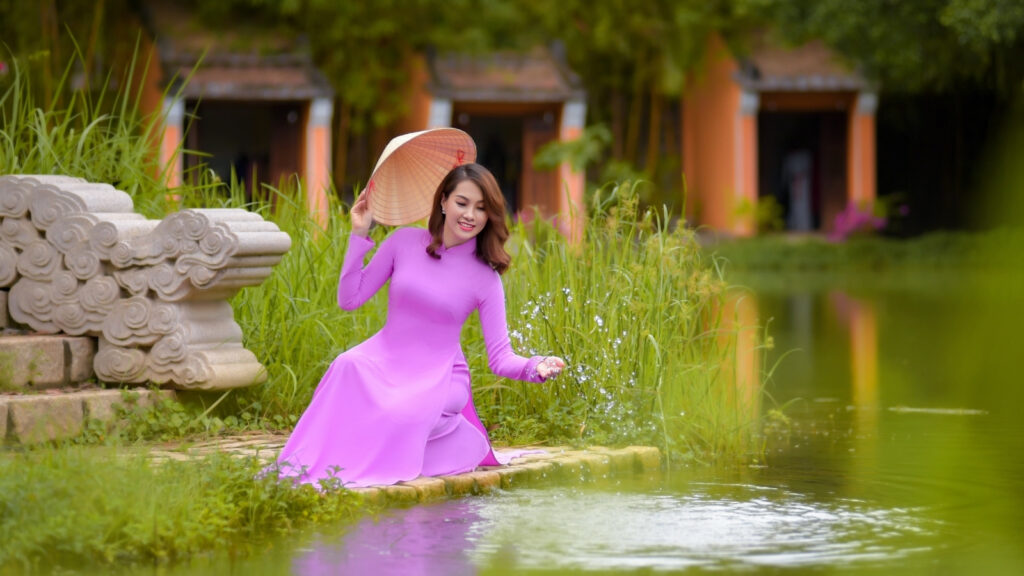
Estimated reading time: 12 minutes
On a spring morning in Hue, rows of students pedal quietly to school, their white Ao Dai catching the soft breeze as they pass the ancient citadel. In Hanoi, families gather beneath centuries-old temple gates during Tet, dressed in vibrant silk that brightens the first days of the Lunar New Year. As evening falls in Hoi An, lantern-lit streets become the backdrop for newlyweds and travelers wearing elegant Ao Dai for photographs they’ll treasure for years.
Though separated by hundreds of miles, these scenes are connected by one unmistakable symbol—the Ao Dai.
Elegant, graceful, and deeply rooted in history, the Ao Dai is far more than Vietnam’s traditional dress. It represents cultural identity, family traditions, artistic craftsmanship, and a quiet sense of national pride that has endured through centuries of change.
Unlike many traditional garments that survive mainly in museums or historical reenactments, the Ao Dai remains woven into everyday Vietnamese life. Students wear it to school, brides choose it for wedding ceremonies, teachers and diplomats wear it on important occasions, and families proudly dress in matching Ao Dai to celebrate Tet and preserve traditions across generations.
For many international visitors, wearing an Ao Dai becomes one of the most memorable experiences of traveling in Vietnam. Beyond its elegant appearance, it offers a chance to connect with the country’s living heritage in a personal and meaningful way.
This guide explores the story behind Vietnam’s national dress—its origins, cultural significance, evolution through history, and the occasions when it continues to be worn today. You’ll also discover where to rent or buy an Ao Dai, how to wear it respectfully, and why this timeless garment continues to captivate both Vietnamese people and travelers from around the world.
Table of Contents
Quick Answer: What Is the Ao Dai?
The Ao Dai is Vietnam’s national dress, consisting of a long, fitted tunic worn over loose trousers. Known for its elegant silhouette, it is one of the country’s most recognizable cultural symbols.
Quick Facts About the Ao Dai
| Feature | Details |
|---|---|
| Country | Vietnam |
| Traditional Name | Áo dài |
| National Dress | Yes |
| Worn By | Women & Men |
| Traditional Fabric | Silk |
| Common Occasions | Tet, Weddings, School Ceremonies |
| Best Places to Experience It | Hue, Hoi An, Hanoi |
Traveler’s Tip
If you’re visiting Vietnam during Tet or exploring historic cities such as Hue or Hoi An, renting or tailoring an Ao Dai is one of the most memorable ways to experience Vietnamese culture beyond sightseeing.
While the Ao Dai is most commonly worn by women, men also wear traditional versions during weddings, Tet, cultural festivals, and ceremonial events. Today, it remains an important part of Vietnamese life, appearing at weddings, graduation ceremonies, official celebrations, and as the iconic white school uniform worn by many female students.
More than a traditional outfit, the Ao Dai reflects Vietnamese history, cultural identity, and a sense of elegance that has been passed down through generations.
What Is the Ao Dai?
The Ao Dai (pronounced “ow yai” in southern Vietnam and “ow zai” in northern Vietnam) is Vietnam’s traditional long dress, admired for its elegant silhouette and enduring cultural significance. It consists of a fitted tunic with high side slits worn over loose-fitting trousers, creating a look that is both graceful and practical.
Although often described as Vietnam’s national dress, the Ao Dai is perhaps better understood as the country’s most recognizable cultural symbol. Vietnam is home to 54 officially recognized ethnic groups, each with its own traditional clothing. The Ao Dai achieved its iconic status because it has been embraced across regions and generations, eventually becoming the garment most closely associated with Vietnamese identity.
Its beauty lies in its simplicity. Clean lines, a high collar, and flowing panels create a silhouette that feels refined rather than ornate. Traditionally crafted from silk, today’s Ao Dai are also made from chiffon, velvet, brocade, linen, lace, and other modern fabrics, allowing designers to adapt the garment for everything from school ceremonies to contemporary fashion shows.
How Is the Ao Dai Different from Other Asian Traditional Dress?
| Country | Traditional Dress |
|---|---|
| Vietnam | Ao Dai |
| Japan | Kimono |
| South Korea | Hanbok |
| China | Cheongsam (Qipao) |
Like the kimono in Japan and the hanbok in South Korea, the Ao Dai is a national symbol deeply connected to cultural identity. Unlike many traditional garments, however, the Ao Dai continues to be worn regularly during school ceremonies, weddings, Tet celebrations, and official events.
Color also carries meaning. While personal style plays a greater role today than in the past, certain colors remain closely associated with specific occasions:
- White symbolizes youth and purity and is widely recognized as the traditional uniform for many female high school students.
- Red represents happiness, prosperity, and good fortune, making it a favorite for weddings and Tet celebrations.
- Gold is often associated with success, celebration, and prosperity.
- Blue, green, and soft pastel tones have become increasingly popular for festivals, family portraits, and everyday cultural events.
Although the women’s Ao Dai is far more familiar to international audiences, men continue to wear traditional versions for weddings, ancestor worship ceremonies, Tet celebrations, and other important occasions. A men’s Ao Dai is often paired with a khăn đóng, the traditional ceremonial headdress that traces its origins to Vietnam’s imperial court.
For visitors, the Ao Dai offers far more than an opportunity to wear beautiful clothing. It provides a window into Vietnamese society, where elegance is often expressed through simplicity, and where tradition continues to coexist naturally with modern life.
Ask almost any Vietnamese family to open an old photo album, and chances are you’ll find an Ao Dai somewhere among its pages. It may appear in a graduation portrait, a wedding ceremony, a Tet family gathering, or a childhood school photograph. Long after fashions have changed, the Ao Dai remains a constant—quietly connecting generations through shared memories and cultural traditions.
That enduring presence explains why the Ao Dai has become much more than a traditional dress. It is a living symbol of Vietnam itself. To understand why, it helps to look back at the centuries of history that shaped the garment we recognize today.
The History of Vietnam’s Ao Dai
Ao Dai Timeline
| Year | Milestone |
|---|---|
| 1744 | Lord Nguyễn Phúc Khoát introduces clothing reforms. |
| 1802–1945 | Nguyen Dynasty refines imperial court dress. |
| 1930s | Le Mur modernizes the Ao Dai. |
| Today | Ao Dai remains Vietnam’s national dress. |
The timeline below highlights the major milestones that shaped the modern Ao Dai over nearly three centuries.
The graceful silhouette of today’s Ao Dai is the result of centuries of cultural change rather than a single moment in history. Like Vietnam itself, the garment has evolved through periods of royal influence, foreign exchange, social transformation, and artistic innovation.
Understanding this history helps explain why the Ao Dai is cherished not simply as clothing, but as a living expression of Vietnam’s cultural identity.
Early Origins
Long before the modern Ao Dai appeared, people across Vietnam wore a variety of garments shaped by geography, climate, and local customs. Ancient carvings, historical paintings, and royal records reveal layered robes, loose trousers, wrap skirts, and long tunics that differed from region to region.
Clothing was not merely practical—it also reflected social status, occupation, and regional identity. Members of the royal court dressed differently from scholars, merchants, or farmers, while communities across northern, central, and southern Vietnam developed their own distinctive styles.
One of the most significant milestones came in 1744, when Lord Nguyễn Phúc Khoát, ruler of southern Vietnam, introduced reforms encouraging officials and citizens to wear long gowns over trousers instead of traditional skirts.
Although historians continue to debate how directly this reform influenced the modern Ao Dai, it is widely regarded as a pivotal step in the garment’s evolution. More importantly, it established a silhouette—long flowing robes paired with trousers—that would remain at the heart of Vietnamese traditional dress for centuries to come.
The Nguyen Dynasty and Royal Elegance
When the Nguyen Dynasty unified Vietnam in the early nineteenth century, court attire became more refined and standardized.
Within the imperial court, clothing followed detailed rules that reflected rank, ceremony, and occasion. Members of the royal family and senior officials wore luxurious silk robes embroidered with dragons, phoenixes, clouds, and floral motifs—symbols that conveyed authority, prosperity, and harmony.
At the center of this cultural refinement stood Hue, the imperial capital from 1802 to 1945.
Even today, Hue is often described as the spiritual home of the Ao Dai. The city’s architecture, royal traditions, and slower pace of life continue to embody the elegance associated with Vietnam’s former imperial court.
Walking through the Imperial City, it’s easy to imagine how these traditions shaped the garment. Long flowing robes complemented palace corridors, ceremonial processions, and formal rituals where graceful movement was considered just as important as appearance.
Although ordinary citizens did not wear the elaborate court robes reserved for royalty, many of the aesthetic principles—balanced proportions, understated beauty, and meticulous tailoring—gradually found their way into everyday clothing.
Those influences remain visible in traditional Ao Dai today, particularly in Hue, where many artisans continue to preserve techniques passed down through generations.
The Birth of the Modern Ao Dai
The modern Ao Dai took shape during the 1930s, when artist Cát Tường, better known as Le Mur, introduced a slimmer and more tailored interpretation of the traditional gown.
Inspired by both Vietnamese aesthetics and European fashion, his design featured:
- A more fitted silhouette
- Defined waistlines
- Softer shoulders
- Lightweight fabrics
- Greater freedom of movement
Initially controversial, the design gradually gained acceptance and laid the foundation for the Ao Dai recognized around the world today.
A Living Tradition
Although everyday clothing in Vietnam has changed dramatically, the Ao Dai has never disappeared.
Instead, it has found new life in weddings, school ceremonies, Tet celebrations, official events, and international cultural exchanges. Contemporary designers continue to experiment with new fabrics and styles while preserving the elegant silhouette that defines the garment.
More than three centuries after its earliest origins, the Ao Dai remains one of Vietnam’s most recognizable cultural symbols—a tradition that continues to evolve without losing sight of its history.
The Ao Dai in Contemporary Vietnam
Today, the Ao Dai is no longer everyday clothing for most Vietnamese people, yet it remains deeply woven into the country’s cultural life.
Across the country, the Ao Dai can still be seen in classrooms, government offices, museums, cultural festivals, and international events. Rather than disappearing into history, it continues to evolve alongside modern Vietnamese society.
Students wear white Ao Dai during their high school years. Brides choose richly embroidered designs for traditional wedding ceremonies. Teachers, diplomats, performers, and beauty queens continue to wear it while representing Vietnam at home and abroad.
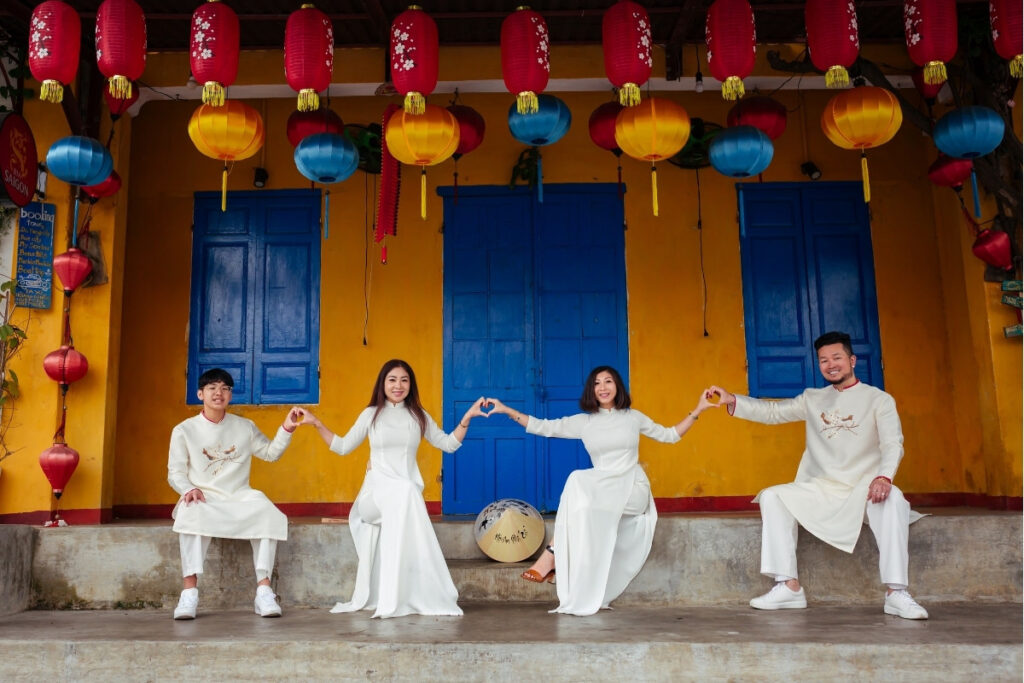
During Tet, entire families often gather in coordinated Ao Dai for reunion dinners and annual photographs. These images become treasured reminders of family continuity, linking grandparents, parents, and children through a tradition shared across generations.
The garment has also found a place on international stages. Vietnamese designers regularly present contemporary Ao Dai collections at fashion weeks and cultural exhibitions around the world, demonstrating how a centuries-old tradition can continue to evolve without losing its identity.
That ability to embrace change while remaining unmistakably Vietnamese is perhaps the Ao Dai’s greatest achievement.
It is not a relic preserved behind museum glass, nor is it simply a fashionable outfit. It is a living tradition—one that continues to accompany Vietnamese people through some of the most meaningful moments of their lives.
Why the Ao Dai Matters in Vietnamese Culture
The beauty of the Ao Dai is immediately visible.
Its deeper meaning takes a little longer to understand.
Ask Vietnamese people what the Ao Dai means, and many won’t begin by describing the dress itself. Instead, they’ll remember the moments they wore it—a graduation ceremony, a wedding, a family reunion during Tet, or a photograph taken with three generations standing side by side.
These memories explain why the Ao Dai occupies such a special place in Vietnamese culture. More than a traditional outfit, it represents family, identity, and the continuity of traditions that have been passed from one generation to the next.
Unlike historical costumes displayed only in museums, the Ao Dai remains part of everyday cultural life. It continues to appear wherever Vietnam celebrates its most meaningful occasions.
Local Insight
Many Vietnamese families buy a new Ao Dai before Tet, even if their previous one is still in excellent condition. Wearing new clothes at the beginning of the Lunar New Year symbolizes a fresh start and hopes for good fortune in the months ahead.
A Symbol of Vietnam
Every country has a cultural symbol that people recognize almost instantly.
Japan has the kimono.
South Korea has the hanbok.
Scotland has the kilt.
For Vietnam, that symbol is the Ao Dai.
Its graceful silhouette has become synonymous with the country itself, appearing at diplomatic events, cultural festivals, international beauty pageants, and even aboard Vietnam Airlines.
Yet the Ao Dai is more than a garment worn to represent Vietnam overseas.
It continues to play an active role within Vietnamese society, making it one of the few national dresses that remains closely connected to everyday cultural life.
Woven into Family Life
The Ao Dai accompanies many of life’s most important milestones.
For many women, the journey begins in high school, where the white Ao Dai becomes part of everyday memories. Years later, another Ao Dai may be worn for an engagement ceremony, a wedding, or family celebrations during Tet.
Open almost any Vietnamese family photo album and the Ao Dai appears again and again.
Different colors.
Different fashions.
Different generations.
The garment quietly connects them all.
That continuity is one of the reasons the Ao Dai carries such emotional significance.
It is remembered not because it is expensive or fashionable, but because it accompanies the moments people treasure most.
Elegance Without Excess
The Ao Dai reflects a distinctly Vietnamese approach to beauty.
Rather than relying on elaborate decoration, it creates elegance through proportion, movement, and simplicity.
A breeze lifting the silk.
Soft folds moving as someone walks.
Natural colors that complement rather than overwhelm.
These qualities can also be seen throughout Vietnamese architecture, traditional art, ceramics, and garden design, where harmony is often valued more than extravagance.
The Ao Dai expresses the same philosophy through clothing.
A Tradition That Continues to Grow
Modern Vietnam looks very different from the country of a century ago.
Cities have expanded, lifestyles have changed, and fashion trends now travel across the world within seconds.
Yet the Ao Dai has never been left behind.
Instead, every generation has found its own way of wearing it.
Contemporary designers experiment with sustainable fabrics and minimalist tailoring. Young Vietnamese proudly wear modern interpretations during festivals and graduation ceremonies, while traditional designs remain central to weddings and Tet celebrations.
The silhouette evolves.
The meaning remains.
Perhaps that is why the Ao Dai continues to feel timeless.
It is not preserved because people are afraid of change.
It survives because every generation continues to make it part of their own story.
When Do Vietnamese People Wear the Ao Dai?
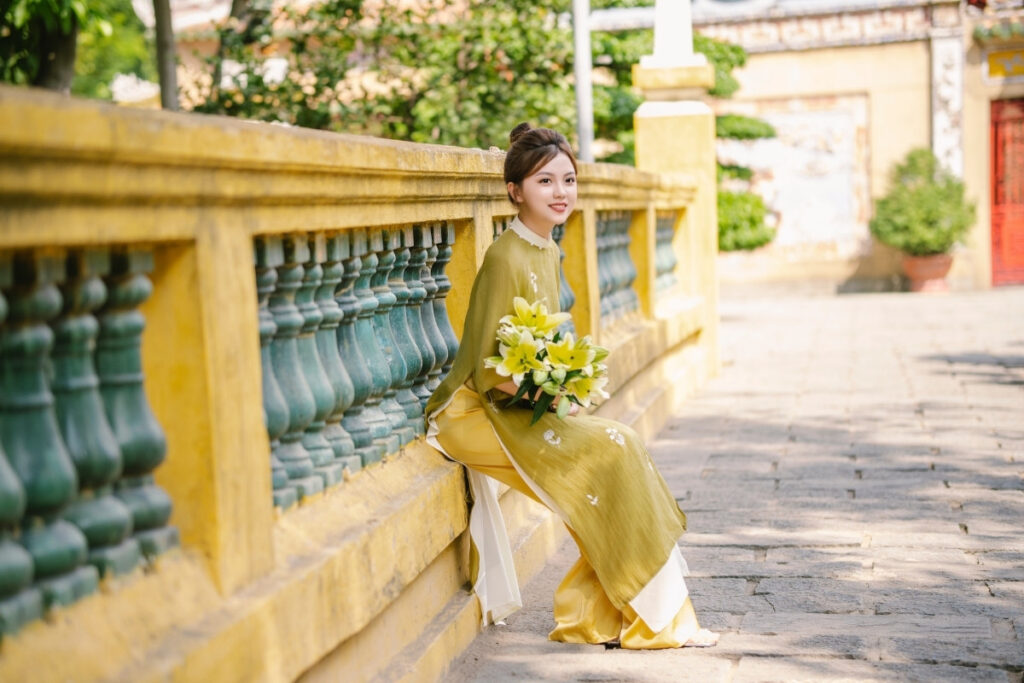
Visitors are often surprised by how naturally the Ao Dai fits into modern Vietnamese life.
During Tet, historic neighborhoods fill with families dressed in vibrant silk. At weddings, brides and grooms honor tradition in matching Ao Dai. During graduation season, university campuses become seas of flowing white dresses.
Each occasion tells a different story, but together they reveal why the Ao Dai remains one of Vietnam’s most enduring cultural symbols—it is worn not simply to celebrate the past, but to mark the moments that matter most.
Tet (Lunar New Year)
Tet is the occasion when the Ao Dai is seen at its most colorful.
Families gather in coordinated outfits to visit relatives, pay respects at family altars, and pose for annual photographs beneath blooming apricot and peach blossoms.
For many households, buying a new Ao Dai before Tet symbolizes a fresh beginning and hopes for prosperity in the coming year.
It is also one of the best times for visitors to experience the Ao Dai as part of living Vietnamese culture.
Weddings
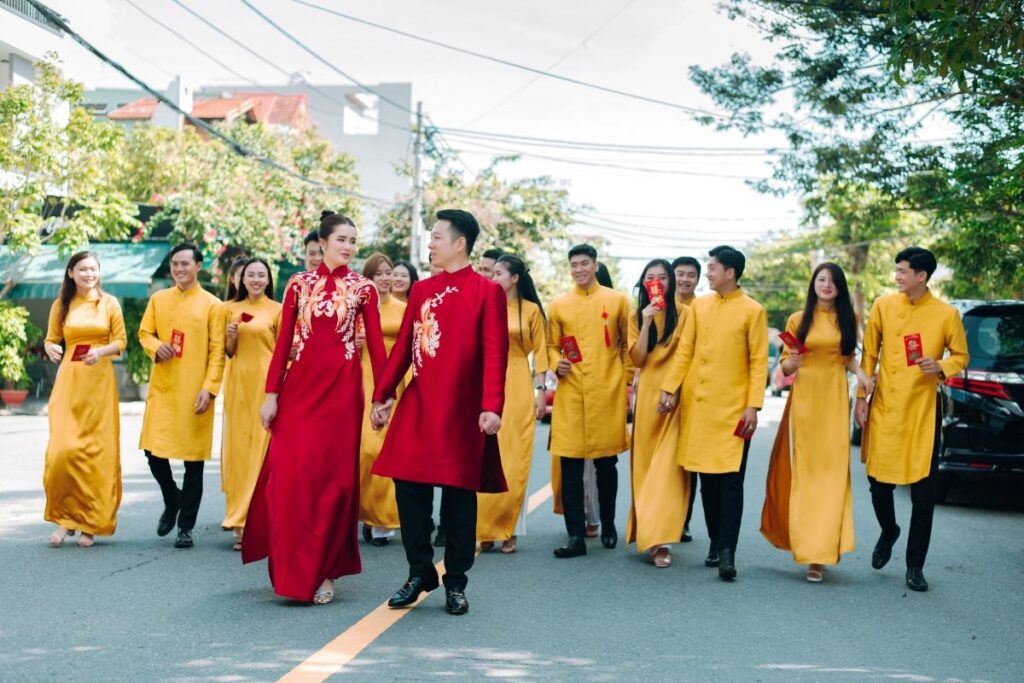
Traditional Vietnamese weddings remain one of the most beautiful settings in which to see the Ao Dai.
Brides and grooms often wear matching designs, while family members choose coordinated colors that reflect unity and celebration.
Although many couples later change into Western wedding attire, the Ao Dai remains central to traditional ceremonies and family rituals.
School and Graduation
One of Vietnam’s most recognizable images is that of female students wearing white Ao Dai.
For many young women, the dress becomes closely associated with school years, friendships, examinations, and graduation.
Years later, photographs taken in white Ao Dai remain among their most treasured memories.
National and Cultural Events
The Ao Dai also appears during official ceremonies, diplomatic receptions, cultural festivals, museum events, and artistic performances.
Teachers, performers, government representatives, and airline staff continue to wear the garment while representing Vietnamese culture both at home and abroad.
More Than Special Occasions
The Ao Dai appears whenever life slows down long enough to celebrate something meaningful.
A wedding.
A graduation.
Tet.
A family reunion.
A national celebration.
That is why it continues to feel relevant today.
Not because it has remained unchanged, but because Vietnamese people continue creating new memories while wearing it.
Among all these occasions, however, one image has become especially iconic—the white Ao Dai worn by generations of Vietnamese schoolgirls. More than a uniform, it has become a symbol of youth, hope, and one of life’s most unforgettable chapters.
White Ao Dai: A Symbol of Youth
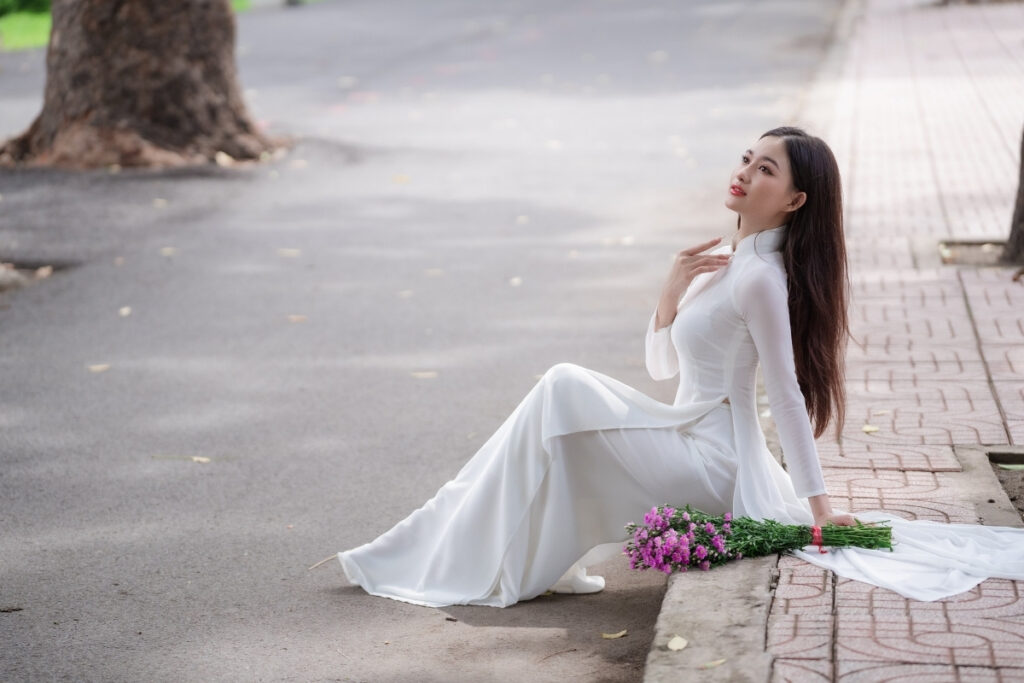
Few images are as closely associated with Vietnam as students cycling to school in flowing white Ao Dai.
On weekday mornings in cities such as Hue, Da Nang, and Ho Chi Minh City, the sight has become part of everyday life. White fabric catches the morning light as students make their way to school, creating a scene that has inspired countless photographs, paintings, and films.
For visitors, it is one of Vietnam’s most recognizable cultural images.
For many Vietnamese people, it is a memory.
The white Ao Dai is worn by female students at many high schools on designated days or for important ceremonies. More than a uniform, it marks a unique stage of life filled with friendships, examinations, graduation, and the excitement of adulthood just beginning.
White has long been associated with youth, sincerity, and new beginnings. Combined with the graceful design of the Ao Dai, it creates an appearance that is elegant without being extravagant.
Years after leaving school, many Vietnamese women still describe the white Ao Dai as the most meaningful piece of clothing they have ever worn—not because of fashion, but because of the memories attached to it.
The Ao Dai Is Not Only for Women
Many first-time visitors assume the Ao Dai is exclusively women’s clothing.
In fact, both men and women have worn long tunics over loose trousers throughout much of Vietnam’s history.
Today, men’s Ao Dai are less common in everyday life but remain an important part of traditional ceremonies.
You are most likely to see them during:
- Weddings
- Tet celebrations
- Ancestor worship ceremonies
- Cultural festivals
- Religious events
- Official ceremonies
Compared with the women’s version, a men’s Ao Dai has a straighter silhouette, broader cut, and a more structured appearance. It is often paired with a khăn đóng, the traditional ceremonial headdress that reflects Vietnam’s imperial heritage.
Popular colors include red for weddings, gold for celebrations, and darker shades such as navy or black for formal occasions.
Although modern designers continue introducing contemporary interpretations, the garment still represents respect, dignity, and family tradition.
Quick Fact
The men’s Ao Dai is still commonly worn by grooms during traditional Vietnamese wedding ceremonies.
Did You Know?
Historically, both Vietnamese men and women wore long tunics over trousers. The women’s Ao Dai evolved into today’s fitted silhouette, while the men’s version remained more formal and ceremonial.
Regional Styles of the Ao Dai
Although the Ao Dai is recognized throughout Vietnam, its appearance varies subtly from one region to another.
Local history, climate, and craftsmanship have all influenced how the garment is designed and worn, making each destination a little different from the next.
Hue: The Cultural Heart of the Ao Dai
If one city is most closely associated with the Ao Dai, it is Hue.
As Vietnam’s former imperial capital, Hue has long been known for refined craftsmanship and timeless elegance. Traditional Ao Dai here often feature classic high collars, luxurious silk, soft color palettes, and delicate embroidery inspired by royal court art.
Walking through the Imperial City or along the Perfume River, visitors quickly understand why many Vietnamese consider Hue the spiritual home of the Ao Dai.
Hoi An: The Best Place for Tailoring
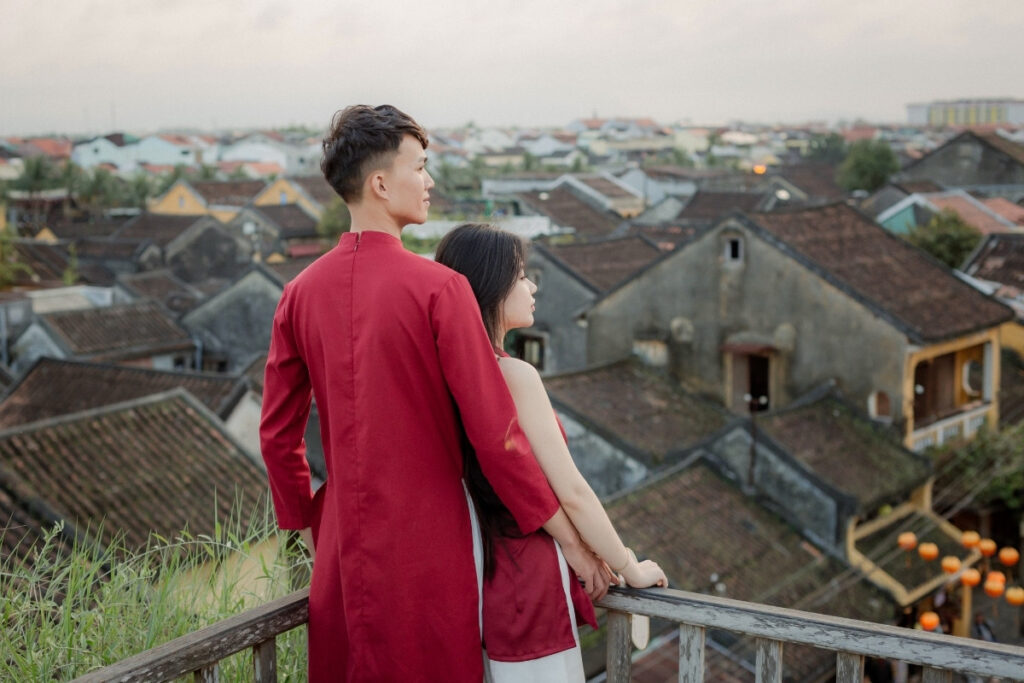
Hoi An offers a completely different experience.
Rather than simply admiring the Ao Dai, visitors can have one made to their own measurements.
The town’s centuries-old tailoring tradition, combined with skilled artisans and an abundance of silk fabrics, has made Hoi An one of Vietnam’s most popular destinations for custom-made Ao Dai.
Many shops complete a garment within 24 to 48 hours, making it possible to wear it while exploring the lantern-lit Ancient Town.
For many travelers, ordering an Ao Dai in Hoi An becomes one of the highlights of their trip.
Hanoi: Timeless Elegance
In Hanoi, the Ao Dai reflects the city’s quiet sophistication.
Designs tend to be simple and refined, favoring neutral colors, high-quality silk, and classic tailoring over elaborate decoration.
Historic locations such as Hoan Kiem Lake and the Temple of Literature have become popular places for graduation and Tet photography, where the elegance of the Ao Dai complements Hanoi’s centuries-old architecture.
Ho Chi Minh City: Modern Creativity
Vietnam’s largest city showcases the contemporary side of the Ao Dai.
Designers regularly experiment with lightweight fabrics, minimalist tailoring, sustainable materials, and modern color palettes while preserving the garment’s iconic silhouette.
These collections demonstrate how the Ao Dai continues to evolve alongside modern Vietnamese fashion without losing its cultural identity.
Which City Is Best for You?
| Destination | Best For |
|---|---|
| Hue | Traditional elegance |
| Hoi An | Custom tailoring |
| Hanoi | Classic style |
| Ho Chi Minh City | Contemporary fashion |
One Dress, Many Stories
Traveling through Vietnam reveals that there is no single “correct” Ao Dai.
Hue preserves imperial elegance.
Hoi An celebrates craftsmanship.
Hanoi values timeless simplicity.
Ho Chi Minh City embraces contemporary design.
Each city tells a different chapter of the same story.
Together, they show how the Ao Dai has adapted to local traditions while remaining one of Vietnam’s most enduring cultural symbols.
Whether worn by a student on her way to school, a groom during a wedding ceremony, or a family celebrating Tet, the Ao Dai continues to connect generations through a shared sense of identity and tradition.
For many travelers, that naturally raises another question: Can visitors wear an Ao Dai? The answer is yes—and understanding a few simple customs will make the experience even more meaningful.
Experience the Ao Dai as a Traveler
For many visitors, seeing the Ao Dai is only the beginning.
The real experience begins the moment they decide to wear one.
Whether it’s for a walk through Hoi An’s lantern-lit streets, a family photo during Tet, or a visit to Hue’s Imperial City, putting on an Ao Dai offers something few souvenirs can—a chance to experience Vietnamese culture from the inside rather than simply observing it.
Fortunately, doing so is both easy and warmly welcomed.
What It Feels Like to Wear an Ao Dai
For many visitors, the most memorable part of wearing an Ao Dai isn’t seeing themselves in the mirror—it’s the way the experience changes the pace of the day.
Walking through Hoi An’s lantern-lit streets or along the quiet pathways of Hue’s Imperial City, the lightweight fabric moves gently with every step. People often slow down without realizing it. They pause more frequently, notice details they might otherwise miss, and begin to see familiar landmarks from a different perspective.
Local people sometimes smile, offer a compliment, or simply nod in appreciation. Professional photographers are a common sight, but so are Vietnamese families taking their own holiday portraits, children laughing in colorful Ao Dai during Tet, and couples celebrating an engagement or wedding. Instead of feeling like an outsider watching local traditions, many visitors find themselves sharing the same spaces and moments.
That quiet sense of connection is what makes the experience memorable. The Ao Dai is more than something to wear for a photograph—it becomes a way to appreciate Vietnam’s living culture from a closer, more personal perspective.
Local Insight
If you’re wearing an Ao Dai at popular cultural sites, don’t be surprised if local families ask to take a photo with you—especially during Tet. It’s usually a friendly gesture and reflects the welcoming spirit many visitors experience while traveling in Vietnam.
Can Tourists Wear an Ao Dai?
The answer is simple.
Yes.
In fact, many Vietnamese people see it as a compliment when international visitors choose to wear the Ao Dai respectfully and take the time to learn about its history.
Unlike some traditional garments that may be reserved for specific communities or ceremonies, the Ao Dai is widely regarded as something visitors are welcome to experience, provided it is worn thoughtfully.
The key is intention.
Wearing an Ao Dai because you appreciate Vietnamese culture is very different from treating it as a costume or novelty item.
In practice, visitors who approach the tradition respectfully are often greeted with smiles, compliments, and friendly conversations.
When Is the Best Time to Wear an Ao Dai?
Although there are no strict rules, some occasions naturally feel more appropriate than others.
Many travelers choose to wear an Ao Dai while:
- Exploring Hue’s Imperial City
- Walking through Hoi An Ancient Town
- Visiting the Temple of Literature in Hanoi
- Celebrating Tet
- Attending cultural festivals
- Joining a traditional wedding as an invited guest
- Taking engagement or family photographs
These are the same moments when Vietnamese people themselves often wear the Ao Dai, making the experience feel authentic rather than staged.
Where Should You Get an Ao Dai?
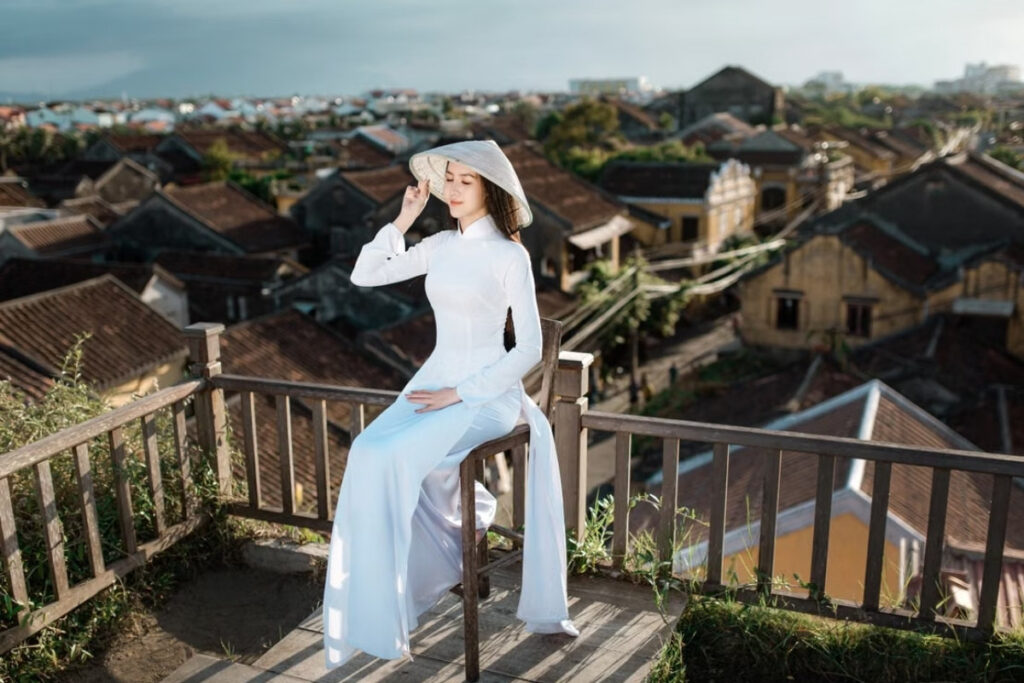
Visitors generally have two choices: rent one or have one tailored.
If you’re planning to wear an Ao Dai for a day of sightseeing or a professional photoshoot, renting is usually the simplest option. Rental studios are available in major destinations such as Hue, Hoi An, Hanoi, and Ho Chi Minh City, with many offering accessories and basic styling advice.
If you’d like to take home something more personal, consider having one custom-made.
Hoi An
Hoi An is widely regarded as Vietnam’s tailoring capital.
Many experienced tailors can produce a custom Ao Dai within 24–48 hours, allowing visitors to choose fabrics, colors, and small design details before returning for a final fitting.
For many travelers, the tailoring process becomes just as memorable as the finished garment itself.
Hue
Hue is ideal for visitors seeking a more traditional style.
Designers here often draw inspiration from the city’s imperial heritage, producing elegant silk Ao Dai with classic proportions and refined embroidery.
Hanoi
In Hanoi, boutiques tend to focus on timeless Northern elegance.
Traditional silk, understated colors, and classic tailoring make the capital an excellent choice for visitors who appreciate simplicity.
Ho Chi Minh City
Those interested in contemporary Vietnamese fashion will find the widest range of modern designs in Ho Chi Minh City, where young designers continue to reinterpret the Ao Dai for a new generation.
How Much Does an Ao Dai Cost?
Prices vary depending on the fabric and craftsmanship, but they are often lower than many visitors expect.
| Option | Typical Price |
|---|---|
| Rental | US$10–30 |
| Ready-made | US$30–100 |
| Custom-tailored | US$60–250+ |
| Designer collections | US$300+ |
Silk, hand embroidery, and bespoke tailoring naturally increase the price, while simpler designs remain affordable for most travelers.
Traveler Tip
If you’re planning a custom-made Ao Dai, allow at least two days for measurements, fittings, and final adjustments—especially if you’re ordering silk.
Wearing an Ao Dai Respectfully
One of the most common questions visitors ask is whether there is a “correct” way to wear an Ao Dai.
There is no complicated etiquette.
Instead, a few simple principles make all the difference.
Choose Comfort First
The Ao Dai should feel elegant, not restrictive. A properly fitted garment allows comfortable movement while maintaining its graceful silhouette.
Lightweight silk or linen is ideal for Vietnam’s tropical climate, particularly if you plan to spend several hours exploring historic sites.
Keep Accessories Simple
The elegance of the Ao Dai comes from its clean silhouette rather than dramatic accessories.
Comfortable shoes, understated jewelry, and natural styling usually work best.
Respect the Setting
If you’re visiting temples or pagodas, remember that respectful behavior matters far more than fashion.
Speak quietly, follow local customs, and avoid interrupting religious activities while taking photographs.
Wear It with Appreciation
Vietnamese people rarely expect visitors to understand every cultural detail.
What they appreciate most is genuine curiosity and respect.
A warm smile, polite attitude, and willingness to learn will always leave a stronger impression than perfectly following every unwritten fashion convention.
More Than a Souvenir
Many travelers initially rent or tailor an Ao Dai because they want beautiful photographs.
That often changes once they begin wearing it.
They notice how naturally the garment moves.
They understand why students wear it to graduation.
They see families dressed alike during Tet.
They begin asking questions about Vietnam’s traditions rather than simply admiring its scenery.
In that sense, the Ao Dai becomes much more than clothing.
It becomes a way of experiencing Vietnam.
And perhaps that explains why so many visitors remember wearing an Ao Dai long after they have forgotten the price they paid for it.
Fascinating Facts About the Ao Dai
The Ao Dai has been part of Vietnamese life for centuries, yet it continues to surprise many visitors.
Behind its elegant silhouette are stories of craftsmanship, family traditions, and cultural identity that extend far beyond fashion.
Here are a few facts that help explain why the Ao Dai remains one of Vietnam’s most enduring symbols.
It Represents One Nation, Not One Ethnic Group
Vietnam officially recognizes 54 ethnic groups, each with its own traditional clothing and textile traditions.
The Ao Dai did not replace these diverse garments. Instead, it gradually became the national dress that represents Vietnam as a whole while existing alongside the rich cultural heritage of the country’s many communities.
Every Ao Dai Is Slightly Different
There has never been a single “official” design.
Collars, sleeves, fabrics, colors, and embroidery have evolved over generations, allowing each era to leave its own mark on the garment.
That flexibility is one of the reasons the Ao Dai continues to feel timeless rather than historical.
Silk Remains the Classic Choice
Although modern Ao Dai are made from linen, velvet, lace, and other fabrics, silk remains the material most closely associated with the garment.
Its lightweight texture and natural movement create the graceful silhouette that has become one of the defining characteristics of the Ao Dai.
It Never Disappeared from Everyday Life
Many traditional garments around the world are worn only during historical reenactments or museum events.
The Ao Dai followed a different path.
Students still wear it to school.
Brides choose it for weddings.
Families celebrate Tet in matching Ao Dai.
Teachers, performers, diplomats, and flight attendants continue wearing it during important occasions throughout the year.
That continuous presence has helped preserve its cultural significance across generations.
The Best Souvenir Is Often the One You Wear
Many visitors arrive in Vietnam hoping to buy an Ao Dai.
They often leave with something more valuable than clothing.
They remember choosing fabric in Hoi An.
Walking through Hue’s Imperial City.
Celebrating Tet with local families.
Or posing for photographs beside Hoan Kiem Lake.
The garment becomes connected to those memories, which is why so many people continue to treasure it long after returning home.
Frequently Asked Questions about Ao Dai Vietnam
Is the Ao Dai Vietnam’s national dress?
Yes. The Ao Dai is widely recognized as Vietnam’s national dress and one of the country’s most important cultural symbols. Although Vietnam’s 54 ethnic groups each have their own traditional attire, the Ao Dai has become the garment most closely associated with Vietnamese identity.
Can foreigners wear an Ao Dai?
Absolutely.
Visitors are welcome to wear an Ao Dai as long as they do so respectfully. Most Vietnamese people appreciate the interest international travelers show in their culture and traditions.
Is the Ao Dai only for women?
No.
Although women’s Ao Dai are more commonly seen, men also wear traditional versions during weddings, Tet celebrations, cultural festivals, ancestor worship ceremonies, and other formal occasions.
Where is the best place to buy an Ao Dai?
Hoi An is the most popular destination for custom tailoring, while Hue is known for traditional craftsmanship. Hanoi specializes in classic designs, and Ho Chi Minh City offers a wide selection of contemporary styles.
How much does an Ao Dai cost?
Prices vary depending on the fabric and craftsmanship.
As a general guide:
- Rental: US$10–30
- Ready-made: US$30–100
- Custom-tailored: US$60–250+
Can I wear an Ao Dai when visiting temples?
Yes.
The Ao Dai is considered appropriate attire for temples and pagodas because of its modest design. Visitors should also respect local customs and maintain quiet, respectful behavior.
Conclusion

Few garments tell the story of a country as gracefully as the Ao Dai tells the story of Vietnam.
For centuries, it has accompanied Vietnamese people through school years, weddings, Tet celebrations, family reunions, and national ceremonies. While its fabrics, colors, and tailoring have evolved, its deeper meaning has remained remarkably constant—a celebration of heritage, family, and cultural identity.
For travelers, experiencing the Ao Dai is about far more than wearing traditional clothing. It offers an opportunity to connect with Vietnam through one of its most enduring cultural symbols, whether by exploring Hue’s Imperial City, strolling through Hoi An’s lantern-lit streets, or celebrating Tet alongside local families.
Long after the journey ends, many visitors remember not only how the Ao Dai looked, but how it made them feel—more connected to the places they visited and the people they met.
Perhaps that is the greatest reason the Ao Dai continues to endure.
It is not simply preserved as part of Vietnam’s history.
It continues to be worn, celebrated, and passed from one generation to the next.
And in doing so, it reminds us that the most meaningful traditions are those that continue to be lived.
Continue Exploring Vietnam
Interested in learning more about Vietnam?
Continue with these in-depth guides:
- Vietnamese Culture Guide – Explore the traditions, beliefs, and customs that shape modern Vietnam.
- Vietnamese Family Culture – Discover why family remains at the heart of Vietnamese society.
- Ancestor Worship in Vietnam – Learn about one of Vietnam’s oldest cultural traditions.
- Vietnamese Festivals Guide – Explore celebrations throughout the year.
- Ao Dai: Vietnam’s National Dress – Discover the history of Vietnam’s iconic traditional clothing.
- Vietnam Food Guide – Taste the country’s most iconic dishes and regional specialties.
- Vietnam Travel Guide – Plan your journey with practical travel advice and destination guides.
Further Reading
👉 Vietnam National Authority of Tourism
👉 UNESCO – Viet Nam Intangible Cultural Heritage
👉 Ministry of Culture, Sports and Tourism of Viet Nam
About the Author
Editorial Standards
This guide was researched and reviewed by the Tam Voc Viet Editorial Team using official tourism resources, historical references, academic publications, and local cultural insights. Our content is regularly updated to ensure accuracy and provide international travelers with trustworthy, experience-focused information about Vietnam.
Last updated: July 2026
Editorial review: Tam Voc Viet Editorial Team
