


 Tiếng Việt
If you walk through a Vietnamese city early in the morning, coffee is hard to miss.
It may be slowly dripping through a metal phin filter on a tiny street-side table. It may arrive over ice with sweetened condensed milk, topped with whipped egg in Hanoi, or mixed with salted cream in Hue.
The settings change. The drinks change.
But one thing remains familiar: people sit down, order coffee, and take their time.
That is one reason coffee matters so much in Vietnam.
Vietnamese coffee is not simply a beverage or a caffeine fix. It is connected to the country’s history, agriculture, economy, food culture, social life, and urban landscape.
To understand “Why is coffee so important in Vietnam?”, you have to look beyond the cup.
Quick Answer
Coffee is important in Vietnam because it is more than a popular drink. It is deeply connected to the country’s history, agriculture, economy, food culture, and everyday social life. Vietnam is also one of the world’s leading coffee producers, particularly of Robusta. From traditional phin coffee and cà phê sữa đá to sidewalk cafés and specialty coffee farms, coffee offers travelers a unique window into Vietnamese culture.
Table of Contents
More Than a Morning Drink: How Coffee Became Vietnamese
Coffee Was a Foreign Arrival
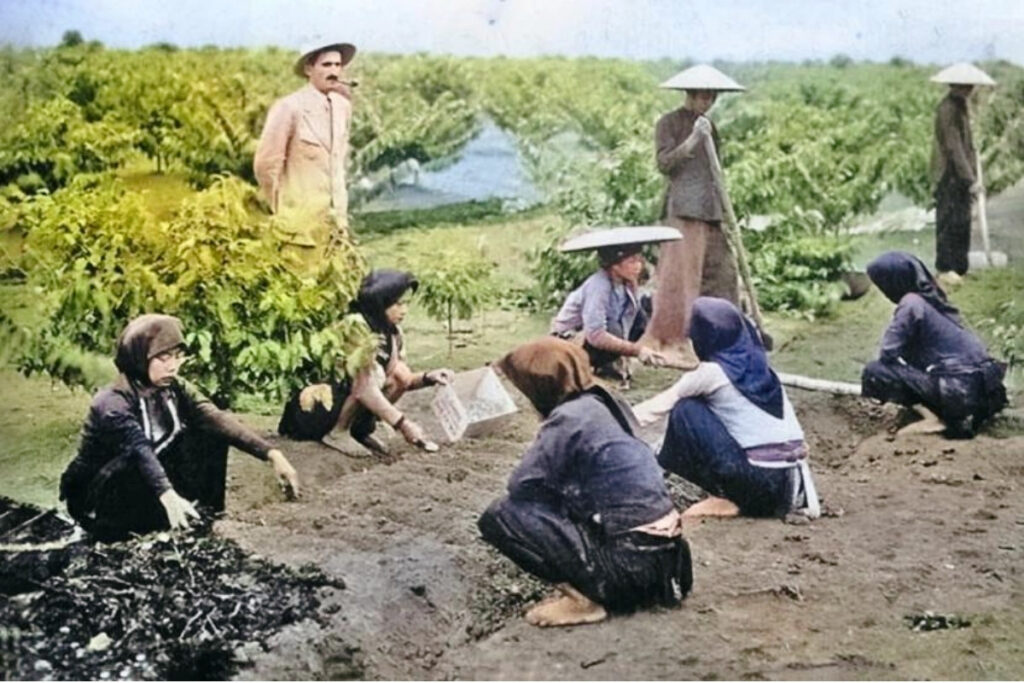
Coffee was introduced to Vietnam by the French in the 19th century, with historical sources generally tracing the first plantings to around 1857.
During the colonial period, coffee was initially developed as an estate crop rather than as the everyday drink it would eventually become.
That distinction matters.
Vietnamese coffee culture was not created simply by importing a European beverage and copying European habits. Vietnam gradually adapted coffee to its own agriculture, climate, ingredients, tastes, and social life.
Coffee cultivation expanded in the highlands, while areas around Da Lat developed an especially interesting Arabica history. Coffee eventually moved beyond plantations and into Vietnamese cities.
Then it became part of everyday life.
Why Robusta Became So Important
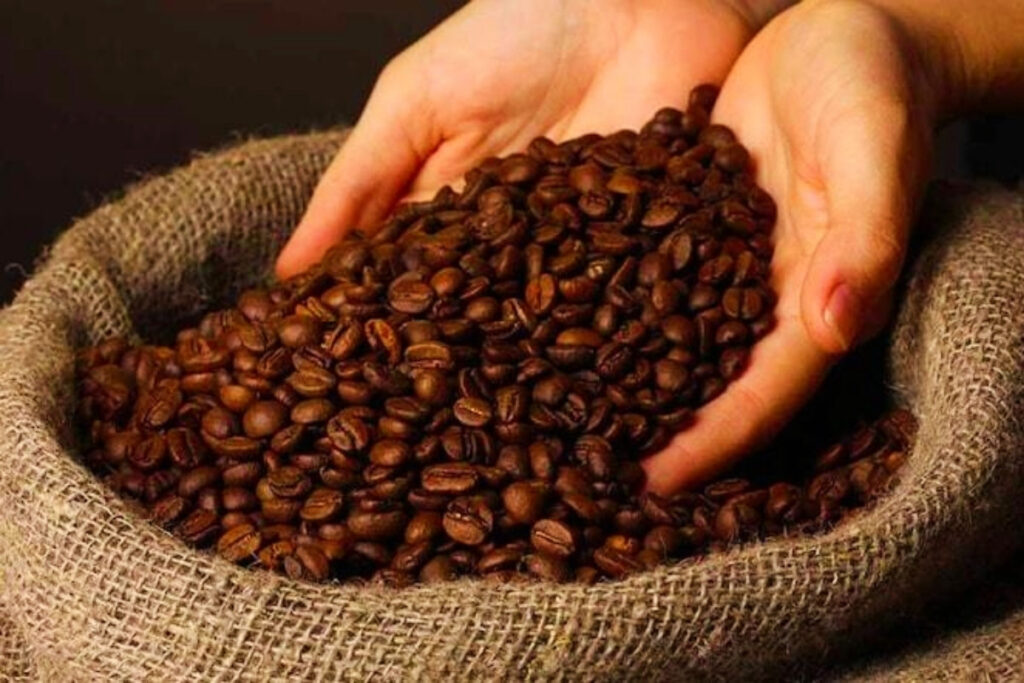
Vietnam’s coffee industry became closely associated with Robusta, a variety known for its strong body, pronounced bitterness, and relatively high caffeine content.
Robusta proved well suited to growing conditions in the Central Highlands and eventually became the foundation of Vietnam’s enormous coffee industry.
This also influenced the character of Vietnamese coffee.
Rather than trying to make Robusta taste like Arabica, Vietnamese coffee culture developed around its intensity.
Strong beans.
Dark roasting.
Concentrated brewing.
Sweetened condensed milk.
The result is the bold flavor many travelers now associate with Vietnamese coffee.
One of its most famous expressions is cà phê sữa đá, Vietnamese iced coffee with condensed milk.
The combination works because the bitterness of the coffee is balanced by sweetness and creaminess, while ice makes the drink particularly refreshing in Vietnam’s hot climate.
From Export Crop to Everyday Ritual
Vietnam’s coffee industry expanded dramatically in the second half of the 20th century.
Agricultural reforms and the Đổi Mới economic reforms beginning in 1986 helped create conditions for rapid growth in coffee production. Coffee became an important export crop and an increasingly important source of rural income.
But coffee did not remain an agricultural story.
As production grew, coffee became increasingly embedded in urban life.
Cafés became places where friends met, colleagues talked, students studied, and people simply watched the street.
The drink had crossed an important cultural boundary.
It was no longer simply a foreign crop.
Coffee had become Vietnamese.
To understand how that transformation shaped the drinks, rituals, and everyday habits found in Vietnam today, explore our guide to Vietnamese coffee culture.
Coffee Became Vietnamese Through Adaptation
The most interesting part of the story is how much Vietnam changed coffee after adopting it.
The country developed its own brewing method, its own flavor combinations, and its own café rituals.
The phin became a defining brewing tool.
Sweetened condensed milk became a signature ingredient.
And local creativity produced drinks such as:
- Cà phê sữa đá — iced coffee with condensed milk
- Cà phê trứng — Hanoi egg coffee
- Cà phê muối — Hue salt coffee
- Coconut coffee
- Bạc xỉu, a sweeter, milk-forward coffee
These drinks are more than novelty variations.
They show how Vietnamese Cuisine adapts outside influences and turns them into something locally recognizable.
Coffee arrived from elsewhere.
Vietnam made it its own.
Why Does Vietnamese Coffee Taste So Different?
If your first Vietnamese coffee tastes unlike the coffee you normally drink at home, you’re not imagining it.
Traditional Vietnamese coffee can be darker, stronger, thicker, and more intense than many coffees familiar to American travelers.
The difference comes from several elements working together:
the bean, the roast, the phin, the condensed milk, and the way Vietnamese coffee is served.
Robusta Changes Everything
Vietnam is particularly famous for Robusta coffee, with the Central Highlands serving as the country’s major coffee-growing region.
For many American coffee drinkers, Arabica is more familiar. Specialty coffee culture often emphasizes Arabica for its acidity, floral aromas, fruit notes, and complexity.
Robusta has a different character.
It tends to produce a heavier body, stronger bitterness, and higher caffeine content.
Vietnamese coffee culture did not develop by trying to hide those characteristics.
It embraced them.
That is why traditional Vietnamese coffee can taste so powerful.
The intensity is not necessarily a flaw.
It is part of the style.
The Central Highlands Give Vietnamese Coffee Its Sense of Place
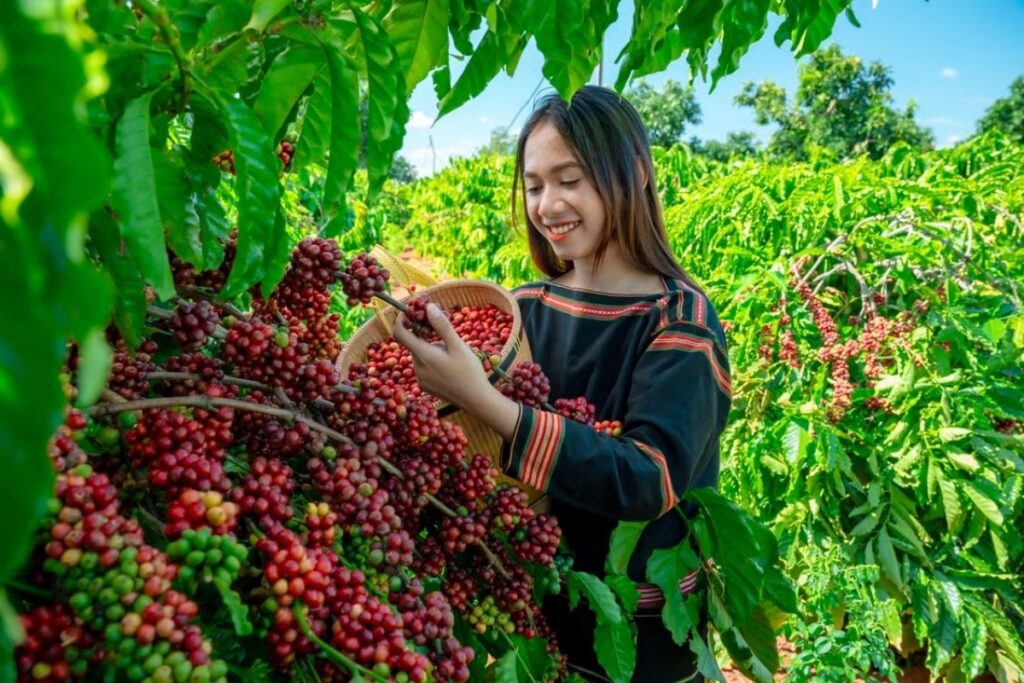
Vietnam’s coffee heartland lies in the Central Highlands, particularly provinces such as Đắk Lắk, Đắk Nông, Gia Lai and Lâm Đồng.
The landscape is dramatically different from Vietnam’s major cities.
Instead of dense streets and motorbikes, travelers encounter highland terrain, plantations, coffee trees, and the distinctive red soil associated with the region.
Da Lat is particularly interesting because its cooler highland climate supports Arabica as well as other forms of coffee production.
This gives Vietnam a more diverse coffee landscape than the country’s reputation for Robusta might suggest.
For travelers, it also creates an important connection between the drink and the land where it is produced.
A cup in Hanoi may begin its journey on a farm hundreds of miles away.
Dark Roasting Creates the Familiar Flavor
Traditional Vietnamese coffee is often associated with dark roasting.
Compared with lighter specialty roasts, this produces a deeper roasted profile that may remind drinkers of dark chocolate, roasted nuts, caramelized sugar, or smoky flavors.
The goal is not necessarily delicate acidity.
It is intensity.
That works particularly well with the traditional brewing method and with condensed milk.
Modern Vietnamese specialty roasters are increasingly experimenting with lighter roasting and more precise processing, but the classic dark-roasted style remains central to the country’s coffee identity.
Why Does Vietnamese Coffee Use Condensed Milk?
Sweetened condensed milk is one of the defining features of traditional Vietnamese coffee.
Historically, it also made practical sense in a country where fresh dairy was not always readily available.
But its importance today is cultural as much as practical.
Strong coffee and sweet condensed milk create a distinctive contrast.
The coffee provides bitterness and depth.
The condensed milk adds sweetness and creaminess.
Ice turns the combination into a refreshing drink suited to Vietnam’s climate.
That is why cà phê sữa đá should not simply be thought of as a Vietnamese version of an iced latte.
It has a different foundation and a different flavor profile.
The Phin Is More Than a Coffee Filter
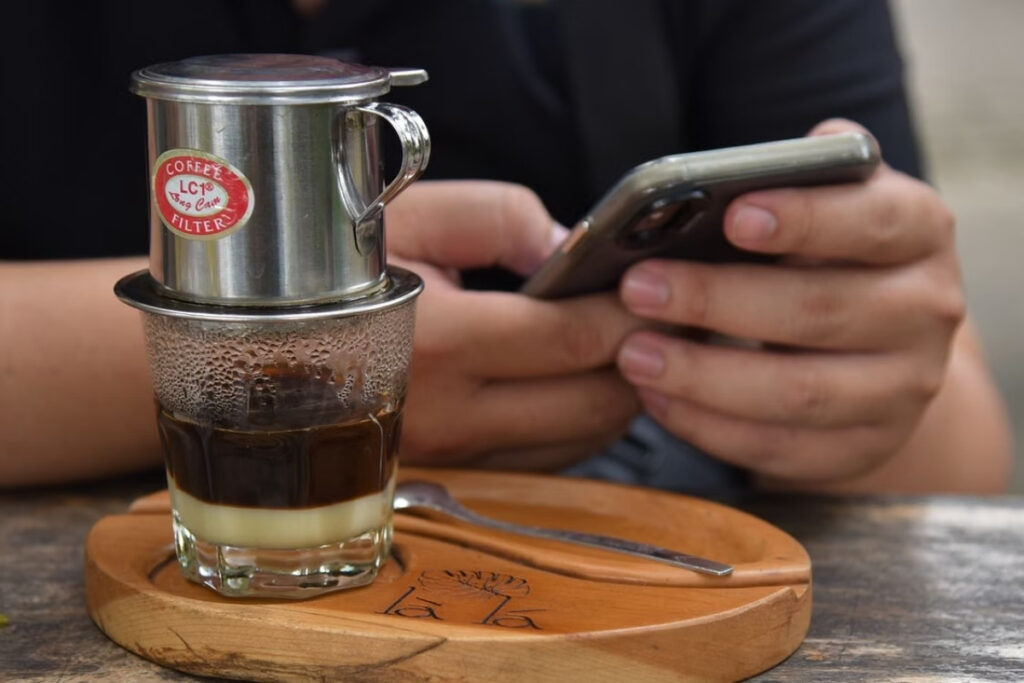
The phin is one of the simplest and most recognizable parts of Vietnamese coffee culture.
It is a small metal filter placed directly over the serving glass. Coffee grounds sit inside while hot water slowly passes through them and drips below.
There is no espresso machine.
No paper filter.
No rush.
You watch the coffee collect drop by drop.
For visitors accustomed to ordering a coffee and receiving it almost immediately, the phin can feel surprisingly deliberate.
But the slow brewing process is part of the experience.
The coffee does not simply arrive.
You watch it being made.
And that creates a natural pause.
Why Vietnamese Iced Coffee Works
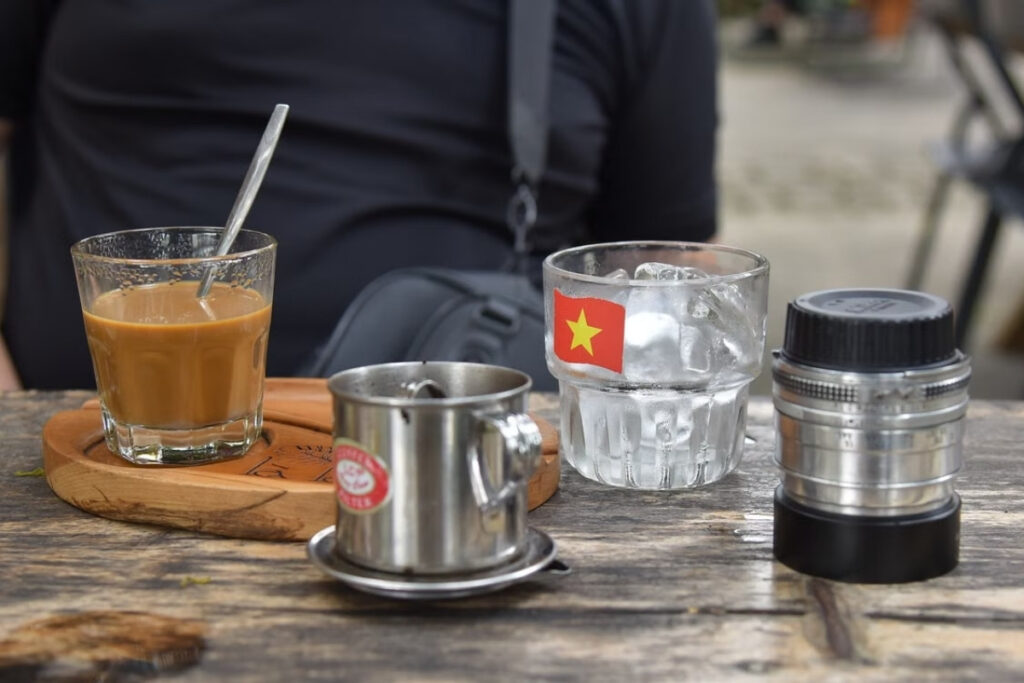
Vietnam’s climate also helps explain the popularity of iced coffee.
Much of the country is hot and humid, making a strong, sweet coffee served over ice an appealing combination.
The coffee is concentrated enough to retain its character after dilution.
The condensed milk adds body and sweetness.
The ice makes it refreshing.
The result is one of the simplest examples of Vietnamese culinary adaptation: a practical combination that became a cultural signature.
Regional Coffee Has Different Personalities
Vietnamese coffee is not exactly the same everywhere.
The basic tradition travels across the country, but different regions have developed their own expressions.
Hanoi: Coffee With History
Hanoi has a coffee culture closely tied to the city’s older neighborhoods, narrow buildings, courtyards, balconies, and sidewalks.
The atmosphere can be as important as the drink.
And Hanoi is especially famous for cà phê trứng, or egg coffee.
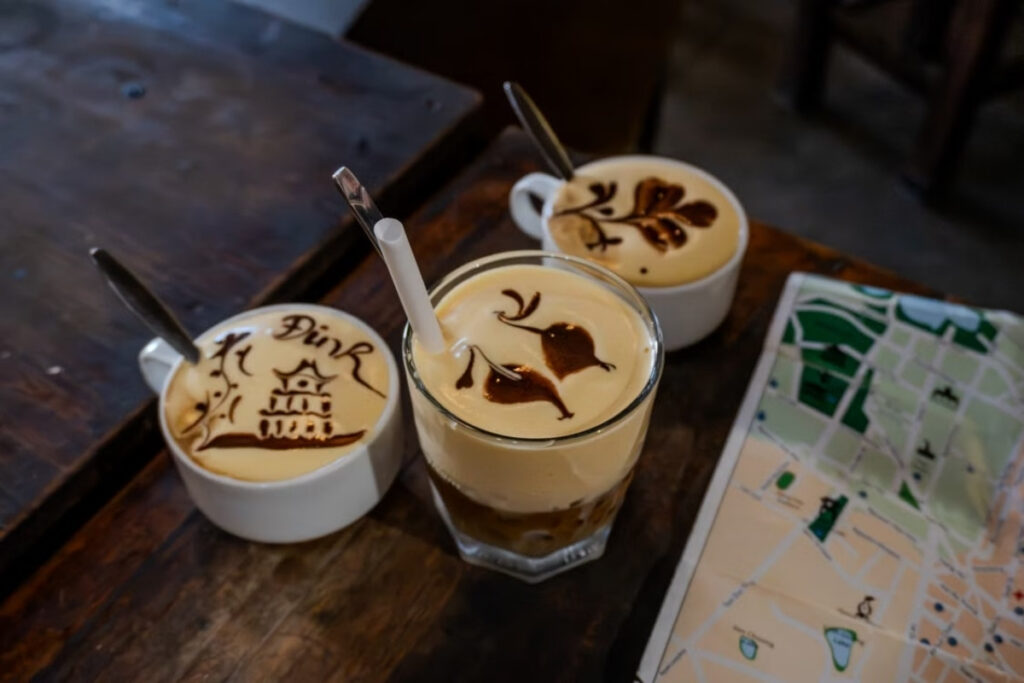
Strong coffee is combined with a rich whipped mixture traditionally made with egg yolk, sugar, and condensed milk.
The result is creamy, sweet, and almost dessert-like.
It is a perfect example of Vietnamese coffee culture turning a simple imported beverage into something distinctly local.
Hue: Salt Coffee
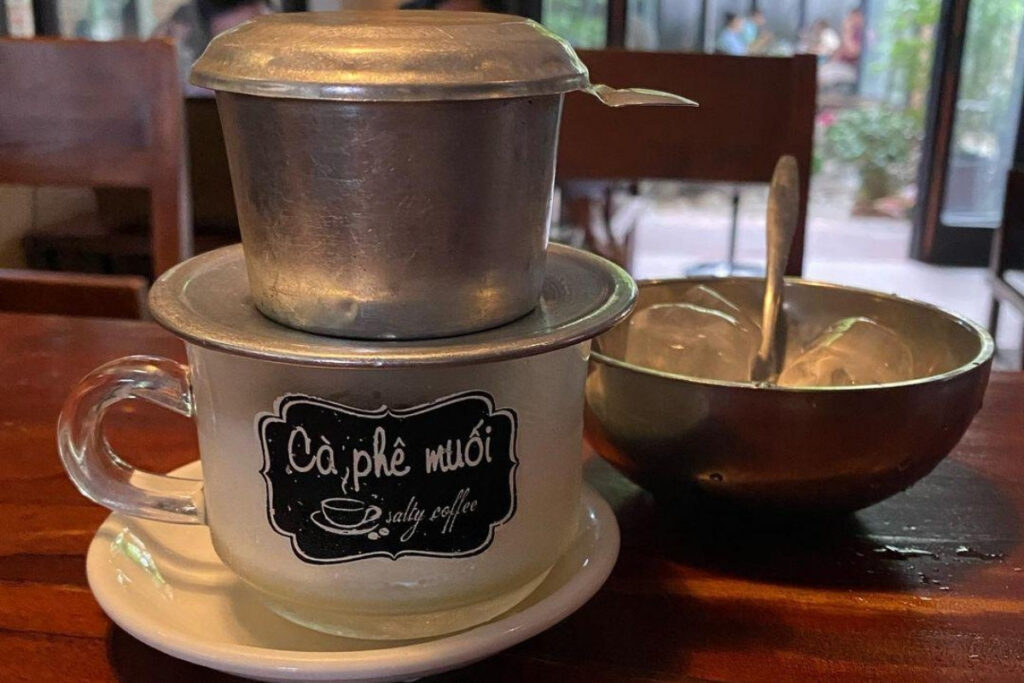
Hue offers another memorable variation: cà phê muối, or salt coffee.
The drink combines coffee with a creamy, slightly salty element.
The salt helps soften bitterness and bring out sweetness, producing a flavor that can remind some travelers of salted caramel.
More importantly, it shows the experimental nature of Vietnamese coffee culture.
There is no single formula that defines what coffee has to be.
Da Lat: Coffee and the Highlands
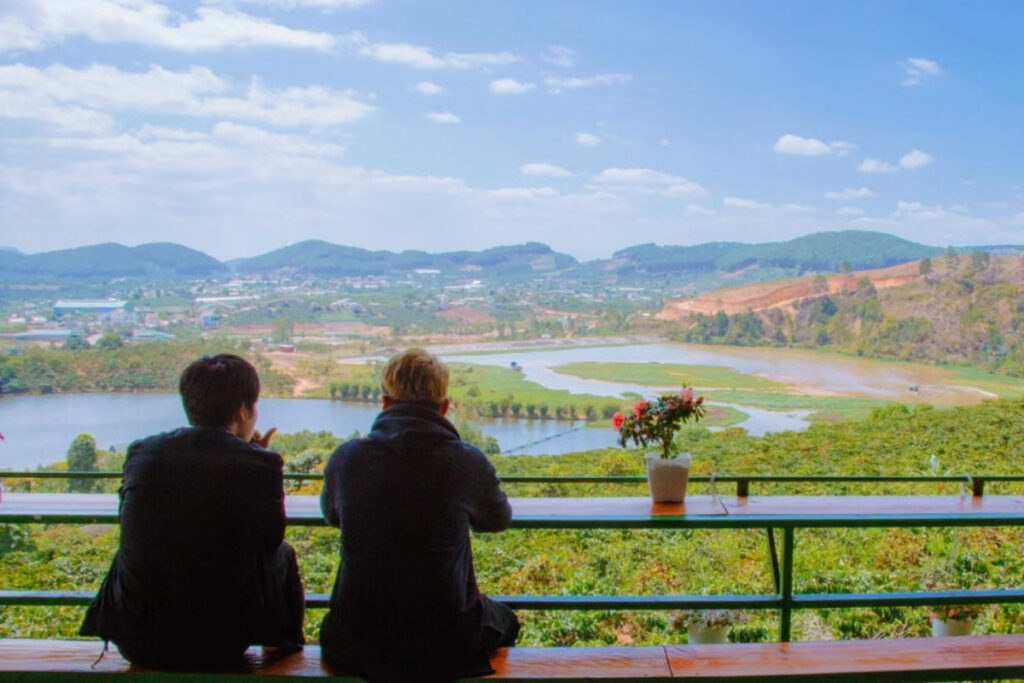
Da Lat offers a different perspective because coffee is closely connected to the surrounding landscape.
The region is known for highland agriculture and Arabica production, as well as a growing specialty coffee scene.
A coffee farm visit can change how travelers think about the drink.
Instead of seeing coffee only as a finished product, you see the cherries, processing, drying, roasting, and landscape behind it.
The distance between farm and cup suddenly becomes much shorter.
Ho Chi Minh City: Coffee as Urban Life
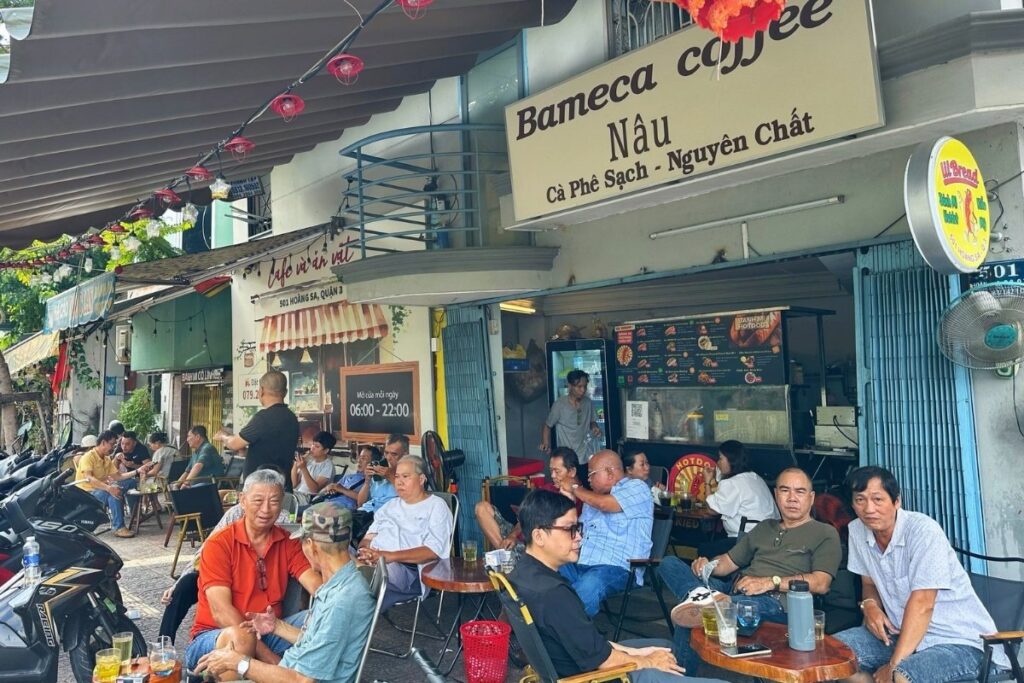
Ho Chi Minh City offers perhaps the most energetic version of Vietnamese café culture.
Traditional sidewalk coffee exists alongside modern specialty cafés, historic coffee stalls, converted buildings, and contemporary roasting businesses.
The city’s old-school cà phê vợt, or cloth-filter coffee, provides another example of how traditional methods continue alongside newer coffee trends.
Here coffee fits naturally into the rhythm of a huge commercial city.
People meet over coffee.
Work over coffee.
Talk business over coffee.
Watch traffic over coffee.
The café becomes part of the city’s infrastructure.
The Café Is Part of Vietnamese Life
The most important thing travelers can miss about Vietnamese coffee is that the café itself is part of the culture.
The drink matters.
But the setting matters too.
Find a café on a busy Vietnamese street and sit for a while.
A person may arrive before work.
Friends may meet to talk.
A student may study.
A freelancer may open a laptop.
An older customer may simply sit and watch the street.
Nobody necessarily seems to be in a hurry.
This is why coffee in Vietnam is often better understood as a social ritual than simply a beverage.
Coffee Is a Reason to Sit Together
“Let’s get coffee” does not always mean “I need caffeine.”
It can mean:
Let’s talk.
Let’s catch up.
Let’s discuss work.
Let’s spend some time together.
That makes coffee an easy social activity.
You do not need to organize an elaborate meal.
You do not need a special occasion.
You simply find a café and sit.
This is one reason coffee has become so deeply embedded in Vietnamese daily life.
The Sidewalk Is Part of the Café
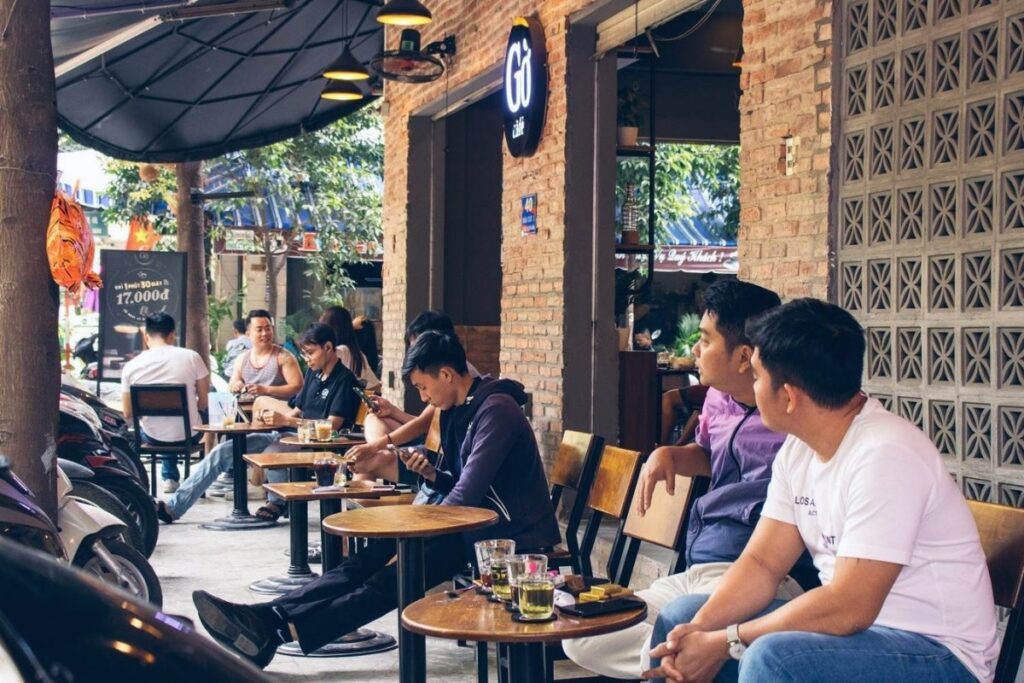
Vietnamese sidewalk cafés are particularly revealing.
Tiny plastic chairs and small tables may spill directly onto the pavement.
The street becomes the view.
Motorbikes pass.
Street vendors move by.
People stop to talk.
Rain changes the atmosphere.
Morning sunlight moves across the pavement.
The café and the city almost become the same space.
For travelers, this can be one of the easiest ways to observe everyday Vietnam without joining a formal tour.
You simply sit there.
Coffee and Conversation
A café also provides a comfortable middle ground between a quick greeting and a formal meal.
Friends can talk.
Colleagues can discuss work.
People can meet without committing to a long dinner.
Because coffee can be enjoyed slowly, conversations do not have to be rushed.
The phin reinforces that rhythm.
The drink takes time.
So does the conversation.
Cafés Have Become Modern Third Spaces
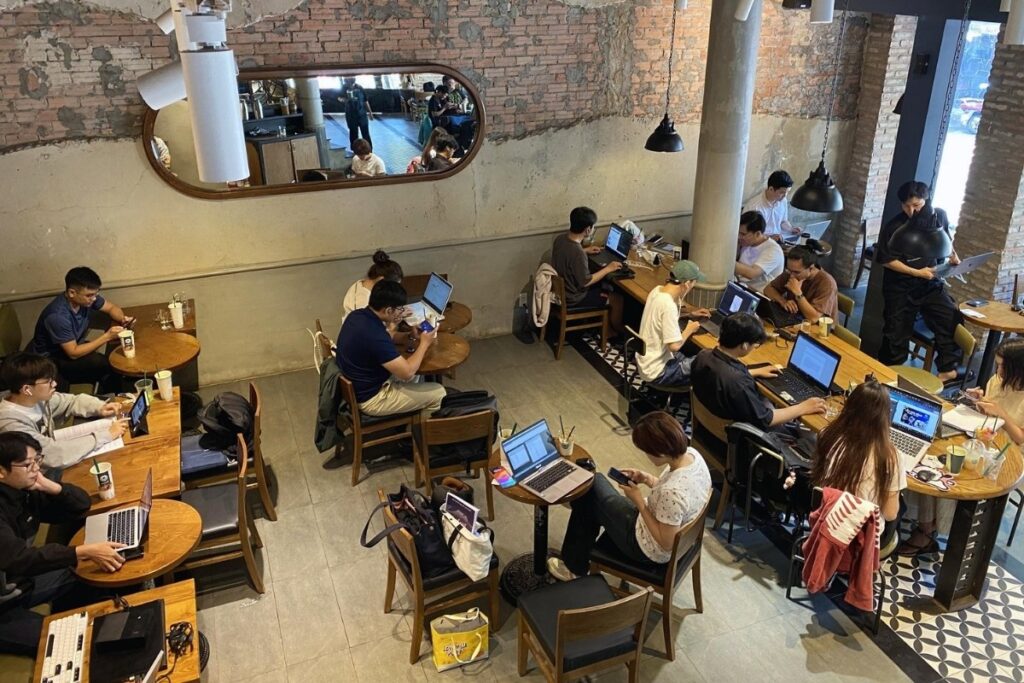
Vietnamese café culture has also adapted to modern urban life.
Contemporary cafés may offer Wi-Fi, air conditioning, comfortable seating, and spaces suitable for studying or working.
A single café can contain:
- students
- office workers
- freelancers
- business meetings
- friends
- couples
- solo customers
The old café did not disappear when laptops arrived.
The plastic stool simply gained Wi-Fi.
This coexistence of old and new is one of the most interesting aspects of modern Vietnamese coffee culture.
Why Can People Sit for Hours Over One Coffee?
The answer is simple:
The coffee is not always the main activity.
Conversation is the activity.
People-watching is the activity.
Reading is the activity.
Working is the activity.
Spending time with someone is the activity.
Sometimes, taking a break is the activity.
If you drink your coffee in five minutes and leave, you experience the beverage.
If you sit for an hour and watch the neighborhood change around you, you experience part of the culture.
That distinction matters.
Hanoi, Ho Chi Minh City, Hue and Da Lat
Each city gives the café experience a different character.
Hanoi often feels historic and atmospheric, with cafés tucked into narrow buildings, balconies, courtyards, and old neighborhoods.
Ho Chi Minh City feels faster and more energetic, with traditional sidewalk coffee existing alongside modern specialty cafés.
Hue offers a slower atmosphere and its distinctive salt coffee tradition.
Da Lat connects coffee culture more directly to highland agriculture and specialty production.
This variety is one reason coffee works so well as a lens for understanding Vietnam.
The drink is familiar.
The setting changes.
Vietnam Is Rethinking What Vietnamese Coffee Means
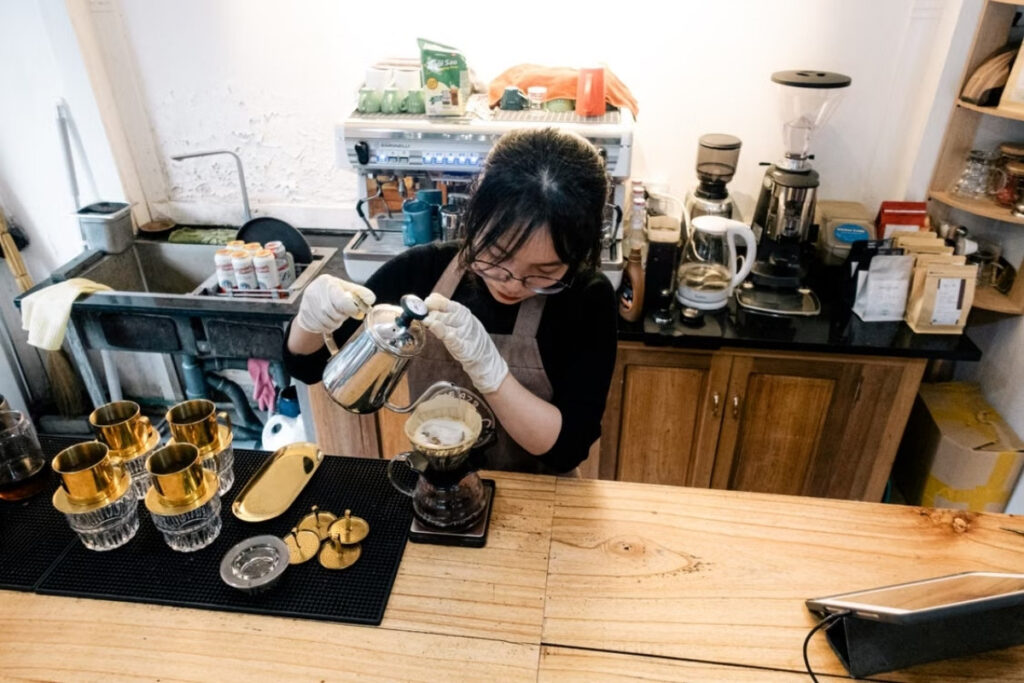
For decades, Vietnam’s international reputation was dominated by one image:
strong Robusta, dark roasting, phin brewing, and condensed milk.
That remains an important part of Vietnamese coffee.
But it is no longer the entire story.
A new generation of Vietnamese farmers, roasters, and café owners is experimenting with processing methods, origin-specific beans, specialty brewing, and different roast profiles.
Vietnamese specialty coffee is becoming more visible in major cities.
High-quality Robusta is receiving greater attention.
Arabica from highland regions such as Da Lat is gaining recognition.
And consumers are increasingly interested in where their coffee comes from.
The result is a coffee culture that is both traditional and experimental.
You can still sit on a tiny plastic stool and drink cà phê sữa đá.
A few streets away, you may find a café serving a carefully prepared single-origin Vietnamese coffee.
Neither experience has to replace the other.
They are two parts of the same evolution.
The Phin Is Having a Second Life
The phin illustrates this particularly well.
For generations, it was simply an ordinary household and café tool.
Today, it has become one of the symbols of Vietnamese coffee around the world.
It is inexpensive, reusable, and simple.
Yet its very simplicity has become part of its appeal.
Something ordinary became a cultural symbol.
That is often how food traditions work.
A tool that once seemed unremarkable becomes meaningful when people understand the story behind it.
Coffee Tourism in Vietnam
Coffee offers travelers an unusual way to explore Vietnam because it connects cities, food, agriculture, and everyday life.
You can experience it at several levels.
In Hanoi
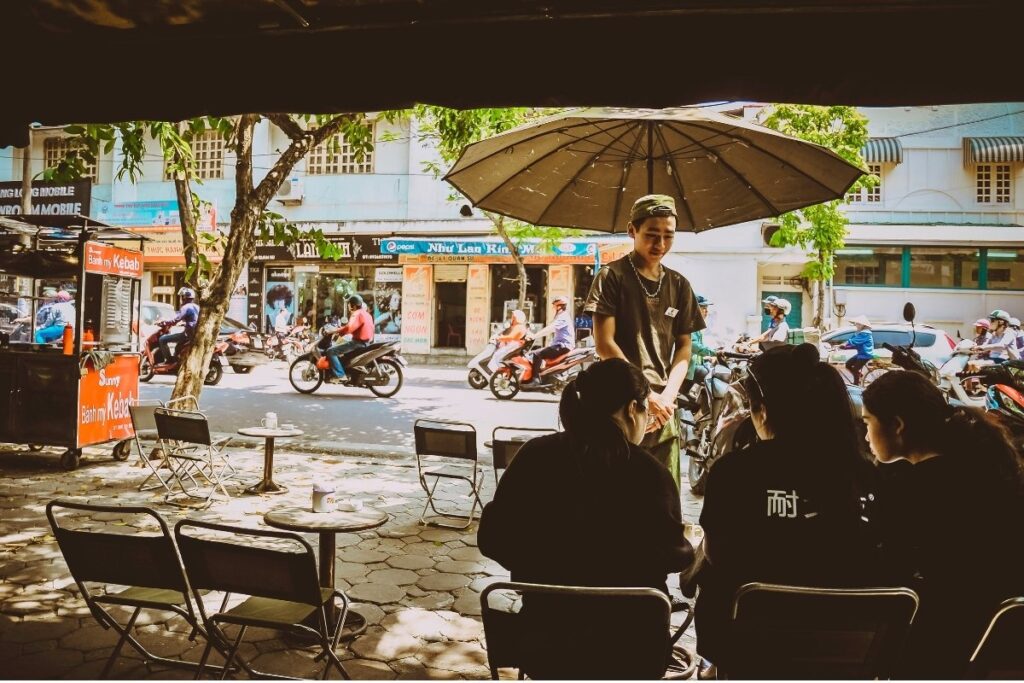
Try traditional phin coffee and egg coffee.
Then sit at a small neighborhood café and watch the street.
The experience is less about checking off famous cafés and more about understanding how coffee fits into city life.
In Hue
Try salt coffee.
Pay attention to how a small amount of salt changes the bitterness and sweetness.
It is a simple drink that reflects Hue’s broader tradition of culinary reinterpretation.
In Da Lat
Explore the connection between coffee farms and highland landscapes.
A farm visit can help you understand the journey from coffee cherry to roasted bean and discover Vietnam’s growing specialty coffee culture.
In Buôn Ma Thuột
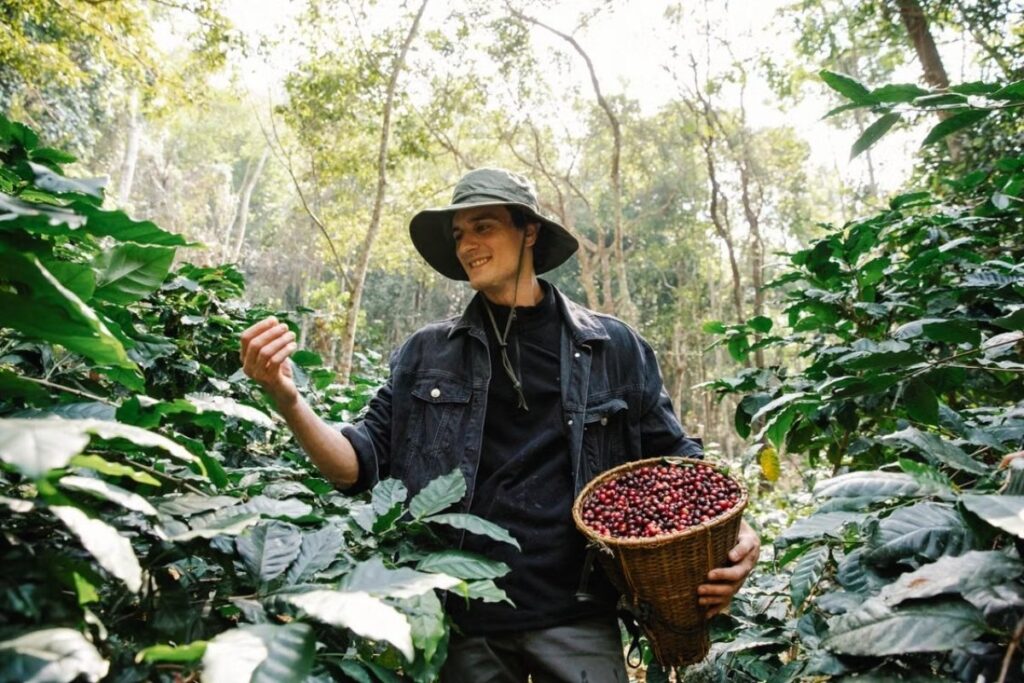
Go deeper into Vietnam’s Robusta heartland.
This is one of the best places to understand coffee as agriculture and an important regional industry rather than simply as a café experience.
What Coffee Reveals About Vietnam
Ultimately, coffee is useful because it reveals several sides of Vietnam at once.
It connects:
History and modern life
Agriculture and cities
Local traditions and global trade
Traditional cafés and specialty coffee
Individual routines and social relationships
Vietnamese coffee is therefore more than a national food or drink.
It is a cultural bridge.
A foreign crop became a major agricultural industry.
A colonial-era beverage became a local ritual.
A simple metal filter became a recognizable symbol.
And an everyday café became one of the places where Vietnamese people meet, work, talk, and spend time together.
Few ordinary products connect so many parts of Vietnamese life.
Why Is Coffee So Important in Vietnam?
The answer has several layers.
Coffee arrived in Vietnam as a foreign crop.
Vietnam turned it into a major agricultural industry.
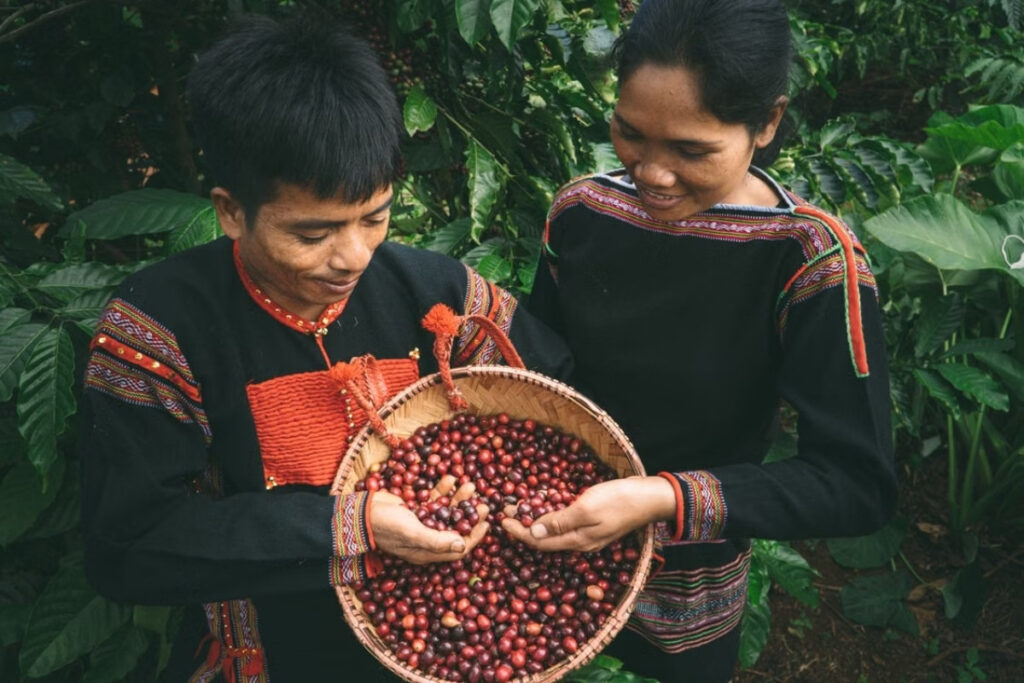
Farmers in the Central Highlands helped make the country one of the world’s leading coffee producers.
Vietnamese consumers transformed the drink through Robusta, dark roasting, the phin, condensed milk, ice, and local creativity.
Cafés turned coffee into a social ritual.
And today, a new generation is taking Vietnamese coffee into the specialty coffee world.
That is why coffee matters.
It is part of Vietnam’s history, economy, food culture, social life, and sense of place.
It connects a plantation in the Central Highlands with a tiny café in Hanoi.
It connects farmers with global markets.
It connects old traditions with modern experimentation.
And it gives people a reason to stop for a few minutes and simply be where they are.
Perhaps that is the most important thing about Vietnamese coffee.
Not the bean.
Not the phin.
Not even the condensed milk.
The pause.
In a country that can seem to move at extraordinary speed, coffee creates a small space to slow down, sit with someone, and watch life happen.
And if you want to understand Vietnam beyond the usual tourist checklist, that is a pretty good place to start.
Frequently Asked Questions About Vietnamese Coffee
Why is coffee so important in Vietnam?
Coffee is important because it is deeply connected to Vietnam’s history, agriculture, economy, food culture, and social life. Vietnam is also one of the world’s leading coffee producers, particularly of Robusta.
Why does Vietnamese coffee taste so strong?
Traditional Vietnamese coffee often uses Robusta beans, dark roasting, and concentrated phin brewing. Together, these create a stronger and more intense flavor than many American coffee drinkers expect.
What is a phin?
A phin is a small metal Vietnamese coffee filter. It allows hot water to slowly pass through ground coffee and drip into a glass below. It is one of the defining features of traditional Vietnamese coffee.
Why does Vietnamese coffee use condensed milk?
Condensed milk historically provided a practical alternative to fresh milk and also balances the strong bitterness of traditional Vietnamese coffee. Today, it is a signature ingredient in drinks such as cà phê sữa đá.
What is cà phê sữa đá?
Cà phê sữa đá is Vietnamese iced coffee made with strong coffee, traditionally brewed through a phin, sweetened condensed milk, and ice.
Is Vietnamese coffee Robusta or Arabica?
Vietnam is best known for Robusta, which dominates its coffee production. However, Arabica is also grown, particularly in highland regions such as Da Lat.
What is Vietnamese egg coffee?
Cà phê trứng, or egg coffee, is a Hanoi specialty made with strong coffee and a rich whipped mixture traditionally based on egg yolk, sugar, and condensed milk.
Where is coffee grown in Vietnam?
Most Vietnamese coffee is grown in the Central Highlands, particularly Đắk Lắk, Đắk Nông, Gia Lai and Lâm Đồng. Da Lat and surrounding areas are also known for Arabica and specialty coffee.
Where should travelers experience Vietnamese coffee?
Hanoi is excellent for traditional café culture and egg coffee. Ho Chi Minh City offers a lively mix of traditional and modern cafés. Hue is known for salt coffee. Da Lat connects coffee with highland agriculture, while Buôn Ma Thuột offers a deeper look at Vietnam’s Robusta industry.
Is Vietnamese coffee stronger than American coffee?
Traditional Vietnamese coffee can taste stronger than many mainstream American coffees because of Robusta, dark roasting, and concentrated brewing. However, Vietnam’s growing specialty coffee industry now includes lighter and more nuanced styles.
One Last Cup

The next time you order Vietnamese coffee, don’t rush it.
Watch the phin drip.
Stir the coffee.
Let the ice melt into the dark brew.
Look at the people around you.
Listen to the street.
For a few minutes, you are not simply drinking coffee.
You are watching Vietnam.
And sometimes, that is the best way to understand it.
Continue Exploring Vietnam Insights
Coffee is only one way to understand Vietnam beyond the usual tourist checklist.
Continue exploring Vietnam Insights from Tam Voc Viet, covering everyday life, local perspectives, food culture, traditions, and the experiences that help travelers understand Vietnam from a deeper perspective.
Recommended next reads:
- Vietnam Coffee Culture Guide — Discover how family relationships shape everyday life, traditions and social expectations.
- Vietnamese Family Culture — Discover how family relationships shape everyday life, traditions and social expectations.
- Vietnamese Markets & Bargaining Culture — Learn how local markets work and why bargaining is part of the experience.
- Vietnamese Etiquette — Understand the small social customs that can make interactions with locals easier and more respectful.
- Why Are There So Many Motorbikes in Vietnam? — Explore the history, practicality and social role of Vietnam’s motorcycle culture.
- 15 Things That Surprise First-Time Visitors to Vietnam
- Common Culture Shocks in Vietnam: 15 Things First-Time Visitors Should Know
- Why Do Vietnamese Families Eat Together?
- Why Do Vietnamese Wake Up So Early?
- The Story Behind Vietnam’s Street Food Culture
- What It’s Really Like to Celebrate Tet in Vietnam
- Vietnamese Work Culture Explained
- What Foreigners Love Most About Living in Vietnam
- Living in Vietnam: The Complete Guide for Foreigners
Together, these Vietnam Insights offer a closer look at the everyday experiences, perspectives, and cultural details that can be easy to miss on a first trip.
A Note for Travelers
You don’t need to know everything about Vietnamese coffee before you try it.
In fact, part of the experience is discovering it for yourself.
Start with something simple: order a traditional coffee, watch the phin slowly drip, and take a few minutes to observe the café around you. The way people sit, talk, work, and spend time over coffee is just as interesting as the drink itself.
You may find that Vietnamese coffee tastes stronger or sweeter than what you’re used to. You may prefer it black, with condensed milk, over ice, or in one of the country’s many regional variations.
There is no single “right” way to experience Vietnamese coffee.
Be curious, take your time, and let the local setting be part of the experience.
That is often the best way to discover why coffee has become such an important part of everyday life in Vietnam.
Sources & Further Reading
This article draws on information about Vietnam’s coffee history, production, café culture, and travel experiences. Because coffee traditions and everyday practices can vary by region and generation, examples in this guide should be understood as cultural context rather than rules that apply to every Vietnamese person or every café.
For current travel information, including transportation, opening hours, attractions, regulations, and other practical details, always check official sources before your trip.
Suggested sources:
- Vietnam National Authority of Tourism / Vietnam Tourism – Official information about Vietnam’s destinations, tourism, culture, and travel experiences.
- Vietnamese Museum of Ethnology – Background on Vietnamese cultural traditions, communities, and everyday life.
- World Bank — Research and historical information relating to Vietnam’s coffee industry, agriculture, rural development, and economic transformation.
- Vietnam Government Portal – Legal Documents – Official government information and legal documents for current regulations and public administration.
Editorial note: Vietnam’s coffee culture continues to evolve. Traditional sidewalk cafés, family-run coffee shops, historic brewing methods, and modern specialty cafés all exist alongside one another. Practices can vary by region, generation, and individual preference. Tam Voc Viet presents these examples as a way to help international travelers understand the cultural context behind Vietnamese coffee, not as universal rules.
About the Author
Tam Voc Viet Editorial Team
The Tam Voc Viet Editorial Team creates travel and cultural guides for international readers who want to understand Vietnam beyond its most famous destinations.
Our content explores Vietnam through its history, culture, food, traditions, people, and everyday life, with a focus on practical context for international travelers.
For cultural and travel topics, we consult official Vietnamese sources, established research, cultural institutions, and relevant travel resources where appropriate. We aim to explain Vietnam in a way that is informative, respectful, and useful while recognizing that experiences can differ across regions and generations.
Our goal is simple:
To help international visitors experience Vietnam with more context, curiosity, and confidence.
Article Information
Category: Vietnam Insights
Topic: Vietnamese Coffee Culture & Everyday Life
Published: August 2026
Last Updated: August 2026
Author: Tam Voc Viet Editorial Team
