


 Tiếng Việt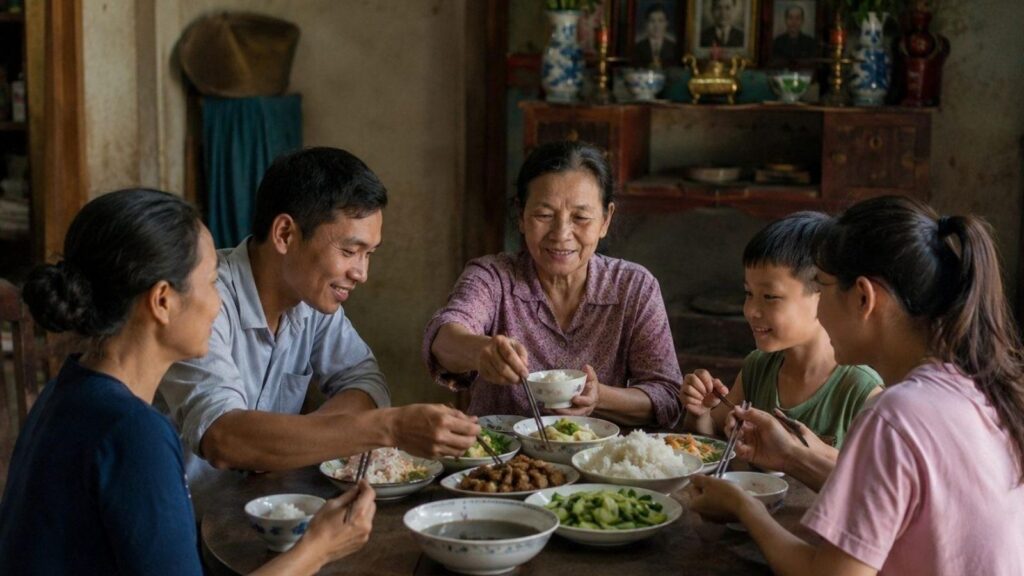
You might notice it the first time you are invited into a Vietnamese home.
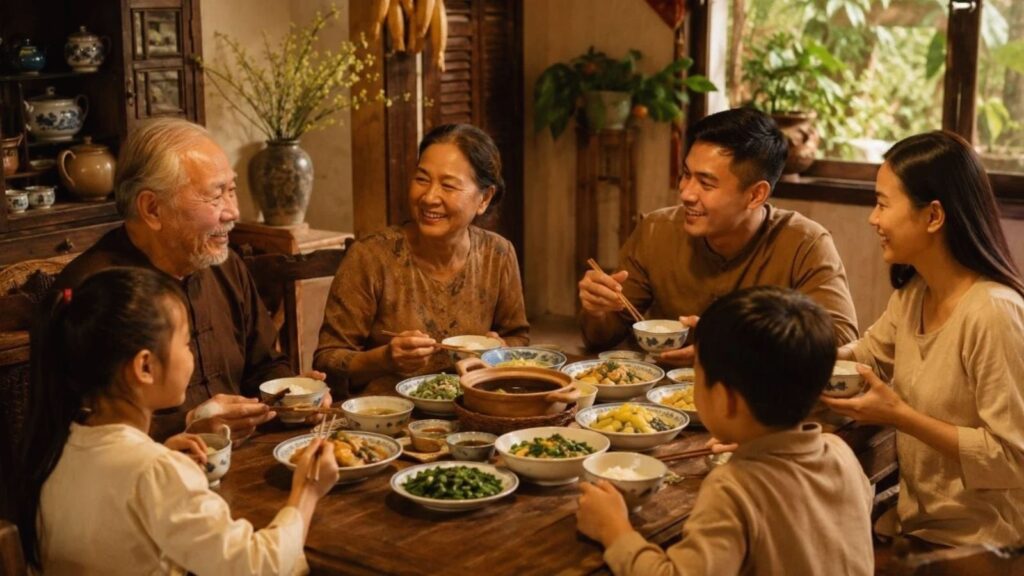
There is a bowl of steaming rice in the middle of the table. A soup is passed from one person to another. Plates of vegetables, fish, meat, or tofu sit within everyone’s reach. Nobody has a completely separate meal. Instead, everyone takes a little from the dishes in front of them.
Then someone looks at your bowl.
“You haven’t eaten much.”
Before you have time to explain that you are already full, another piece of food appears.
For a traveler, it can be a charming — and sometimes slightly confusing — introduction to Vietnamese family life.
But there is a reason food plays such a central role in these moments.
In Vietnam, a family meal is often about much more than eating.
It is a time to reconnect after a day of work or school, check on older relatives, look after children, share stories, and simply be in the same place for a while. The dishes on the table may be ordinary, but the act of sitting down together carries a deeper meaning.
This is also why Vietnamese food culture is difficult to understand if you experience it only through restaurants.
You can learn how phở is made.
You can discover the difference between northern and southern cuisine.
You can spend days exploring street food in Hanoi or Ho Chi Minh City.
But to understand what food means to many Vietnamese people, you need to look at what happens around the family table.
The answer is not that every Vietnamese family eats together every night. Modern life has changed that, just as it has everywhere else. Long working hours, school schedules, traffic, smartphones, food delivery, and busy city life can make shared meals harder to maintain.
Yet the family meal remains an important cultural idea.
Because in Vietnam, asking someone whether they have eaten can sometimes be another way of asking:
Are you okay?
And offering someone food can be another way of saying:
You are welcome here.
That is the part travelers often miss.
A Vietnamese meal is not simply something placed on a table.
It is often a way of bringing people closer.
Quick Answer
Vietnamese families traditionally eat together because meals provide a regular opportunity to maintain family bonds, show care and respect, share daily experiences, and pass cultural habits between generations.
Instead of serving completely separate portions, many Vietnamese home meals are served family-style, with shared dishes placed in the center of the table. Each person has their own rice bowl and chopsticks but takes food from the communal dishes.
The tradition is closely connected to the importance of family in Vietnamese culture. Eating together allows parents, children, grandparents, and other relatives to spend time together even during busy daily routines.
For Vietnamese people, food can also be a practical expression of affection. Offering someone another serving, placing food into their bowl, or preparing a favorite dish may communicate care more naturally than saying it directly.
Not every Vietnamese family eats together every day, especially in modern cities. But the shared family meal remains an important symbol of connection, hospitality, respect, and belonging.
Table of Contents
More Than Dinner: Why the Vietnamese Family Meal Matters
Why Do Vietnamese Families Eat Together?
The simplest answer is also the most important:
Because eating is one of the easiest ways for a family to be together.
A family meal does not require a special occasion.
Nobody needs to buy tickets, make reservations, or plan an outing.
Dinner simply arrives.
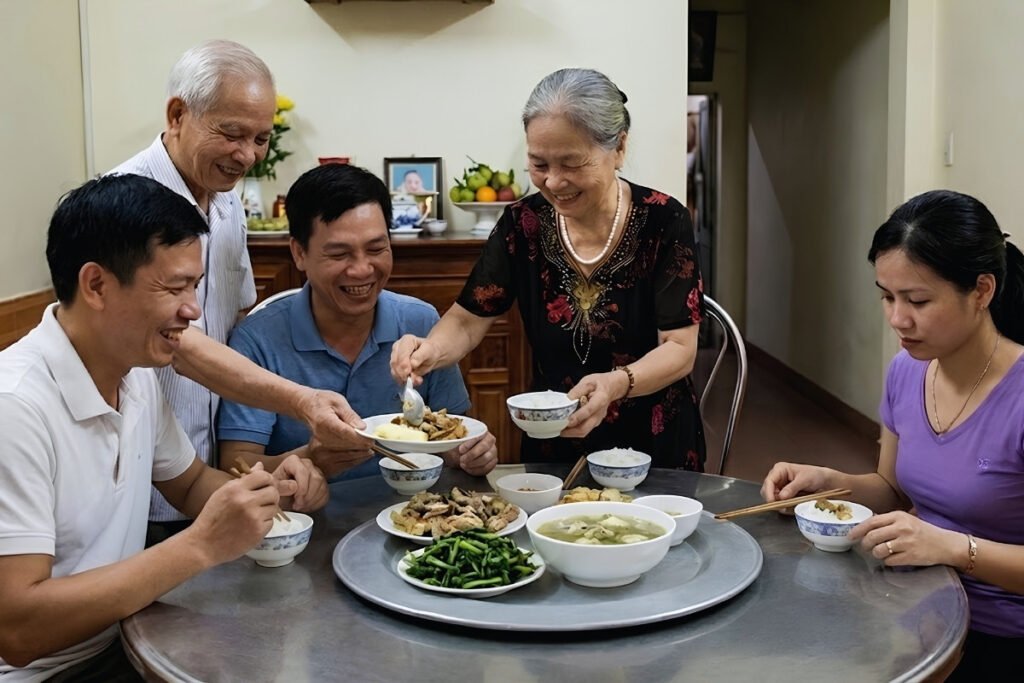
Someone cooks the rice. Someone prepares the soup. A few dishes are placed on the table. Family members gradually appear, sit down, and begin eating.
For many Vietnamese households, this ordinary routine has traditionally provided a reliable point of connection.
That matters in a society where family relationships can extend across several generations.
A child may eat with parents and grandparents.
An adult daughter may live with her parents.
A grandmother may help look after grandchildren.
Relatives may live nearby and drop in around mealtimes.
The family table therefore becomes more than a place to consume food.
It becomes a place where relationships are maintained.
You might hear someone talking about work.
A child may complain about school.
A parent may ask about tomorrow’s plans.
A grandparent may remind everyone to eat more vegetables.
Someone may mention a relative who has not arrived yet.
None of this sounds particularly remarkable.
And that’s exactly the point.
The importance of the Vietnamese family meal is often found in its ordinariness.
It creates a small, repeated ritual of connection.
In a busy world, that ritual can be surprisingly powerful.
Food Creates a Reason to Gather
There is another reason meals work so well as a family ritual: eating is universal.
You don’t need a special topic of conversation.
You don’t even need to be particularly talkative.
You can simply sit together.
For older generations especially, this can be an important part of family life.
A meal provides time to notice whether someone is tired, whether a child is eating properly, whether an elderly parent needs something, or whether a family member has had a difficult day.
Care happens in small gestures.
“Have some more.”
“Try this.”
“Eat the vegetables.”
“There’s still soup.”
“Don’t forget to eat.”
To a foreign visitor, these sentences might sound like simple comments about food.
Within a family, they can carry something more personal.
They say:
I noticed you.
I am looking after you.
You are part of this family.
That is one reason Vietnamese food culture is so closely connected to family culture.
A Vietnamese Meal Is About the People, Not Just the Food
If you have spent time in Western restaurants, you may be accustomed to thinking about a meal in terms of individual portions.
Your plate arrives.
Your food is arranged for you.
You eat what is on your plate.
Vietnamese family meals often follow a different logic.
The meal belongs to the group.
A typical home meal may include rice accompanied by several shared dishes. Vegetables, meat, fish, tofu, soup, and dipping sauces are placed in the middle of the table. Everyone has their own bowl, but the main dishes are communal.
This style of dining is one of the defining characteristics of Vietnamese food culture. Vietnam Tourism describes the Vietnamese meal as centered around shared dishes, with everyone taking food from the plates placed around the table.
That arrangement changes the social experience.
You are constantly interacting with the people around you.
Someone reaches across the table for vegetables.
Someone asks you to try a particular dish.
Someone passes the soup.
Someone serves an older family member.
Someone notices that your bowl is empty.
The meal becomes a quiet choreography of sharing.
And because the dishes are communal, eating is naturally less individualistic.
You are not simply deciding what you want to eat.
You are participating in what the table is eating.
The Shared Table Creates a Sense of “Us”
This may sound like a small distinction, but it helps explain why Vietnamese meals can feel particularly communal to visitors.
Imagine a table with five people.
There might be one plate of fish.
One bowl of vegetables.
One soup.
One plate of meat.
One dish of dipping sauce.
And a pot of rice.
Nobody owns a particular dish.
Instead, everyone takes a little.
Then a little more.
The meal develops as a shared experience.
This does not mean Vietnamese people never eat individually. Of course they do.
Vietnam has an enormous street-food culture, countless cafés, takeaway meals, convenience foods, and restaurants where people eat according to their own schedules.
But the traditional family meal represents a different idea.
The food is shared because the moment is shared.
And that distinction is useful for travelers.
When you are invited to eat in a Vietnamese home, the host is usually not simply giving you something to consume.
They are asking you to participate in the household’s rhythm.
What “Ăn Cơm” Really Means
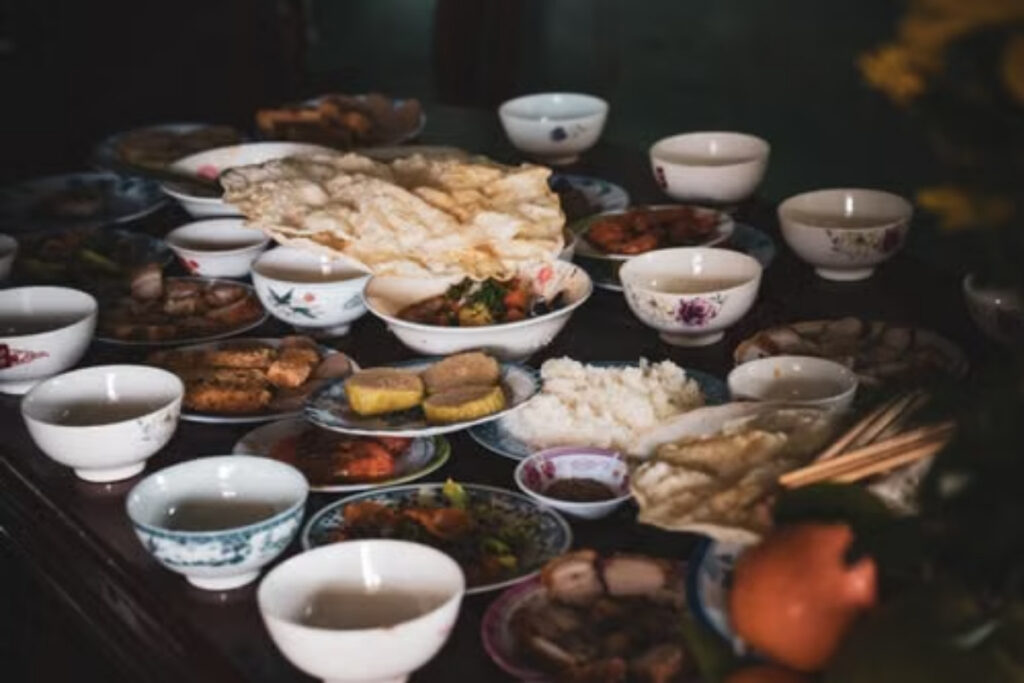
One of the most revealing Vietnamese expressions is ăn cơm.
Literally, it means “eat rice.”
But in everyday conversation, ăn cơm can refer more broadly to having a meal.
You might hear:
“Ăn cơm chưa?”
Literally:
“Have you eaten rice yet?”
But the natural meaning can be closer to:
“Have you eaten yet?”
Or, depending on the relationship and context:
“Have you had something to eat?”
And sometimes, underneath the question, there is an even simpler message:
“How are you doing?”
This is one of those cultural details that can be difficult to translate perfectly because the meaning depends on context.
Food has historically been deeply connected with everyday Vietnamese life, and rice has long been a staple of the Vietnamese diet. But cơm can also function as a broader idea of a proper home meal.
That is why the expression is so interesting for travelers.
It shows that food and everyday care are not always treated as completely separate things.
In English, asking someone “Have you eaten?” can sound like a practical question.
In Vietnamese, ăn cơm chưa? can be much more relational.
It may come from a parent checking on a child.
A friend asking another friend whether they have had lunch.
A relative greeting someone.
A host making sure a guest has been fed.
The words are simple.
The cultural meaning can be much richer.
Rice Is More Than a Side Dish
Rice also helps explain the structure of the Vietnamese family meal.
Instead of thinking of rice as just another item on the plate, Vietnamese meals traditionally organize much of the meal around rice.
A person has a small bowl of rice and uses chopsticks to take food from shared dishes.
The rice provides the foundation.
The other dishes provide variety.
There may be something salty, something fresh, something savory, something brothy, something crunchy or something aromatic.
The combination creates balance.
And because the dishes are shared, every person can adjust their meal according to what they want.
One person may take more vegetables.
Another may prefer fish.
A child may eat mostly rice and soup.
A grandparent may choose softer foods.
The table accommodates everyone.
This is one reason Vietnamese home cooking can feel less like a fixed menu and more like a conversation between different dishes.
The Family Table as a Daily Meeting Place
Think about what a modern family needs to coordinate.
Work.
School.
Traffic.
Homework.
Appointments.
Shopping.
Household responsibilities.
Messages.
Phones.
Social media.
There are countless ways for people living under the same roof to spend an entire day barely seeing one another.
The family meal creates an interruption.
For a few minutes, everyone has somewhere to be.
At the table.
This does not mean Vietnamese households are free from the pressures of modern life.
Quite the opposite.
In Vietnam’s rapidly growing cities, daily schedules can be demanding. People commute, work long hours, study late, and increasingly rely on restaurants and food delivery.
As lifestyles change, traditional family meals can become less frequent or shorter.
Yet the idea of gathering around food remains culturally powerful.
Vietnam Tourism has described the family meal as a valuable pause in contemporary life, while also acknowledging that modern lifestyles are making shared meals more difficult for some families.
That tension is important.
The Vietnamese family meal is not important because everyone follows the tradition perfectly.
It is important because people notice when the opportunity to eat together starts disappearing.
Three Generations, One Table
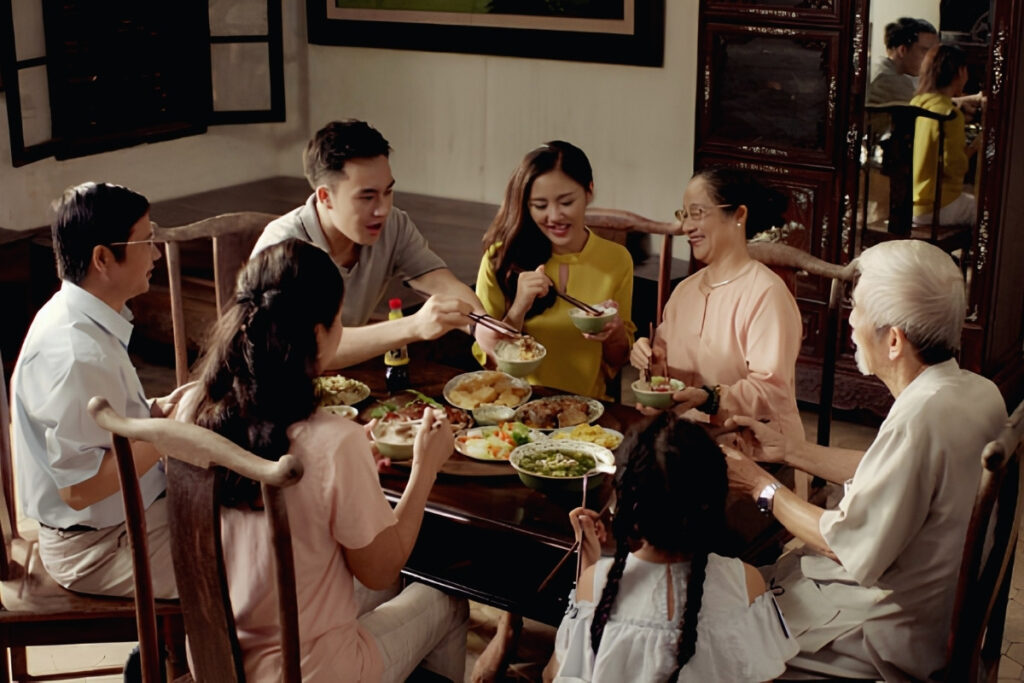
In some Vietnamese families, the dining table can bring together people from very different generations.
A grandparent may have grown up in a very different Vietnam.
The parents may have experienced the country’s rapid economic transformation.
The children may be growing up with smartphones, international entertainment, and an increasingly global lifestyle.
They may disagree about almost everything.
But they can still share the same bowl of soup.
That is one of the quiet strengths of food.
It creates common ground.
A grandmother may teach a child how to eat a particular dish.
A parent may explain where a food comes from.
A child may introduce the family to something they discovered online.
Recipes, preferences and eating habits move between generations.
So does memory.
A particular soup may remind someone of their grandmother.
A certain fish dish may be associated with family gatherings.
A simple bowl of rice may remind someone of childhood.
Food becomes a kind of informal family archive.
You don’t need to write down every memory.
Sometimes you simply taste it again.
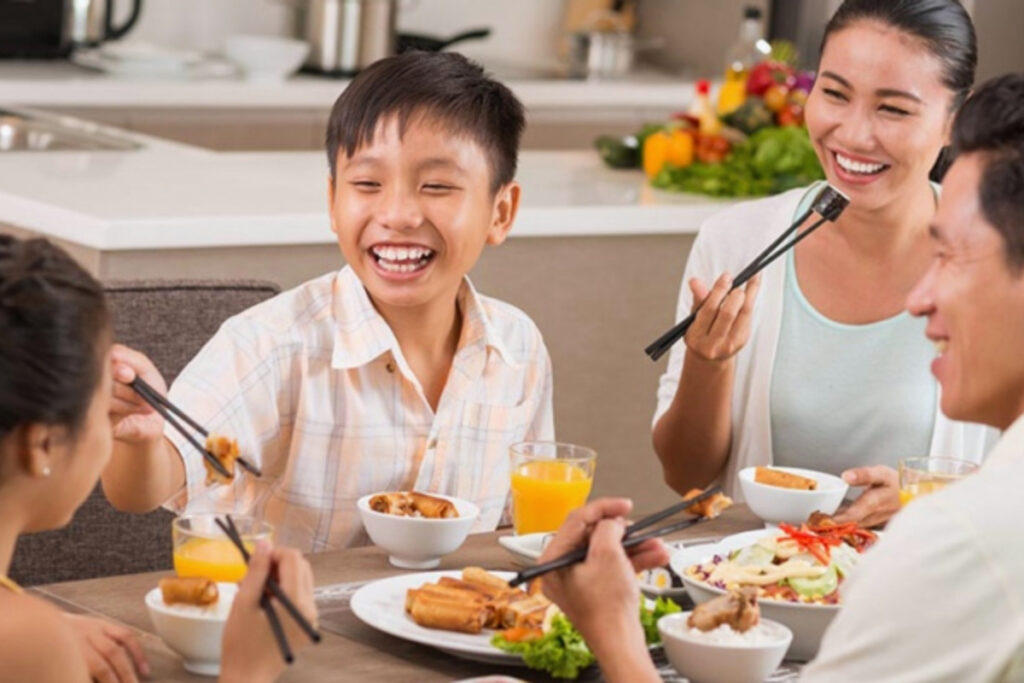
Why Sharing Food Is a Form of Caring
Perhaps the most important thing for a traveler to understand is that Vietnamese hospitality is often expressed through action.
Not necessarily through grand speeches.
Not necessarily through formal displays.
Often, it comes in the form of food.
Someone cooks for you.
Someone tells you to eat more.
Someone gives you the best piece of meat.
Someone adds vegetables to your bowl.
Someone asks whether you like the dish.
Someone brings out another plate because they are worried there isn’t enough.
These gestures can be especially noticeable when you are a foreign guest.
You may politely say:
“No, thank you. I’m full.”
And your host may respond by giving you another piece of food anyway.
Don’t immediately assume that your answer has been ignored.
In many situations, the repeated offering is part of hospitality.
Vietnam Tourism notes that Vietnamese hosts may show warmth by encouraging guests to eat, offering additional food, and even placing choice pieces of food into a guest’s bowl.
The message is often simple:
There is enough for you.
Please make yourself comfortable.
You are welcome at our table.
That is why food can function almost like a second language.
A parent may not say, “I worry about you.”
Instead:
“Eat more.”
A grandmother may not say, “I missed you.”
Instead:
“I made your favorite dish.”
A host may not say, “You are welcome in my home.”
Instead:
“Sit down. Eat with us.”
The words are ordinary.
The gesture carries the meaning.
When “Are You Full?” Means Something Else
This is also why visitors may encounter questions about whether they have eaten, whether they want more, or whether they like a particular dish.
In a strictly practical sense, these are questions about food.
In a family setting, they can also be questions about your well-being.
That does not mean every Vietnamese person is secretly communicating a profound emotional message every time they offer you dinner.
Sometimes dinner really is just dinner.
But when food is repeatedly used to express concern, hospitality and affection, it becomes difficult to separate the meal completely from the relationship.
And that is the bigger cultural lesson.
In Vietnam, caring for someone often includes making sure they are fed.
What Happens Around a Vietnamese Family Table?
Vietnamese food culture is the easiest way to notice once you stop thinking of dinner as a collection of individual dishes.
A Vietnamese family meal has its own rhythm.
Rice is served.
Shared dishes arrive.
Someone sits down.
Someone reaches for the soup.
A bowl gets refilled.
A child is reminded to eat.
An older family member is served first.
Conversation comes and goes.
Nobody necessarily announces any of this.
It simply happens.
For a first-time visitor, understanding these small details can make a Vietnamese home meal feel much more natural.
How a Typical Vietnamese Family Meal Is Served
There is no single menu that defines a Vietnamese family dinner.
What appears on the table depends on the region, season, household, budget, and whatever ingredients are available that day.
One evening might bring fish with vegetables and soup.
Another might be pork, tofu, greens, and a simple broth.
A coastal family may eat more seafood. A household in southern Vietnam may prepare dishes with flavors and ingredients that differ from those found in the north. A city family may combine traditional home cooking with supermarket ingredients, convenience foods, or dishes inspired by other cuisines.
That variety is part of what makes Vietnamese food culture interesting.
But the structure of the meal is often recognizable.
There may be:
- Steamed rice
- A savory main dish
- Vegetables
- Soup
- A dipping sauce
- Fresh herbs or other accompaniments
The dishes are generally placed where everyone can reach them.
Each person has a small bowl and chopsticks.
Then everyone begins eating.
There is no elaborate ceremony.
And that is precisely why it can feel so different from a formal Western dinner.
The meal is designed to be practical, flexible, and shared.
Rice Usually Provides the Center
For many traditional Vietnamese meals, rice is the foundation.
A pot of cooked rice may be placed on or near the table, allowing people to serve themselves.
The rice is then eaten together with the other dishes.
A bite might combine rice with fish.
Another might be rice with vegetables.
Then soup.
Then perhaps a little dipping sauce.
The combinations are flexible.
You are not necessarily expected to finish one dish before moving to another.
Instead, the meal unfolds naturally.
This also means that the same dish can taste different depending on what you eat with it.
A salty piece of fish may be balanced by plain rice.
A rich dish may be followed by vegetables.
Soup may refresh the palate.
The result is not simply a meal with several dishes.
It is a meal in which the dishes work together.
Why the Dishes Go in the Middle of the Table
One of the first things a Western traveler may notice at a Vietnamese family meal is the lack of individual main courses.
Instead of receiving a plate containing everything you are expected to eat, you may see several dishes arranged around the table.
This is the heart of family-style dining in Vietnam.
Everyone has an individual bowl.
The food is communal.
That distinction matters.
Imagine four people sitting down to dinner.
There may be one plate of vegetables.
One dish of grilled fish.
One bowl of soup.
One plate of meat.
Everyone takes a little.
Nobody has a predetermined portion of every dish.
You decide how much you want as the meal progresses.
This makes the table interactive.
You need to reach for food.
You may pass a dish to someone else.
You may ask someone to move something closer.
And if a dish is particularly good, you may notice that everyone keeps going back for another bite.
Sharing Changes the Social Experience
This style of dining also encourages awareness of the people around you.
You are not eating entirely inside your own space.
You are watching what others are doing.
Is someone trying to reach the vegetables?
Does an older person need a dish moved closer?
Is there enough soup left?
Does your guest have anything they can eat?
These tiny decisions create social interaction without requiring formal conversation.
This is one reason shared meals can feel intimate even when the food itself is very simple.
The table creates a common space.
And the food constantly moves through that space.
Rice, Soup, Vegetables, Meat and Dipping Sauce
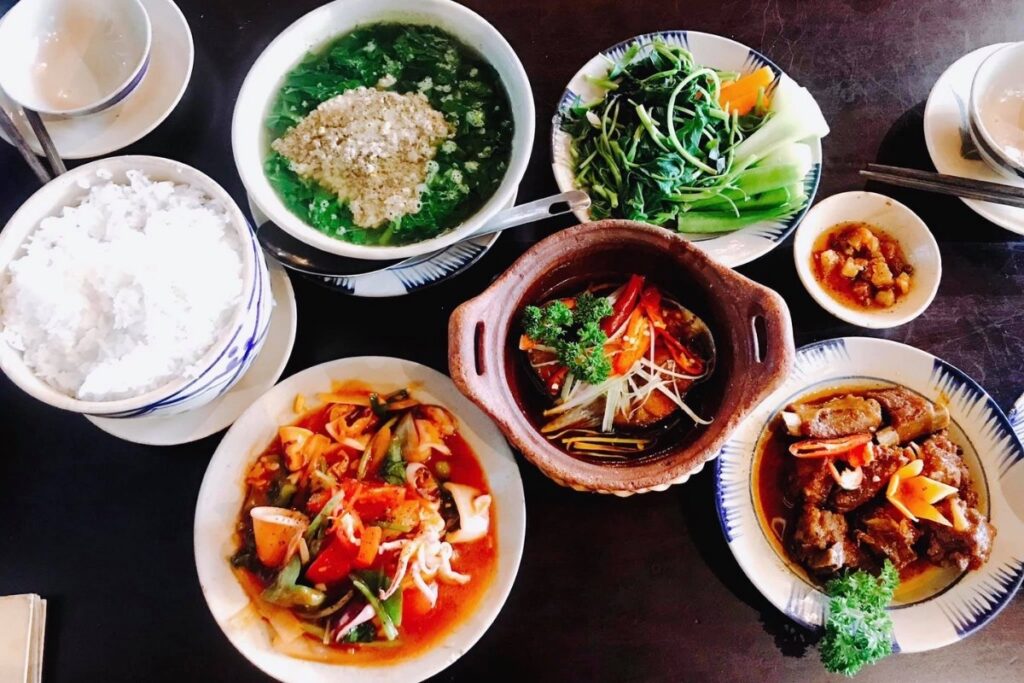
If you want to understand a Vietnamese family meal, don’t look for one signature dish.
Look at the combination.
A traditional home meal often works through balance.
Rice provides a neutral foundation.
A savory dish provides depth.
Vegetables bring freshness.
Soup adds warmth and liquid.
A dipping sauce brings saltiness, acidity, sweetness, spice, or umami, depending on what is being served.
This combination allows relatively simple ingredients to become a satisfying meal.
The Role of Soup
Soup deserves special attention.
To visitors accustomed to soup being served as an appetizer or as a separate course, Vietnamese soup can seem unusual because it may appear directly alongside rice and other dishes.
A bowl of canh — Vietnamese-style soup or broth — may contain vegetables, meat, seafood, or herbs.
It is not necessarily treated as a formal first course.
Instead, people may eat it throughout the meal.
A spoonful of soup can be eaten between bites of rice and other dishes.
It helps balance the meal and provides another texture and flavor.
This is one of those details that becomes obvious only when you sit at the table.
Vietnamese meals are often less about a strict sequence of courses and more about eating several things together.
Vegetables Are Part of the Main Event
Vegetables are not merely decorative side dishes.
Boiled greens, stir-fried vegetables, cucumber, herbs, pickled vegetables, bean sprouts, and other fresh ingredients can play an important role in balancing richer foods.
For travelers, this can be one of the easiest ways to understand the logic of Vietnamese home cooking.
A meal does not need to be heavy to feel complete.
The balance between rice, protein, vegetables, soup and condiments creates variety without requiring elaborate preparation.
Dipping Sauce Brings the Table Together
Then there is nước chấm.
There is no single recipe for Vietnamese dipping sauce.
The ingredients and proportions vary depending on the dish and region, but fish sauce is one of the best-known foundations of Vietnamese flavor.
A dipping sauce may combine fish sauce with ingredients such as lime juice, sugar, chili, garlic, or water.
It can transform a simple piece of food.
And because the sauce may be shared, it becomes another communal element of the meal.
You take a piece of food.
Dip it.
Eat.
Then reach for another dish.
It sounds simple.
But this constant interaction is part of what gives Vietnamese family meals their distinctive rhythm.
Why Vietnamese Meals Feel Different From Western Meals
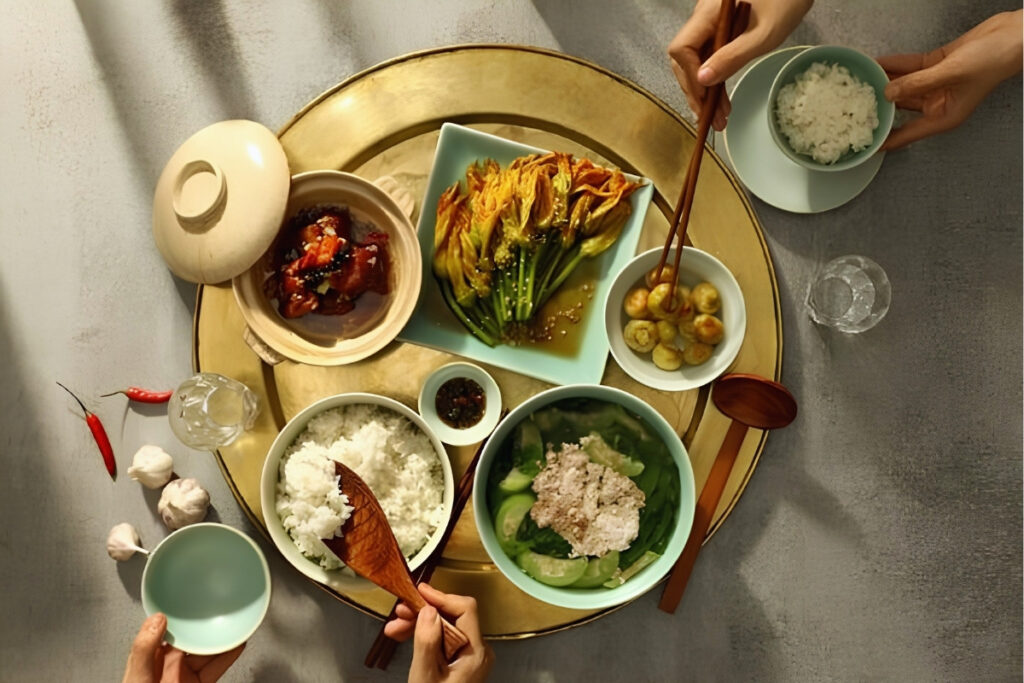
For many American travelers, the biggest adjustment is not chopsticks.
It is the concept of shared ownership of the food.
At a typical American family dinner, you might have a plate of food in front of you.
The portions are yours.
If you want more potatoes, you ask for them.
If you don’t want the salad, you leave it alone.
At a Vietnamese family table, the main dishes may remain communal throughout the meal.
That creates a different set of expectations.
You are encouraged to participate.
You take what you want.
But you also remain aware that other people are eating from the same dishes.
This does not mean there is a rigid set of rules controlling every movement.
Vietnamese families are not performing etiquette at every meal.
They are simply accustomed to sharing.
There Is No Need to Overthink It
Travelers sometimes become anxious when confronted with unfamiliar dining customs.
Should I use chopsticks?
Where should I sit?
Can I take food myself?
What if I don’t like something?
Do I have to finish everything?
The good news is that a family meal is usually not an etiquette exam.
If you are unsure, watch what everyone else does.
Follow the rhythm of the table.
If a dish is passed to you, take some.
If you are offered more, accept it if you want it.
If you are genuinely full, you can politely decline.
Most hosts will understand that a foreign guest may not be familiar with every custom.
The goal is not perfection.
The goal is participation.
Age, Respect and Seating at the Table
Vietnamese family meals can also reveal something about the importance of age and family hierarchy.
Vietnamese culture traditionally places considerable importance on showing respect toward older family members.
This can appear in small dining behaviors.
You may see younger people invite older relatives to eat first.
A younger family member may serve an older person a dish.
Someone may make sure grandparents have what they need before everyone begins eating.
Again, these practices are not necessarily formal rituals.
In many families, they happen almost automatically.
They are learned from childhood.
A child watches adults.
The child imitates them.
Eventually, the behavior becomes instinctive.
This is one way cultural values survive across generations.
You do not need a textbook explaining respect.
You see it happening at the table.
The Table Reflects Family Relationships
The dining table can therefore reveal more than food preferences.
It can show who takes care of whom.
Older people may receive attention from younger relatives.
Parents may serve children.
Children may be encouraged to share.
Guests may be given particularly generous portions.
These actions communicate relationships.
And they can vary considerably from one family to another.
A younger urban family may have a much more relaxed approach than an older rural household.
A large family gathering may follow different patterns from a casual weekday dinner.
The important point for travelers is simply to recognize that age and relationship can influence dining behavior in Vietnam.
Why Someone May Put Food Into Your Bowl
This is one of the moments most likely to surprise a foreign visitor.
You are sitting at a Vietnamese family table.
A dish arrives.
You are looking at it.
Before you decide what to take, someone places a piece directly into your bowl.
You may think:
Did I ask for that?
Probably not.
But that may not be the point.
Offering food directly can be an expression of hospitality and care.
A host may want you to try the best part of a dish.
An older family member may serve a younger person.
Someone may notice that you have not tried something and encourage you to taste it.
Vietnam Tourism identifies offering food to guests — including placing food into a guest’s bowl — as part of Vietnamese hospitality.
For Americans especially, this can initially feel more personal than expected.
In the United States, we often emphasize individual choice around food.
“Help yourself” is a common expression of hospitality.
In Vietnam, hospitality may sometimes take the opposite form:
“Let me give you some.”
Both gestures are welcoming.
They simply communicate welcome differently.
What Should You Do?
If you like the food, eat it.
A smile and a simple “cảm ơn” — thank you — are usually enough.
If you are full, allergic to something, vegetarian, or simply cannot eat a particular dish, it is perfectly reasonable to explain.
You do not need to force yourself to eat something that is unsafe or unsuitable for you.
But if there is something you genuinely want to try, accepting a small serving can be a lovely way to participate in the meal.
The important thing is to recognize the intention behind the gesture.
Someone is not necessarily trying to control what you eat.
They may simply be saying:
“I want you to have the best part.”
The Deeper Meaning Behind the Meal
By now, the Vietnamese family meal may seem familiar.
There is rice in the middle of the table. Shared dishes move from one person to another. Someone serves an older relative. A child is reminded to eat. A guest is offered another piece of food even after saying they are full.
But there is a deeper layer to all of this.
The Vietnamese family meal is not simply a tradition that survived because people like eating together.
It carries ideas about love, respect, responsibility, memory, and belonging.
And perhaps the most interesting part for a traveler is that these ideas are often expressed without anyone explaining them.
You see them in what people do.
Food as a Language of Love
In Vietnam, affection is not always expressed through direct words.
A parent may not constantly tell an adult child, “I love you.”
Instead, they may ask whether the child has eaten.
A mother may prepare food for a son who is leaving home.
A grandmother may remember exactly how someone likes their fish cooked.
A family member may save a favorite dish for someone who is arriving late.
None of these gestures is particularly dramatic.
But together, they form a language of care.
“Have You Eaten Yet?”
One of the most recognizable examples is the Vietnamese expression:
“Ăn cơm chưa?”
Literally, it means:
“Have you eaten rice yet?”
To a traveler, it may initially sound like a practical question about hunger.
But in many everyday situations, it can function as something warmer.
It can be a greeting.
A way to check on someone.
A way to show concern.
Or simply a way to start a conversation.
The important point is not that every Vietnamese person secretly means something profound whenever they ask whether you have eaten.
Context matters.
But the expression illustrates a broader cultural pattern: food can become a natural way of expressing concern for another person.
That is why a parent may ask about lunch before asking about work.
It is why a grandmother may worry that a grandchild has eaten too little.
And it is why someone who is living far from home may receive a package of homemade food from their family.
Food travels where affection travels.
Grandparents, Parents and Children at the Same Table
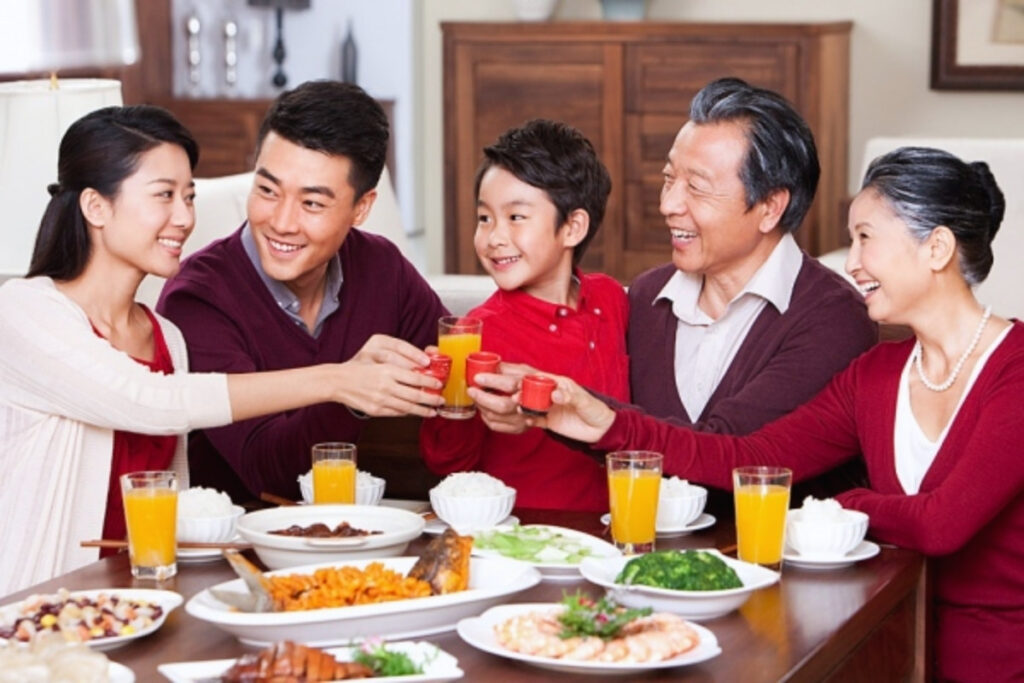
One of the most meaningful aspects of Vietnamese family meals is the possibility of bringing different generations together.
Vietnam has traditionally placed strong importance on family relationships, and multigenerational households remain part of Vietnamese social life, although living arrangements vary widely today.
When several generations share a home, the dining table becomes one of the places where those relationships are naturally reinforced.
A grandparent may sit beside a grandchild.
Parents may serve children.
Children may learn how to behave by observing older relatives.
Stories can appear naturally during meals.
So can family history.
A dish may remind an older person of their childhood.
A recipe may have been passed from a grandmother to a daughter.
A child may grow up associating a particular soup or dessert with a family member.
The meal therefore becomes a quiet bridge between generations.
Children Learn Culture Without Realizing It
This is particularly important.
Culture is not transmitted only through formal lessons.
Children learn by watching.
They watch who is served first.
They learn how to hold chopsticks.
They learn how to share food.
They hear relatives talking.
They discover which dishes their family considers special.
They learn that guests should be welcomed.
They learn that older relatives deserve respect.
They learn when to offer food to someone else.
Nobody needs to stand up and give a lecture titled “Today We Are Learning Vietnamese Family Values.”
The lesson is built into everyday life.
That is one reason ordinary meals can be culturally powerful.
They turn abstract values into repeated behavior.
Vietnamese Family Meals and Ideas About Respect
Respect in Vietnamese culture can be expressed through language, behavior, family roles, and everyday interaction.
The dining table is one place where these relationships become visible.
Age can matter.
Relationship can matter.
Who is a guest can matter.
Who is hosting can matter.
A younger person may show consideration toward an older relative by offering food or making sure they have what they need.
A host may pay particular attention to a guest.
Children may be encouraged to wait for older family members before beginning.
These practices are not universal rules followed identically by every household.
Modern Vietnamese families can be much more relaxed.
But the underlying idea remains recognizable:
The meal is a shared social space, and people pay attention to one another within it.
That is different from treating dinner as a purely individual activity.
Respect Is Often Practical
One interesting thing about Vietnamese hospitality is how practical it can be.
Respect does not always look formal.
It can look like:
“Here, try this.”
“Let me get you some more.”
“Take this piece.”
“There’s still soup.”
“Eat some vegetables.”
“Don’t eat too little.”
To an outsider, these comments may sound repetitive.
Inside the family, they can be perfectly ordinary.
And that ordinariness is important.
Respect is not something reserved for ceremonies.
It can be practiced over dinner.
Why “Have You Eaten Yet?” Can Mean “How Are You?”
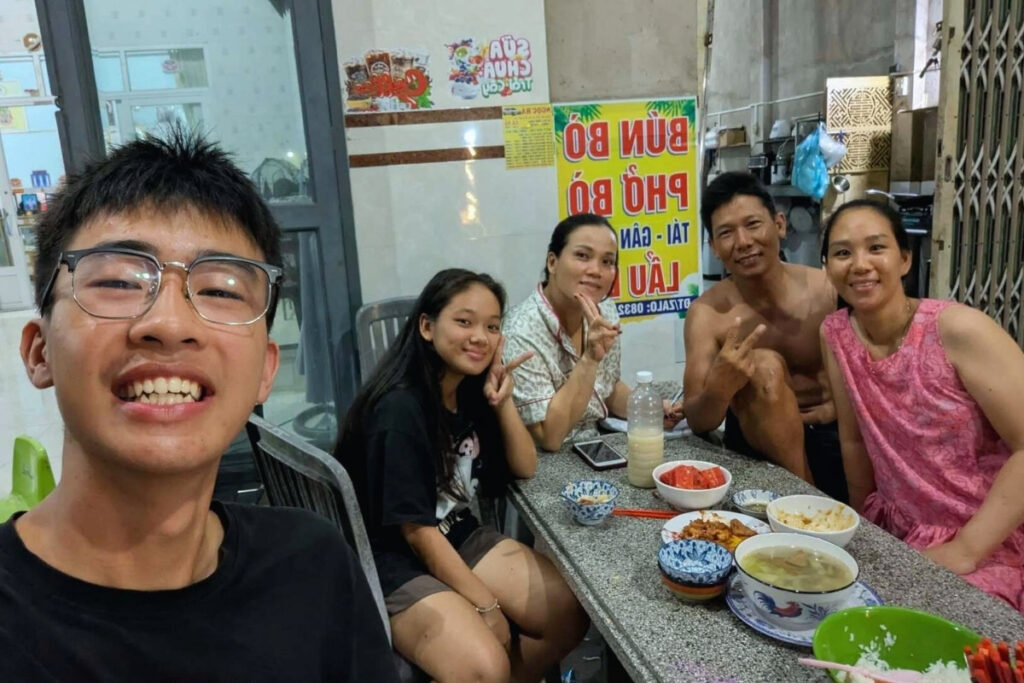
There are few phrases that better capture the relationship between food and everyday care in Vietnam than:
“Ăn cơm chưa?”
If translated word-for-word, the expression seems simple.
But language does not work word-for-word all the time.
Imagine a Vietnamese relative calling someone in the evening.
“Have you eaten yet?”
The real conversation may quickly move somewhere else.
How was work?
Are you tired?
When are you coming home?
How are the children?
What are you doing tomorrow?
The question about food becomes the doorway into the relationship.
This is why travelers sometimes find Vietnamese conversations about eating surprisingly frequent.
You may be asked what you have eaten.
You may be asked whether you are hungry.
You may be offered food shortly after arriving somewhere.
You may be encouraged to eat before doing something else.
Food is an easy way to establish connection.
It is practical, familiar, and universal.
Everyone needs to eat.
So asking about food becomes a natural way to ask about the person.
It Is Not Just About Rice
The expression also helps explain why translating Vietnamese literally can sometimes miss the cultural meaning.
Ăn cơm literally references rice.
But rice can stand for a meal.
And the meal can stand for everyday life.
So the question can carry more emotional weight than its English translation suggests.
For travelers, this is a useful reminder:
Vietnamese culture often communicates meaning through context and action, not just through literal words.
Food, Memory and the Idea of Home
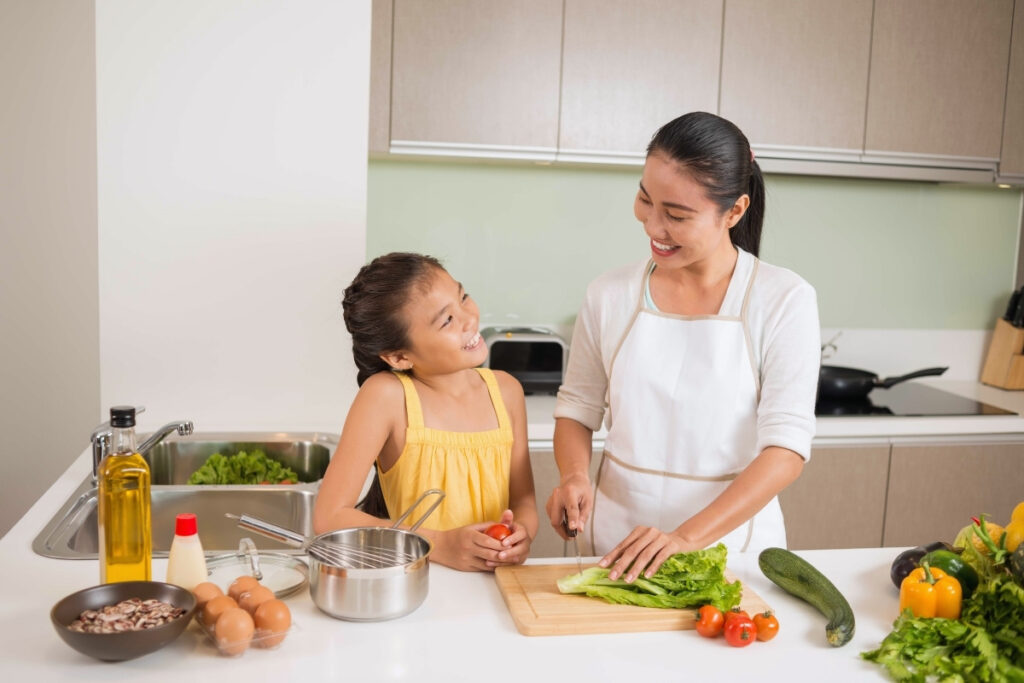
Ask someone what reminds them of home, and the answer is often not a building.
It may be a smell.
A sound.
A particular dish.
For Vietnamese people living away from their hometown — or abroad — food can become a powerful connection to where they came from.
A bowl of canh.
A plate of fried fish.
A particular style of braised pork.
A family recipe.
A dipping sauce made in a very specific way.
These foods can carry memories that are difficult to explain.
Maybe it is the dish a grandmother used to make.
Maybe it is the meal eaten after school.
Maybe it is something the family prepared during Tết.
Maybe it is the food waiting on the table when someone returned home after living away for months.
The recipe itself may be simple.
The memory is not.
The Taste of Childhood
This is one reason Vietnamese food culture is deeply personal.
Two people can eat the same dish and have completely different reactions.
For one traveler, a bowl of soup may be an interesting introduction to Vietnamese cuisine.
For someone else, that same soup may taste like childhood.
It may remind them of a particular kitchen.
A particular person.
A particular period of life.
Food can preserve these memories because taste and smell are closely tied to experience.
And family meals provide the setting where those memories are created in the first place.
This is why the question “What is authentic Vietnamese food?” can be more complicated than it sounds.
Authenticity is not always about following a fixed recipe.
Sometimes it is about whether a dish still tastes like home to the person eating it.
What Happens When Modern Life Changes the Family Meal?
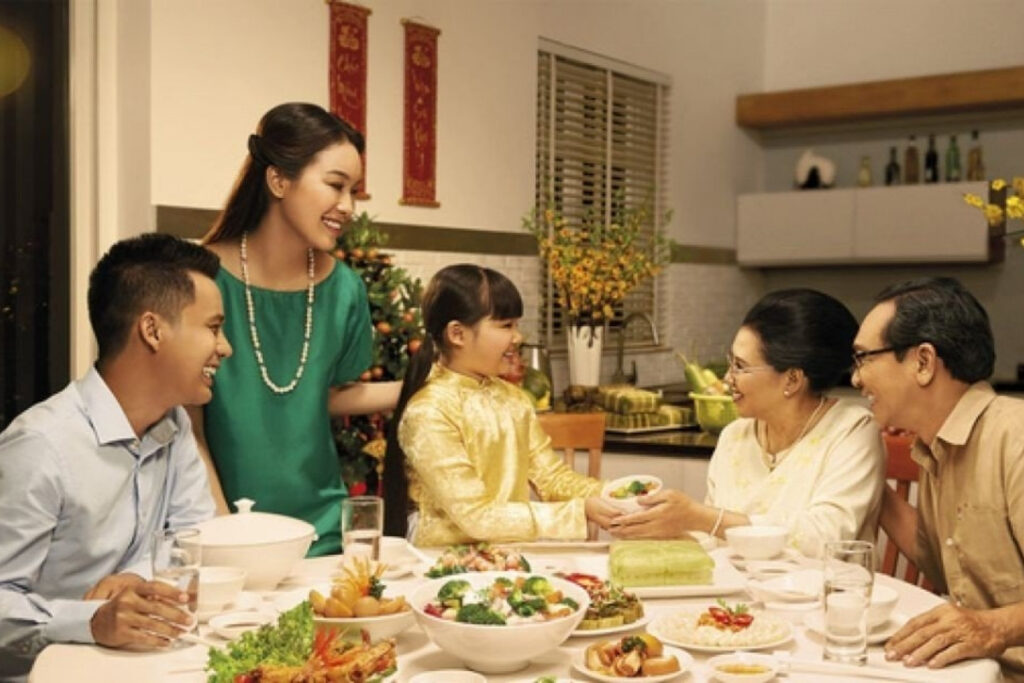
The traditional Vietnamese family meal is important.
But Vietnam is not frozen in time.
The country has changed dramatically over recent decades.
Cities have grown.
Commuting times have increased.
Work patterns have changed.
Young people spend more time away from their hometowns.
Food delivery has become increasingly convenient.
Families use smartphones at the table.
Children have busy school schedules.
Adults may return home at different times.
All of this makes eating together every day more difficult.
And Vietnam is not unique in this respect.
The same pressures affect families in the United States, Europe, and many other parts of the world.
The interesting question is what happens to a cultural tradition when the circumstances that created it begin to change.
The Family Meal Is Adapting
For some Vietnamese families, dinner may now mean ordering several dishes through an app and eating them together at home.
For others, it may mean meeting at a restaurant.
Some families may eat together only on weekends.
Others may prioritize family meals during holidays and special occasions.
The format changes.
The underlying idea can remain.
We should still make time to eat together.
That is why the family meal should not be understood as a rigid set of rules.
It is better understood as a cultural value that continues to adapt.
A family does not become less Vietnamese simply because dinner came from a delivery app.
If everyone still gathers around the same table, shares the food, talks, laughs, argues, and checks on one another, much of the social meaning remains.
Experiencing Vietnamese Family Meal Culture as a Traveler
Understanding why Vietnamese families eat together is one thing.
Actually sitting down at a Vietnamese family table is another.
For travelers, this is where the cultural ideas discussed above become real. The shared dishes, the small bowls, the offers of extra food, and the interaction between generations are no longer things you are reading about. They are happening around you.
The good news is that you do not need to master Vietnamese dining etiquette before accepting an invitation.
A little awareness goes a long way.
What It Means If a Vietnamese Family Invites You to Eat
If someone you know in Vietnam invites you to their home for a meal, it is usually best understood as a gesture of hospitality and personal connection, rather than a formal cultural ceremony.
The food may be simple.
It might be rice, vegetables, soup, fish, meat, or whatever the family happens to be eating that evening.
That is not the point.
You are being invited to share part of the family’s everyday life.
For a traveler, this can be more revealing than eating at a restaurant designed specifically for visitors. You get to see how people actually eat at home, how dishes are shared, how family members interact, and how conversation flows naturally around the table.
If you are comfortable accepting the invitation, do so with an open mind.
You do not need to arrive knowing exactly what will happen.
The invitation itself is part of the experience.
Vietnamese Dining Etiquette Travelers Should Know
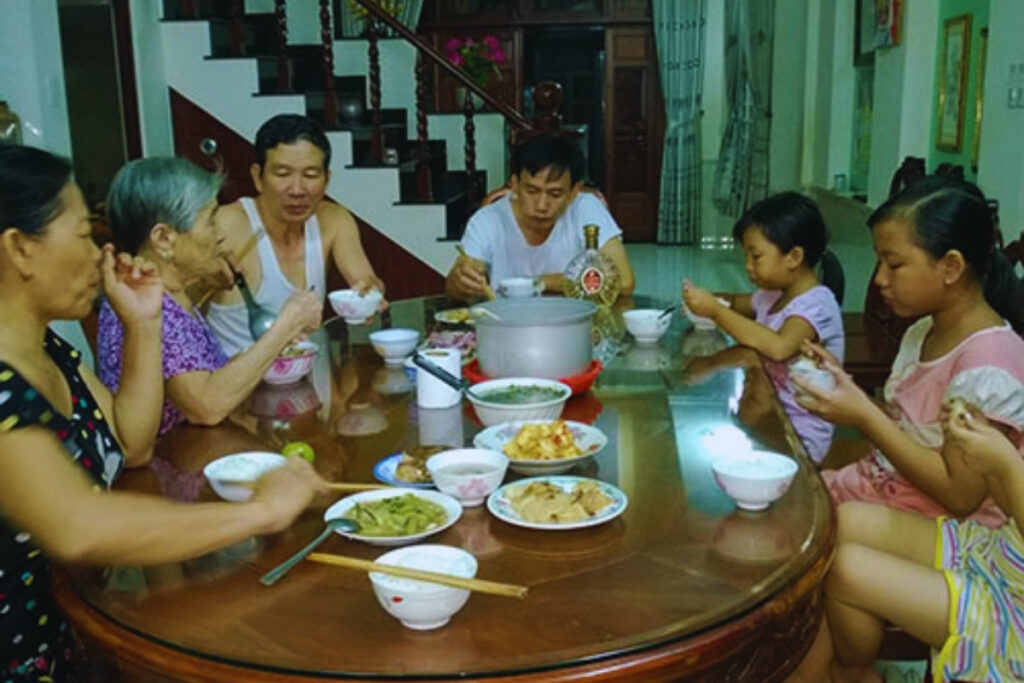
There is no single rulebook that applies to every Vietnamese family.
Dining habits can differ by region, age, household, and social setting. A casual meal with young friends in Ho Chi Minh City may feel very different from a large family gathering with grandparents in the countryside.
Still, a few simple habits can help you feel comfortable.
Watch What Others Do
This is probably the most useful rule for a first-time visitor.
If you are unsure when to begin eating, watch the people around you.
Notice how they take food from the shared dishes. See whether someone serves an older family member. Follow the general rhythm of the table rather than worrying about every individual movement.
When in doubt, observe first.
Use Your Own Bowl
At a typical Vietnamese family meal, each person generally has their own small bowl and chopsticks, while the main dishes remain in the center of the table.
Take a reasonable amount from the shared dishes and bring it to your bowl.
If you are not comfortable using chopsticks, don’t worry. Most hosts will understand that you are a visitor and may even help you.
Share Rather Than Build a Private Plate
One of the biggest differences for many American travelers is that Vietnamese family meals are not usually organized around one large personal plate.
Instead, take a little from the shared dishes.
You can always have more later.
This keeps the meal communal and leaves enough food for everyone.
It also means you can try several dishes without committing to a large serving of something unfamiliar.
Pay Attention to Older Family Members
If grandparents or other older relatives are at the table, notice how the family interacts with them.
You may see younger people serve them food, pass dishes, or make sure they can easily reach what they want.
You do not need to imitate every detail.
Simply showing awareness and courtesy is enough.
The goal is not to perform Vietnamese etiquette perfectly.
It is to show that you respect the people sharing the table with you.
What to Do When Someone Offers You More Food
This is one of the moments that can surprise first-time visitors.
You have finished eating.
Your host offers you another piece of meat.
You say you’re full.
A few minutes later, another dish is offered.
What should you do?
Usually, nothing complicated.
If you want more, accept it.
If you are full, politely decline.
A simple:
“Cảm ơn, tôi no rồi.”
means:
“Thank you, I’m full.”
You can also smile and gently indicate that you have had enough.
Repeated offers of food are often part of Vietnamese hospitality. A host may simply want to make sure a guest is comfortable and has eaten well.
At the same time, you are not expected to eat beyond your limits.
If you have an allergy, dietary restriction, or simply cannot eat a particular ingredient, say so clearly.
Hospitality should never require you to ignore your own needs.
Should You Bring Something to a Vietnamese Home?
If you are invited to someone’s home, bringing a small gift can be a thoughtful gesture, although it is not necessarily required.
Fruit is an easy and natural choice.
Flowers may also be appropriate depending on the occasion.
If you are visiting from another country, a small specialty from your hometown can be especially meaningful because it gives your host something to discover about you in return.
The gift does not need to be expensive.
What matters is the gesture of appreciation.
You were invited to someone’s home.
You bring something small.
Everyone sits down together.
The exchange becomes part of the hospitality itself.
How to Enjoy a Vietnamese Family Meal Without Overthinking It
The easiest way to make a Vietnamese family meal enjoyable is to treat it as an experience rather than a test.
Be Curious
If you don’t recognize a dish, ask what it is.
Ask how people usually eat it.
Ask whether something is spicy.
Food naturally creates conversation, so your curiosity can actually make the meal more enjoyable.
Try Something New
If there is something unfamiliar that you can safely eat, give it a try.
You don’t need to love every dish.
The point is to experience something outside your usual routine and show that you are open to the food being shared with you.
Eat Slowly
Vietnamese family meals are often social rather than rushed.
There may be several dishes on the table, conversations between bites, and people returning to the same dishes throughout the meal.
Take your time.
You do not need to finish everything quickly.
Say Thank You
A simple “Cảm ơn” — thank you — is enough.
If you genuinely enjoy something, you can also say:
“Ngon quá!”
— “So delicious!”
A sincere compliment about the food is an easy way to show appreciation to your host.
Most importantly, don’t worry if you make a small mistake.
You are a guest from another culture.
People generally understand that you may not know every local custom.
Be respectful, pay attention, and enjoy the moment.
A Simple Meal Can Become a Lasting Vietnam Memory
Travelers often remember the major sights first.
The limestone islands of Ha Long Bay.
The old streets of Hoi An.
The energy of Hanoi.
The beaches of central Vietnam.
The markets, temples, and famous dishes.
But some of the memories that last longest are much less spectacular.
A family inviting you to sit down.
A grandmother insisting that you try something she cooked.
A host quietly adding another piece of food to your bowl.
A conversation that continues long after everyone has finished eating.
These moments are difficult to plan because they are not attractions.
They are simply everyday life.
And that is what makes them valuable.
When you share a Vietnamese family meal, you are not just learning what people eat.
You are seeing how food fits into relationships, hospitality, memory, and daily life.
You may forget the exact dishes that were on the table.
You may even forget how many bowls of rice you ate.
But you are much more likely to remember being welcomed to the table.
For a traveler, that can be one of the most meaningful ways to experience Vietnam — not as a place you simply visited, but as a place where, for one evening, someone made room for you in their everyday life.
FAQ — Vietnamese Family Meal Culture
Why do Vietnamese families eat together?
Vietnamese families traditionally eat together because shared meals provide an opportunity to maintain family relationships, show care and respect, and spend time together. Family-style dining also makes food a communal experience rather than a collection of individual portions.
What is a typical Vietnamese family meal?
A typical Vietnamese home meal may include steamed rice, a savory meat or fish dish, vegetables, soup, and dipping sauce. The exact dishes vary by region, season, household and available ingredients.
Do Vietnamese people eat family-style?
Yes. Traditional Vietnamese home meals are commonly served family-style, with shared dishes placed in the center of the table. Each person usually has their own bowl and chopsticks while sharing the main dishes.
Why do Vietnamese people share food?
Sharing food is both practical and social. It allows everyone to enjoy several dishes and can also express hospitality, generosity and care for other people at the table.
What should I do if a Vietnamese family invites me to dinner?
Accept the invitation if you are comfortable, arrive with a small gift if appropriate, observe how the family eats, try some of the food if you can, and thank your hosts. You do not need to know every Vietnamese dining custom beforehand.
Is it rude to refuse food in Vietnam?
No. You can politely refuse food, particularly if you are full or have allergies or dietary restrictions. However, Vietnamese hosts may offer food several times as a sign of hospitality, so a friendly explanation can help avoid confusion.
Conclusion — More Than a Meal
Why do Vietnamese families eat together?
Because a shared meal creates something that busy life can easily take away: time together.
The food may be simple — rice, soup, vegetables, fish, or meat — but the meaning goes beyond what is on the table. Family members check on one another, share stories, care for older relatives, teach children, and welcome guests.
For travelers, this is one of the easiest ways to see Vietnamese culture in everyday life.
You do not need to know every dining rule. Just sit down, pay attention, try what you can, and enjoy the moment.
Because in Vietnam, a meal is often about more than eating.
It is a way of being together.
Continue Exploring Vietnam
A Vietnamese family meal is only one small part of a much larger cultural story.
If you want to understand Vietnam beyond famous landmarks and tourist attractions, explore more Vietnam Insights from Tam Voc Viet — stories about everyday life, local perspectives, food culture, traditions, and the experiences that shape modern Vietnam.
Recommended next reads:
- Vietnamese Family Culture — Discover how family relationships shape everyday life, traditions and social expectations.
- Vietnamese Markets & Bargaining Culture — Learn how local markets work and why bargaining is part of the experience.
- Vietnamese Etiquette — Understand the small social customs that can make interactions with locals easier and more respectful.
- Why Are There So Many Motorbikes in Vietnam? — Explore the history, practicality and social role of Vietnam’s motorcycle culture.
- 15 Things That Surprise First-Time Visitors to Vietnam
- Common Culture Shocks in Vietnam: 15 Things First-Time Visitors Should Know
- Why Is Coffee So Important in Vietnam?
- Why Do Vietnamese Wake Up So Early?
- The Story Behind Vietnam’s Street Food Culture
- What It’s Really Like to Celebrate Tet in Vietnam
- Vietnamese Work Culture Explained
- What Foreigners Love Most About Living in Vietnam
- Living in Vietnam: The Complete Guide for Foreigners
Together, these Vietnam Insights offer a closer look at the everyday experiences, perspectives, and cultural details that can be easy to miss on a first trip.
A Note for Travelers
You don’t need to understand every Vietnamese dining custom before sitting down for a meal.
In fact, trying to understand everything in advance can sometimes take away from the experience.
If you are invited to share a meal with a Vietnamese family, start with something simple: observe, participate, and pay attention to the people around you.
Notice how the dishes are shared. Watch how family members serve one another. Listen to the conversation between generations. If someone offers you food, understand that it may be a gesture of hospitality and care rather than simply an offer of another serving.
You may notice customs that are different from what you are used to. Food may be placed in the center of the table rather than served as individual portions. Someone may encourage you to eat more. An older family member may be served before younger people. A host may place a piece of food directly into your bowl.
You don’t have to get every detail right.
If you are unsure, simply follow the rhythm of the table. If you have dietary restrictions or cannot eat something, explain politely. And if you make a small cultural mistake, don’t worry too much.
Be curious, be respectful, and let the people at the table guide you.
The most meaningful part of a Vietnamese family meal is rarely perfect etiquette.
It is the opportunity to share time, food, conversation, and a little piece of everyday life with other people.
That is often the best way to understand why eating together remains such an important part of Vietnamese family culture.
Sources & Further Reading
This article draws on information about Vietnamese family life, food culture, hospitality, shared meals, and everyday social practices. Because family traditions and dining habits can vary by region, generation, household, and individual preference, the examples in this guide should be understood as cultural context rather than rules that apply to every Vietnamese family.
For current travel information, including transportation, attractions, opening hours, regulations, and other practical details, always check official sources before your trip.
Suggested sources:
- Vietnam National Authority of Tourism / Vietnam Tourism – Official information about Vietnam’s destinations, culture, traditions, food, and travel experiences.
- Vietnamese Museum of Ethnology – Background on Vietnamese communities, cultural traditions, family life, and everyday practices.
- Voice of Vietnam (VOV5) – Articles and cultural features covering Vietnamese society, family life, traditions, and contemporary life.
- Vietnam Government Portal – Legal Documents – Official government information and legal documents for current regulations and public administration.
Editorial note: Vietnamese family and dining culture continues to evolve. Traditional home-cooked meals, multigenerational family gatherings, casual weekday dinners, restaurant meals, and food delivery can all be part of contemporary Vietnamese life. Practices may differ significantly between regions, generations, and individual households. Tam Voc Viet presents these examples as cultural context to help international travelers understand Vietnam, not as universal rules about how Vietnamese people must behave.
About the Author
Tam Voc Viet Editorial Team
The Tam Voc Viet Editorial Team creates travel and cultural guides for international readers who want to understand Vietnam beyond its most famous destinations.
Our content explores Vietnam through its history, culture, food, traditions, people, and everyday life, with a particular focus on the context that helps international travelers experience the country more thoughtfully.
For cultural and travel topics, we consult official Vietnamese sources, established cultural institutions, research materials, and relevant travel resources where appropriate. We aim to explain Vietnamese traditions in a clear and accessible way while recognizing that Vietnam is not culturally uniform and that everyday experiences can differ across regions and generations.
Our goal is simple:
To help international visitors experience Vietnam with more context, curiosity, and confidence.
Article Information
Category: Vietnam Insights
Topic: Vietnamese Family Culture & Dining Traditions
Published: August 2026
Last Updated: August 2026
Author: Tam Voc Viet Editorial Team
