


 Tiếng Việt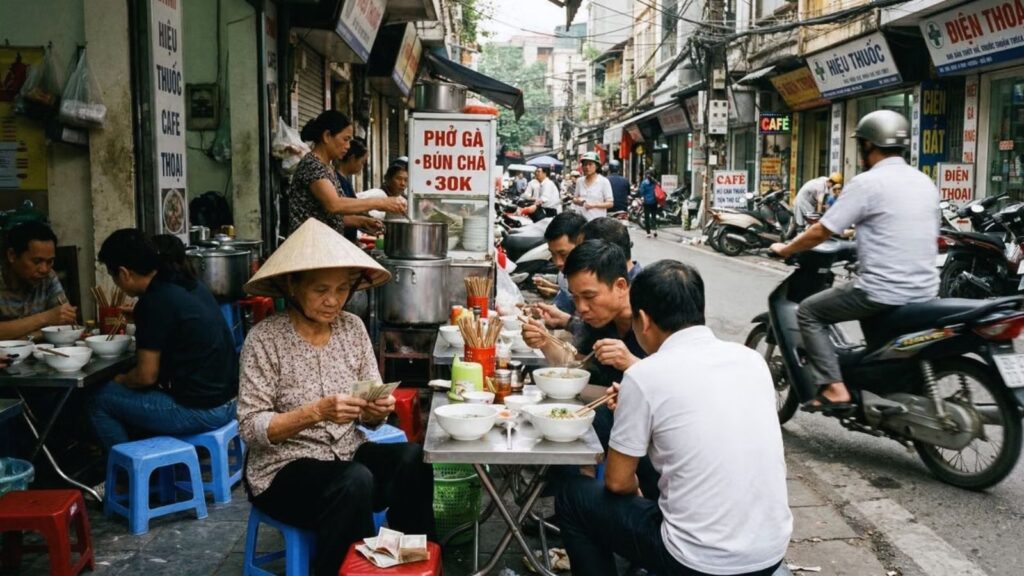
In Vietnam, some of the most revealing meals happen in places you might walk past without noticing.
A pot of broth steaming beside a busy road. A woman slicing herbs behind a tiny counter. A bánh mì cart with a line of customers that seems to move almost as quickly as the traffic. A row of plastic stools filling a patch of sidewalk just before the morning rush begins.
Nothing about the scene looks particularly formal.
And that is the point.
Vietnamese street food culture is woven into ordinary life. For generations, people have eaten breakfast on the way to work, stopped for lunch near their shops, grabbed snacks in the afternoon, and met friends over food in the evening. The street is not merely where the food happens to be sold. It is part of the setting in which everyday life unfolds.
That is what makes Vietnam’s street food culture so much more interesting than a list of dishes to try.
A bowl of phở can tell a story about regional traditions and changing cities. Bánh mì carries the trace of a French colonial ingredient but became something unmistakably Vietnamese. A dish from Hue tastes different from one in Hanoi or Ho Chi Minh City because food, like language and landscape, carries the character of the place where it develops.
And behind almost every dish is another story: markets supplying fresh ingredients, families passing down techniques, vendors building relationships with regular customers, and generations of cooks adapting old traditions to new circumstances.
For travelers, that makes street food one of the most accessible ways to see Vietnam beyond its major attractions.
You do not need a reservation.
You do not need to understand every dish on the menu.
Sometimes, you simply need to find an open stall, pull up a plastic stool, and see what the neighborhood is eating.
Because the story of Vietnamese street food is ultimately not just about what is in the bowl.
It is about the people, history, places, and everyday habits that brought the bowl to you.
Quick Answer
Vietnamese street food culture is an everyday way of eating shaped by local markets, regional traditions, small neighborhood vendors, and changing urban life. Food is often prepared close to where people live and work, making meals convenient, affordable, and deeply connected to daily routines.
What makes the culture distinctive is not only the food itself. Markets supply fresh ingredients, vendors preserve and adapt recipes, and customers turn small stalls into informal social spaces. Centuries of cultural exchange, migration, and economic change have also shaped what people eat today.
For travelers, Vietnamese street food offers more than something to taste. It is a way to see how food fits into Vietnamese life.
Table of Contents
1. Street Food Was Built Around Everyday Life
Vietnamese street food did not begin as something people sought out for a special experience.
It grew around ordinary routines.
Before the city is fully awake, a noodle vendor may already be serving the first customers of the day. A shopkeeper grabs breakfast before opening the doors. Office workers stop for a quick bowl on the way to work. Later, the same streets fill with lunch stalls, snack vendors, coffee shops, and small places where friends meet at the end of the day.
Food follows the rhythm of the neighborhood.
That is one of the easiest things for a traveler to notice once you stop looking at street food simply as something to eat.
In Vietnam, a meal does not always require a restaurant.
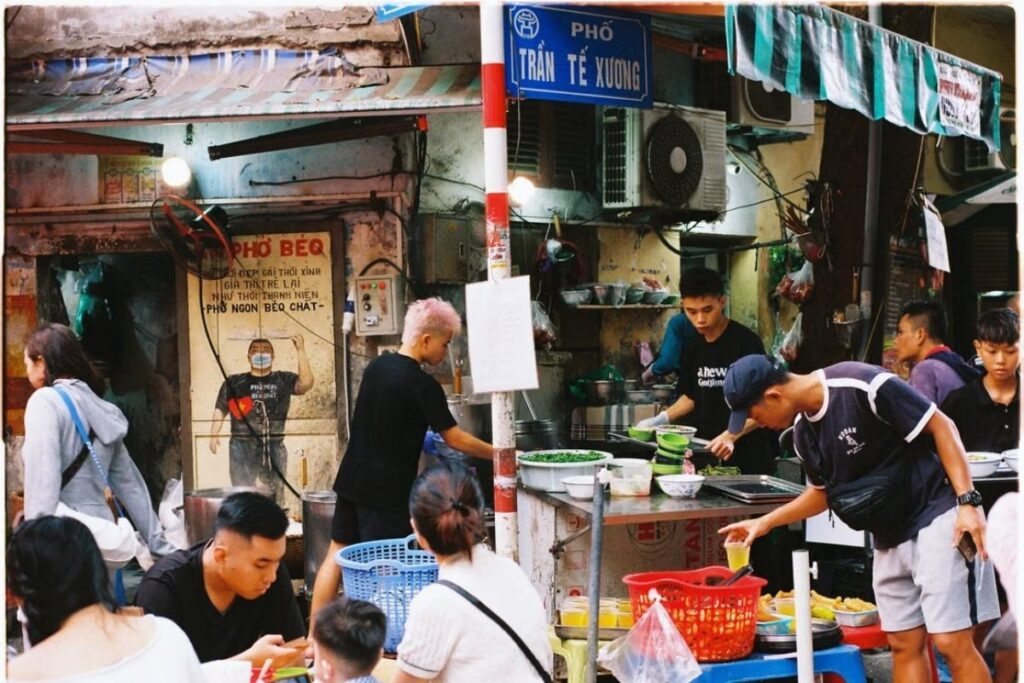
A vendor might work from a narrow storefront, a small cart, or a few square meters of sidewalk. There may be only a handful of dishes on the menu. Customers sit on low plastic stools, eat, pay, and continue with their day.
The arrangement is remarkably practical.
The food is close to where people live and work. The menu is often focused. Preparation is organized around speed and repetition. A vendor can serve a large number of customers without the space, staff, or formal setting required by a conventional restaurant.
That helps explain why street food became so deeply embedded in urban life.
It fits the way people move through the city.
A bowl of phở before work is not necessarily an occasion. Neither is a bánh mì picked up on the way somewhere else. These meals are part of the day itself.
For travelers, that difference matters.
A restaurant can show you what Vietnamese food tastes like.
A street stall can show you where that food belongs in everyday life.
Look closely and the meal becomes a small piece of social information. You can see whether people are eating alone or with others, whether a dish is mainly associated with breakfast or later in the day, how quickly customers come and go, and which foods appear again and again on the tables around you.
These details are easy to overlook because nothing about them feels extraordinary to the people living there.
For a visitor, however, they can reveal something important: street food is not simply a culinary attraction. It is part of how neighborhoods function.
The food becomes a way of reading the city.
And once you begin to see it that way, the sidewalk no longer looks like a backdrop to the meal.
It is part of the meal.
2. Behind Every Stall Is a Market
The bowl in front of you is only the final step in a much larger food system.
Before a vendor serves breakfast, someone has already been working in the market.
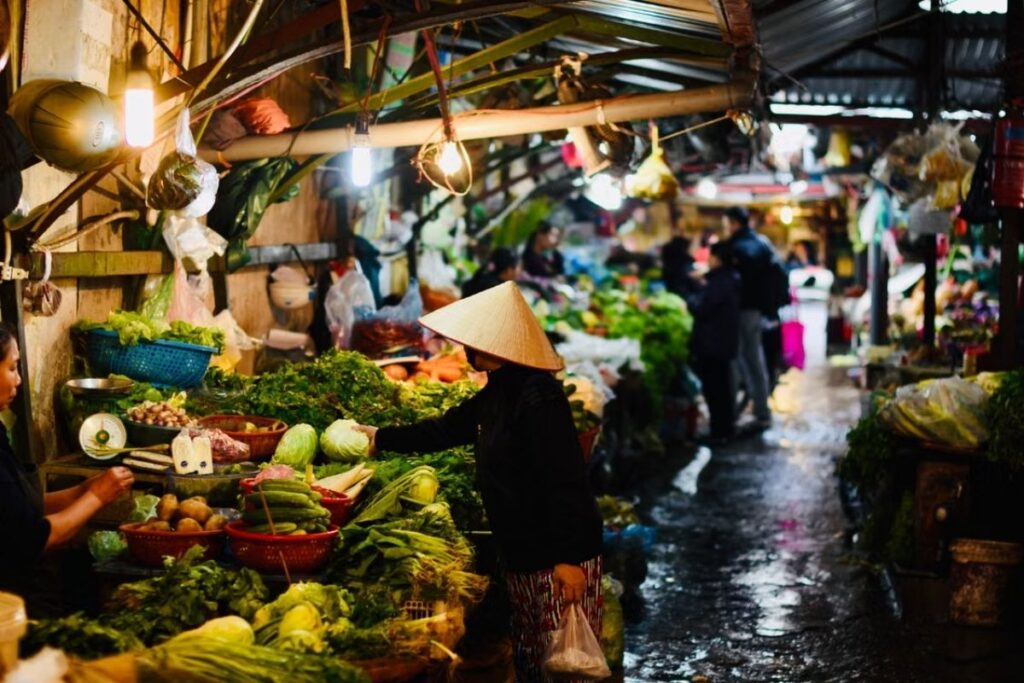
Vietnamese markets are places where vegetables, herbs, meat, seafood, noodles, fruit, spices, and other ingredients move through the neighborhood every day. Vendors buy what they need, ingredients are sorted and prepared, and food eventually finds its way into kitchens and street stalls.
Much of this happens early.
By the time a traveler sits down for a morning bowl of noodles, the less visible work may already be well underway.
Herbs have been washed.
Meat has been prepared.
Sauces have been mixed.
Broth may have been simmering for hours.
The customer sees a few minutes of cooking.
The vendor is managing an entire chain of preparation behind those few minutes.
This close relationship with local markets helps explain another characteristic of Vietnamese street food: the importance of fresh ingredients.
Herbs and vegetables are not simply added at the end to make a dish look attractive. They can provide aroma, texture, freshness, and contrast. Fish sauce, lime, chili, garlic, and other seasonings help build layers of flavor around the main ingredients.
The system is simple, but it is not careless.
A small stall does not necessarily need a large storage room or an elaborate kitchen. Ingredients can be sourced through local networks and prepared in quantities suited to the day’s demand.
That efficiency is part of what makes street food work.
It also makes markets important to the cultural story.
A market is where the ingredients behind everyday Vietnamese meals become visible. It is where food is bought before it becomes breakfast, lunch, dinner, or a snack on the street.
For visitors, markets can initially seem chaotic.
There may be narrow aisles, unfamiliar ingredients, overlapping smells, scooters, vendors calling to customers, and constant movement.
But spend a little time watching and a pattern emerges.
People know where to go.
Vendors know their suppliers.
Regular customers know what they want.
The apparent disorder has its own logic.
To a first-time visitor, this system can be difficult to see because the food supply chain is mostly hidden.
The herbs on the table do not show where they came from. The broth does not reveal how early someone began preparing it. The vendor rarely explains how many small decisions were made before the first customer arrived.
But once you start looking for those connections, the street stall changes meaning.
It is no longer just a place where food is sold. It becomes the visible end of a much larger local food network.
And that logic continues all the way from the market to the little plastic stool where a traveler eventually sits down to eat.
The street stall is only the visible end of the story.
3. How Vietnamese Street Food Culture Changes From Region to Region
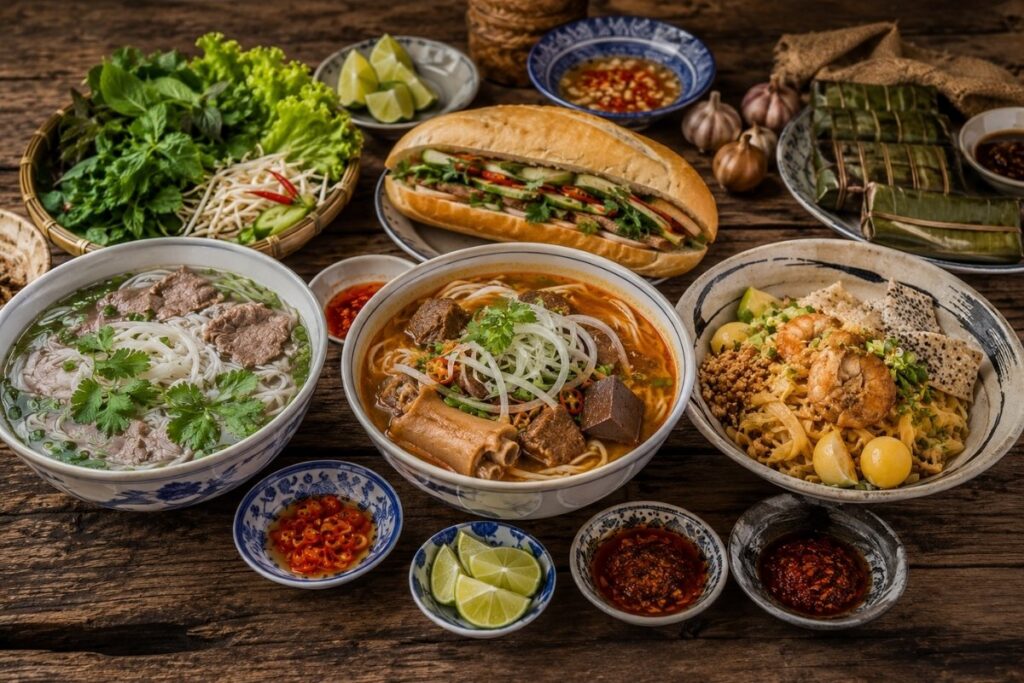
Vietnamese street food may share many of the same ingredients, but it does not taste the same everywhere.
That is one of the easiest ways to understand the connection between Vietnamese street food culture and regional identity.
Rice is at the heart of Vietnamese cooking. It appears as steamed rice, rice noodles, rice paper, sticky rice, and many kinds of cakes and snacks. Noodles are equally versatile, appearing in soups, dry dishes, grilled-meat bowls, and regional specialties.
The ingredients may travel.
The traditions built around them do not always travel in the same way.
In Hanoi, dishes such as phở and bún chả reflect northern cooking traditions that often emphasize restrained flavors and the natural taste of ingredients. In Central Vietnam, dishes such as bún bò Huế and mì Quảng have their own stronger character, shaped by local ingredients and culinary traditions. In the south, dishes such as cơm tấm and hủ tiếu belong to a food culture influenced by the region’s ingredients, migration, and long history of cultural exchange. Vietnamese cuisine is highly regional, with noticeable differences in ingredients, flavors, and cooking traditions from north to south. Vietnam Tourism notes that each region develops its own dishes through a combination of local ingredients, preferences, and cultural influences.
This means that street food is not simply a collection of recipes.
It is one way a place expresses its identity.
Take phở as an example.
The basic idea is familiar: rice noodles, broth, meat, herbs, and aromatics. Yet the experience changes with the place. Northern phở, particularly in Hanoi, is known for a clear, delicate broth and relatively simple garnishes, while phở in southern Vietnam is often served with a broader range of fresh herbs and accompaniments. The dish remains recognizable, but regional food traditions shape how it is prepared and enjoyed. See more details in The culinary symphony of Vietnam: A journey through taste and tradition.
The same pattern appears with other noodle dishes.
Mì Quảng is closely associated with Central Vietnam and is typically served with only a small amount of flavorful broth, alongside fresh herbs, vegetables, and toppings. Bún bò Huế is a signature dish of Huế, known for its rich, complex, and spicy broth. Bún chả, meanwhile, is closely associated with Hanoi, where grilled pork, rice vermicelli, herbs, and dipping sauce come together in a distinctly northern street food tradition.
These differences matter because they tell travelers something that a list of famous Vietnamese dishes cannot.
Vietnam does not have one single street food culture.
It has regional food cultures connected by shared ingredients, techniques, and eating habits.
One useful way to notice these differences is to compare not only what people eat, but how the meal is constructed.
In one place, the broth may carry most of the flavor. Somewhere else, fresh herbs, grilled meat, dipping sauce, or a smaller amount of broth may play a larger role. The ingredients can overlap, yet the balance between them changes.
That is why regional food identity is difficult to understand from a dish name alone.
The recipe matters, but the local way of eating it matters too.
Fresh herbs are part of that connection.
They can add aroma, texture, freshness, and contrast to noodles, grilled meats, broths, and rice dishes. Fish sauce can provide another layer of balance, often combined with ingredients such as lime, sugar, garlic, or chili. The result is not simply a matter of using particular ingredients. It is about how those ingredients are combined and how people eat the finished dish.
That is why two meals made with familiar ingredients can feel completely different.
The difference may come from the broth.
It may come from the herbs.
It may come from the seasoning.
It may come from the way the food is served.
Or it may come from the place itself.
For a traveler, this creates an opportunity that goes beyond trying famous dishes.
Instead of asking only, “What Vietnamese food should I try?”
A more revealing question is:
“What does this place eat, and why does it taste this way here?”
That question leads naturally from food to culture.
A bowl of bún chả can tell you something about Hanoi.
A bowl of bún bò Huế can introduce you to Huế.
A plate of cơm tấm can open a window into southern urban food culture.
The dish becomes a starting point for understanding the place that created it.
And that is where Vietnamese street food becomes more than cuisine.
It becomes a map of regional identity, carried from one neighborhood to another in bowls, plates, baskets, and street-side stalls.
4. The Food Has a History of Its Own
Vietnamese street food can look timeless.
The small stool.
The steaming pot.
The baguette behind the glass.
The metal coffee filter.
Yet many of the foods now associated with Vietnamese everyday life also carry traces of a much longer history of cultural exchange.
Vietnam has spent centuries absorbing outside influences while adapting them to local tastes, ingredients, and ways of eating. That process is visible in some of the country’s most familiar street foods.
Bánh mì and the Vietnamese adaptation of bread
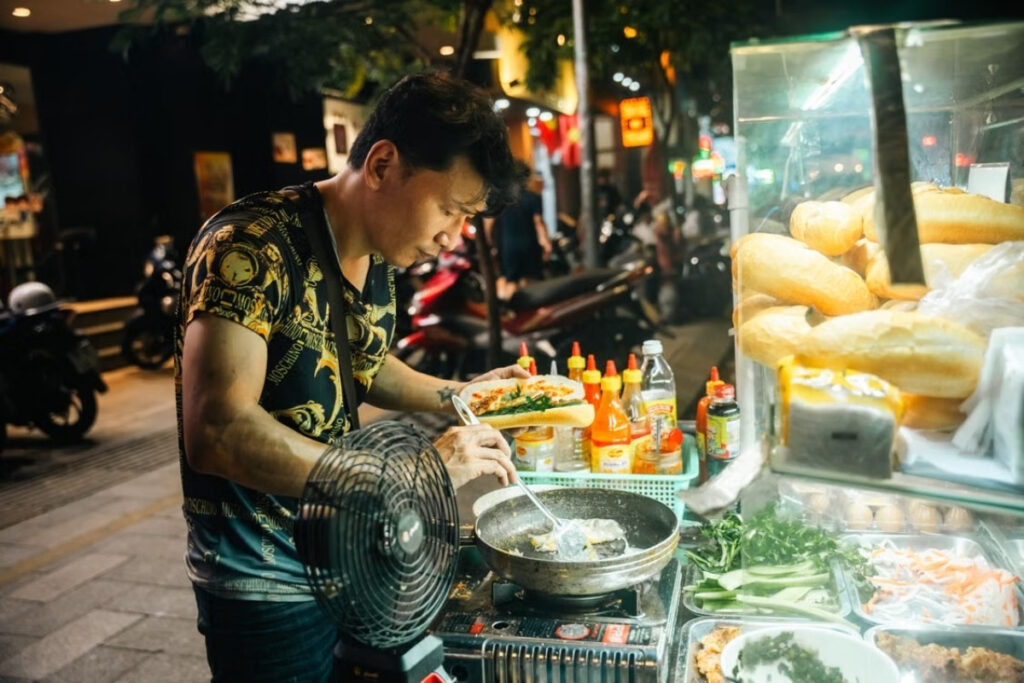
Bánh mì offers one of the clearest examples.
The baguette became part of Vietnamese food culture during the period of French colonial rule. But the Vietnamese version did not remain a copy of the French original. Local cooks combined bread with ingredients and flavors suited to Vietnamese tastes, eventually creating the bánh mì sandwich now recognized around the world. Vietnam Tourism describes this transformation as part of the story of Vietnamese bánh mì, while Andrew Lam’s Cairo Review of Global Affairs likewise describes how Vietnamese cooks adapted the French baguette with local ingredients. (Vietnam Tourism; The Cairo Review of Global Affairs)
That distinction matters.
Cultural exchange does not always mean that one cuisine replaces another.
Sometimes an outside ingredient enters a country and becomes something new.
Bánh mì is a useful example of how Vietnamese food culture absorbed an outside influence and made it its own.
Coffee became part of everyday Vietnamese life
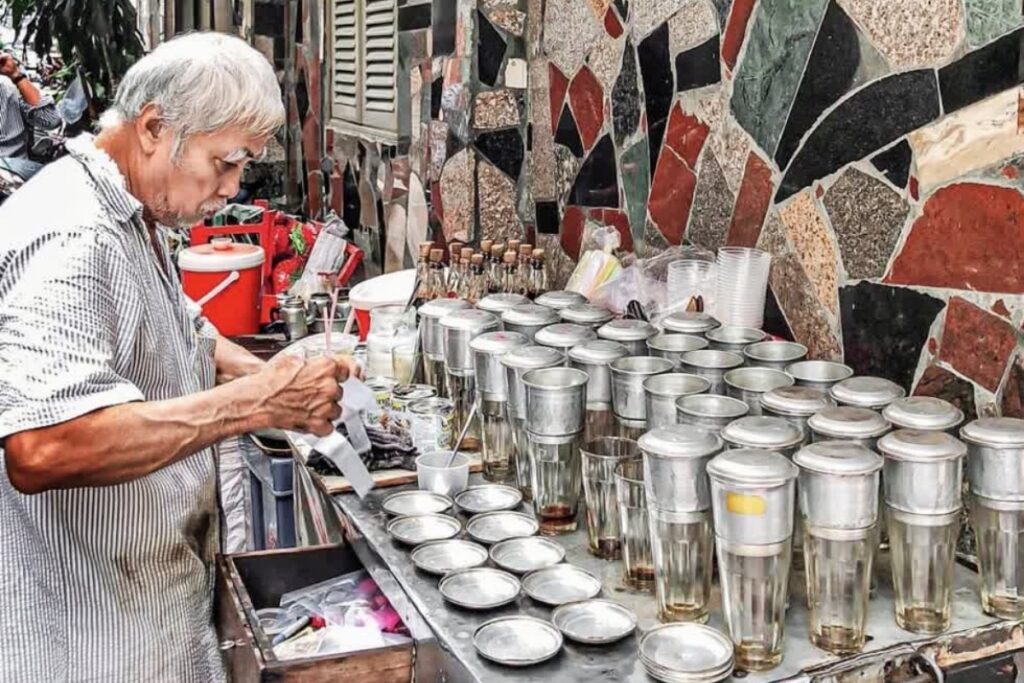
Today, Vietnamese coffee has an identity of its own. Strong coffee brewed slowly through a traditional phin filter, often served with sweetened condensed milk or ice, has become part of everyday life in cities across Vietnam.
But the most revealing part of the coffee ritual may be what happens around the cup.
A sidewalk café can function as a place to pause, talk, meet friends, or simply watch the street. The slow drip of the phin creates a different rhythm from a coffee culture built around taking a drink away as quickly as possible. Vietnam Tourism similarly describes the phin as part of Vietnam’s coffee identity and connects the slow-drip ritual with conversation and social connection. (Vietnam Tourism)
For a traveler, that difference is worth noticing.
The coffee is the product. The ritual around it is the culture.
Food also moved with people
History changed Vietnamese food in other ways.
War, economic disruption, migration, and movement between regions affected where people lived, what ingredients they could obtain, and which dishes traveled with them.
A regional dish could leave its original home and appear somewhere else.
A family could carry a recipe to another city.
A cook could adapt a familiar dish because a traditional ingredient was unavailable.
Over time, food traditions moved with people.
That helps explain why Vietnamese cuisine can feel both strongly regional and surprisingly interconnected.
The same country can have very different local food traditions, yet ingredients, techniques, and dishes continue to cross regional boundaries.
Đổi Mới changed the setting around the food
The economic reforms known as Đổi Mới, launched in 1986, marked a major turning point in Vietnam’s economic development. The reforms moved the country toward a more market-oriented economy, expanded the role of private economic activity, and opened Vietnam more widely to foreign trade and investment. The World Bank describes Đổi Mới as a comprehensive reform program that began in 1986 and restructured Vietnam’s economic system. (World Bank)
Food culture did not remain outside that transformation.
As cities expanded and consumer choices increased, traditional food vendors increasingly existed alongside restaurants, supermarkets, convenience stores, cafés, takeaway businesses, and later digital delivery platforms.
The important point is not that modern commerce replaced traditional food.
It is that the same food could move between different settings.
A family recipe might continue in a small shop rather than on a sidewalk. A vendor might accept digital payments instead of only cash. A traditional dish might reach customers through a delivery app rather than a passing stream of pedestrians.
The setting changed, but adaptation remained part of the tradition.
That pattern connects the past to the present.
Vietnamese street food has never been completely static. It has absorbed outside ingredients, moved with people, adapted to changing cities, and responded to economic shifts.
The question is therefore not whether street food will remain exactly as it looks today.
The more interesting question is whether the next generation will continue finding new ways to make familiar food part of everyday life.
That may be the real story behind the food: not tradition frozen in place, but tradition that keeps moving.
What makes Vietnamese food history interesting
This is why the history of Vietnamese street food is more complicated than a simple story of foreign influence.
Chinese culinary traditions were one part of the wider cultural exchange that shaped foodways in Vietnam. Across Southeast Asia, Chinese migrants and communities adapted culinary knowledge to local ingredients and circumstances, creating food traditions that were neither simply imported nor unchanged. This broader pattern of adaptation is useful when thinking about Vietnamese cuisine as well. (University of Chicago Press)
French colonial influence later introduced another set of ingredients and food practices, including bread and coffee. Vietnamese cooks adapted these influences to local tastes and everyday eating habits rather than simply reproducing the original forms.
Vietnamese food history is therefore better understood as a process of adaptation than as a simple list of foreign influences.
The result is not a cuisine defined by what came from outside.
It is a cuisine shaped by what Vietnamese people did with those influences.
That distinction helps explain why foods such as bánh mì and Vietnamese coffee can have recognizable historical connections to France while feeling completely at home in Vietnam today.
Food changes when people change.
And Vietnamese street food has spent generations adapting to those changes.
That is why a meal on a Vietnamese sidewalk can tell a story about much more than cooking.
It can reveal something about colonial history, migration, economic change, regional identity, and the ability of everyday culture to absorb change without losing its own character.
5. Family, Vendors, and the Taste of a Place
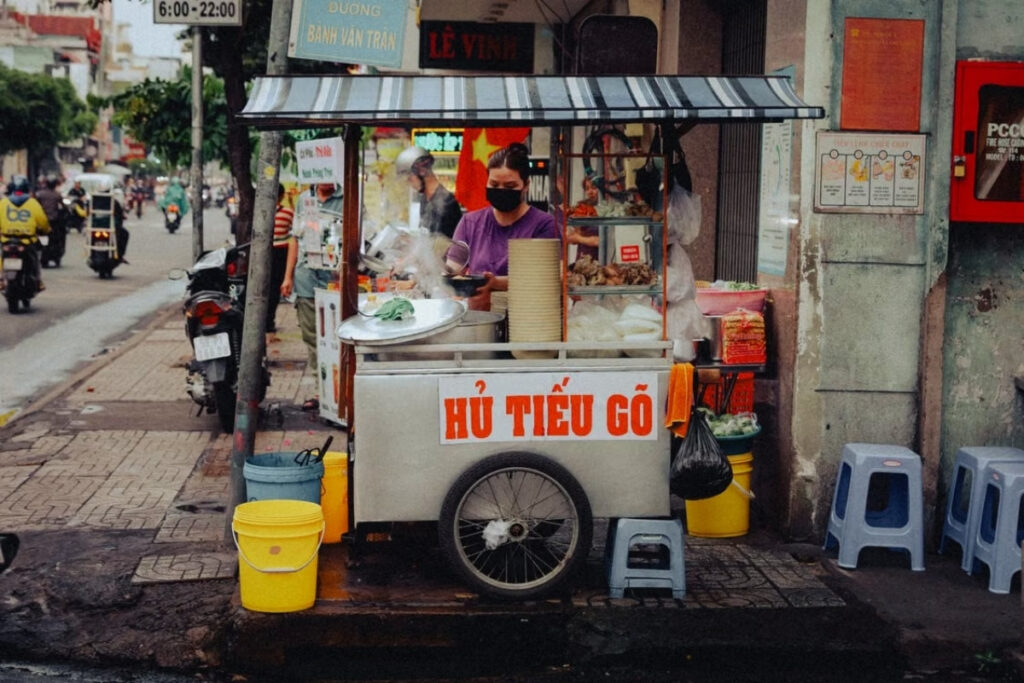
A street food stall may look temporary.
The knowledge behind it often is not.
Recipes, techniques, and preferences can move through families and neighborhoods over years. A younger family member may grow up around the work, learning not only what ingredients go into a dish, but also how customers expect it to taste and how the food fits into the rhythm of the business.
Some of that knowledge is difficult to reduce to a written recipe.
A cook learns how a broth should smell before it is ready. They learn how ingredients respond to heat, how much seasoning a regular customer prefers, and when a familiar dish has reached the taste the stall is known for.
This is one reason two vendors can serve the same dish and still produce noticeably different meals.
The difference may not be a secret ingredient.
It may be the accumulated knowledge of the person preparing it.
That knowledge can become part of a place’s identity.
A stall does not need to be famous nationwide to matter. A small group of regular customers may be enough to give it a role in the neighborhood. People return because they recognize the taste, know the vendor, or associate the dish with a particular street or routine.
The vendor becomes part of the food’s identity.
This is especially important when looking at Vietnamese cuisine regionally.
A dish is often tied not only to its ingredients, but to the place and people who continue to prepare it.
In Hanoi, bún chả is closely associated with the city’s food culture, bringing together grilled pork, rice vermicelli, herbs, and dipping sauce. In Huế, bún bò Huế reflects a different Central Vietnamese tradition, known for its rich and complex broth. Around Hoi An, cao lầu is closely connected to the local culinary landscape.
These dishes are not simply recipes that happen to be popular in different cities.
They are food traditions attached to places.
That connection helps explain why Vietnamese street food can feel so personal.
A recipe can travel.
A technique can be taught.
Ingredients can cross regional boundaries.
But the way a dish becomes part of a neighborhood is shaped by the people who keep making it.
For travelers, this is one reason eating regionally is more revealing than simply searching for a list of famous Vietnamese dishes.
Instead of asking only:
“What Vietnamese food should I try?”
ask:
“What does this place make well, and what does that food tell me about the people who live here?”
The first question leads to a meal.
The second can lead to a better understanding of the place.
6. The Little Stool and the Life Around It
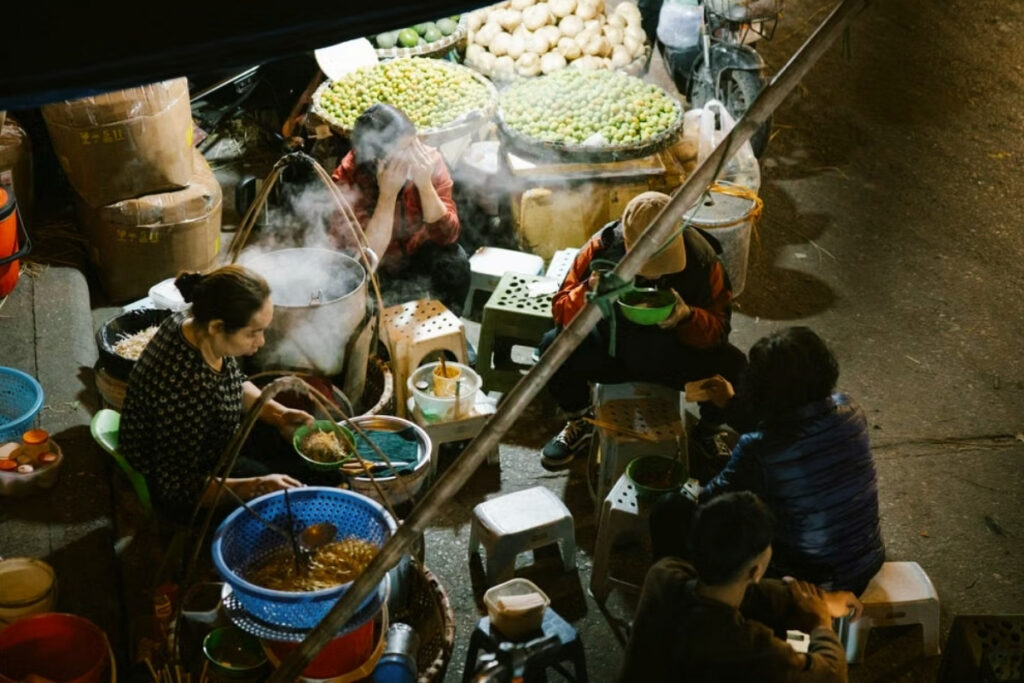
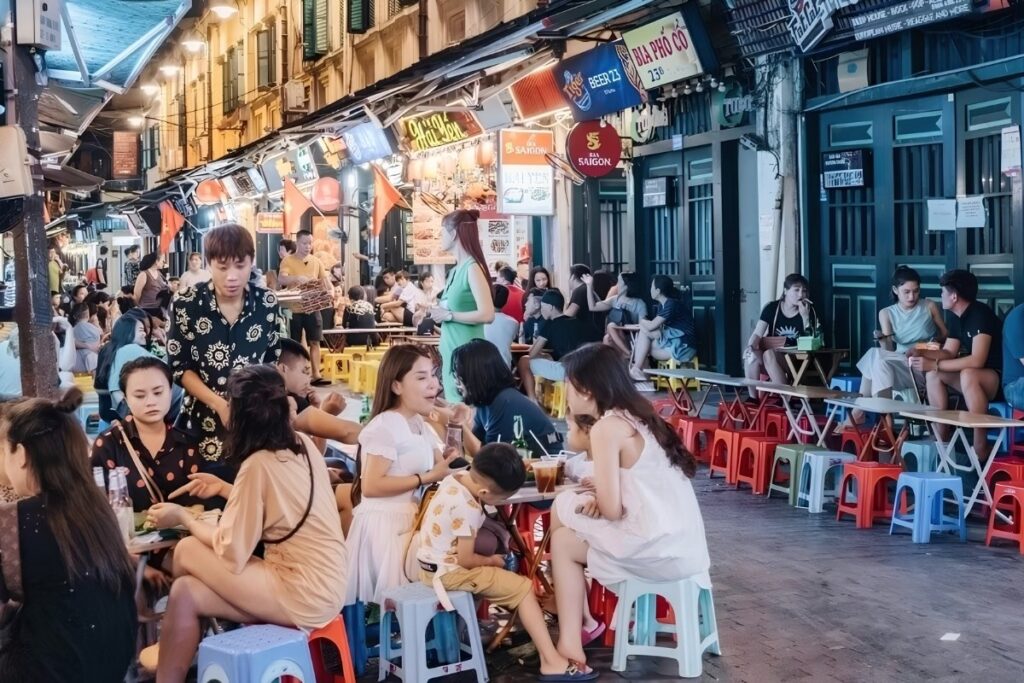
For many visitors, one of the first images that comes to mind when they think about Vietnamese street food is a row of tiny plastic stools.
They seem almost too small to matter.
But they tell you something important about how street food works.
They are inexpensive, easy to move, easy to stack, and practical in places where space is limited. A vendor does not need a large dining room to serve customers. A few stools can turn the edge of a storefront or a small section of sidewalk into a place to eat.
And because the setup is so open, the street remains part of the experience.
A customer sits a few feet from the cooking area.
Someone walks past.
A motorbike moves through the street.
Another customer arrives and takes the next available stool.
The meal happens in the middle of ordinary city life.
There is very little boundary between the table and everything happening around it.
That creates a particular kind of social experience.
A family may eat beside office workers. A student may sit beside an older resident. A traveler may find themselves sharing a table with people who have eaten at the same stall for years.
Nobody needs to introduce themselves.
Nobody needs to have a conversation.
They are simply sharing the same small piece of public space.
This is one reason street food can feel so different from dining in a conventional restaurant.
The restaurant separates the meal from the world outside.
The street does the opposite.
The street remains part of the meal: traffic passes nearby, the vendor prepares food within sight, other customers reveal what is popular, and the rhythm of the neighborhood continues around the table.
For a traveler, those details can become part of the memory of the food.
And there is no need to perform “authenticity” by choosing the least comfortable place you can find.
You do not have to eat somewhere unpleasant to experience Vietnamese street food.
The cultural value is in the setting and the people who use it, not in how uncomfortable the stool happens to be.
What to notice when you eat at a street stall
If you want to understand the culture rather than simply photograph the food, pay attention to a few small details.
Notice when people arrive and what they order.
Notice whether customers eat quickly or stay to talk.
Notice how ingredients are arranged and replenished.
Notice how the vendor interacts with regular customers.
And notice what happens around the meal — the traffic, conversations, nearby shops, and ordinary routines continuing without interruption.
These details may seem minor.
Together, they show why Vietnamese street food is better understood as part of everyday life than as a separate tourist attraction.
The meal is public, ordinary, and shared — and that is what makes it special.
7. A Living Tradition in a Changing Vietnam
Vietnamese street food is often photographed as though it belongs to another era.
A vendor over a steaming pot.
A market before sunrise.
A row of plastic stools.
A baguette being filled by hand.
The image feels timeless.
The reality is more complicated.
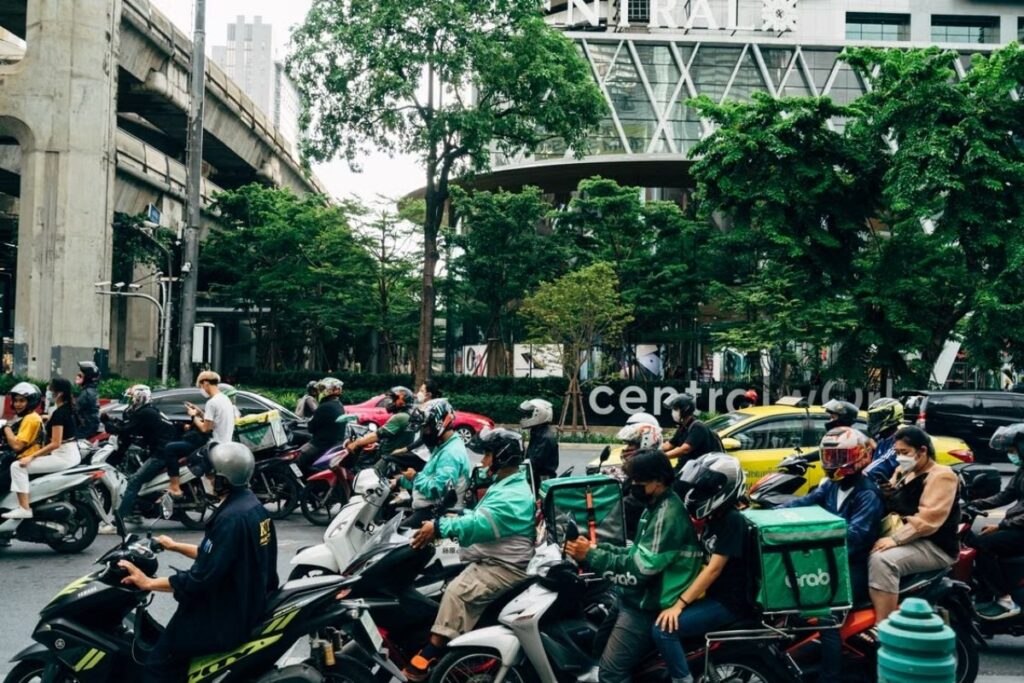
Vietnam is changing quickly, and its food culture is changing with it.
A vendor who once depended entirely on people walking past may now receive delivery orders through a phone. A small family business can accept digital payments, promote itself on social media, or become famous because a short video reaches thousands of viewers.
Traditional food can travel farther without the vendor moving at all.
At the same time, the physical space that allowed street food to flourish is under pressure.
Vietnamese cities are becoming denser. Sidewalks have competing demands. Rents rise. Regulations change. Some vendors move indoors, become takeaway businesses, or disappear when the next generation chooses another career.
Younger Vietnamese diners also have more choices than previous generations.
They can eat at a traditional stall, a modern Vietnamese restaurant, an international chain, a shopping mall, or order food through an app.
Street food therefore has to compete with an entirely different urban food landscape.
But change does not necessarily mean disappearance.
Sometimes tradition survives precisely because it adapts.
A younger family member may modernize the business without changing the recipe.
A traditional dish may move from a sidewalk stall into a small shop.
A vendor may use digital tools while continuing to prepare food according to techniques learned from a parent.
The setting changes.
The relationship between food and everyday life remains.
That is important because Vietnamese street food has never been completely static.
It absorbed outside ingredients.
It adapted to changing cities.
It traveled with migrants.
It responded to economic changes.
And it continues to evolve today.
So the future of Vietnamese street food is probably not about preserving every stall exactly as it looks now.
It is about whether the next generation can continue finding ways to make familiar food part of everyday life.
That may be the real story behind the food: not tradition frozen in place, but tradition that keeps moving.
Conclusion: The Story Is Bigger Than the Bowl
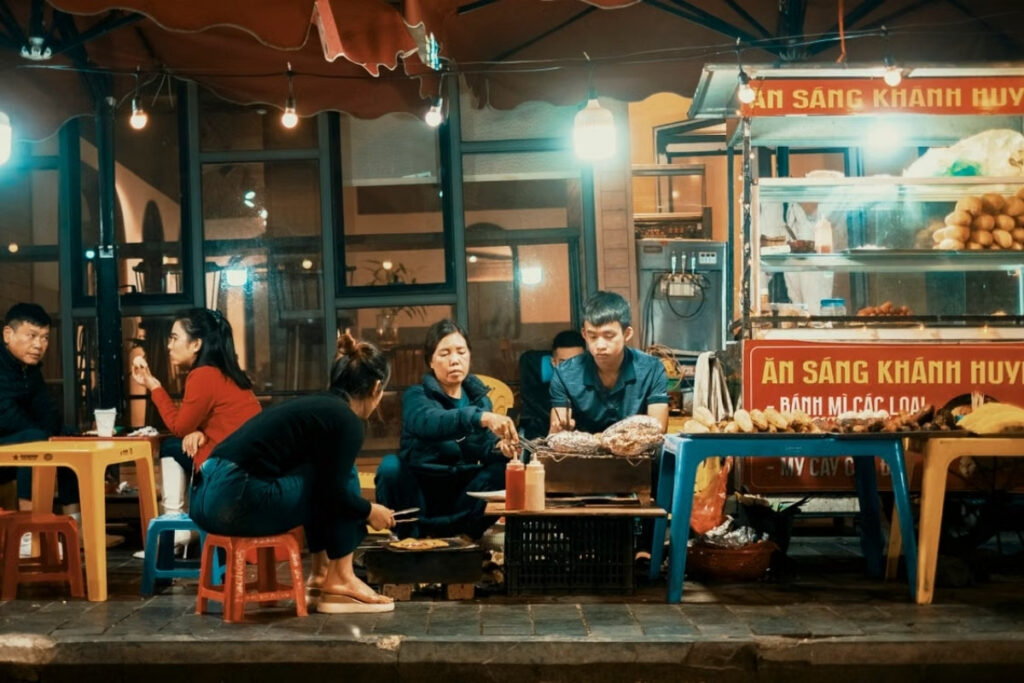
Early in the morning, a Vietnamese sidewalk can look almost ordinary.
A vendor lifts the lid from a pot of broth.
Herbs are arranged in baskets.
Coffee begins to drip.
Plastic stools appear.
The first customers sit down.
For a traveler, it may look like the beginning of a food adventure.
For the people around the table, it is simply another morning.
And that is precisely what makes Vietnamese street food so fascinating.
Its story was not created for tourists.
It grew from markets, neighborhoods, family businesses, regional ingredients, migration, history, and the practical needs of everyday people.
Some dishes carry traces of centuries of cultural exchange.
Some recipes survive because a family kept making them.
Some stalls have been replaced by modern shops or delivery businesses.
Others continue almost exactly as they always have.
The setting and the city may change, but the basic idea remains remarkably resilient: good food made accessible, close to where people live their lives.
So when you sit down at a Vietnamese street food stall, look beyond the bowl.
Notice the person cooking it.
Notice who else is eating.
Notice the ingredients.
Notice the neighborhood.
Because the meal is only one part of the experience.
The real story is everything that brought it to your table.
And sometimes, the best way to understand Vietnam is not to stand back and watch.
It is to pull up a plastic stool and eat what the neighborhood is eating.
Frequently Asked Questions
What is Vietnamese street food culture?
Vietnamese street food culture is the everyday practice of buying, preparing, and eating food in markets, small stalls, sidewalk shops, and other informal settings. It is closely connected to local neighborhoods, family businesses, fresh ingredients, regional traditions, and daily routines.
Why is street food so popular in Vietnam?
Street food is popular because it is convenient, affordable, widely available, and deeply connected to everyday Vietnamese life. Small vendors can serve meals close to homes, workplaces, markets, and busy streets, making street food a practical part of daily routines.
What is the most famous Vietnamese street food?
Phở and bánh mì are probably the best-known Vietnamese foods internationally, but they represent only a small part of the country’s street food culture. Regional specialties such as bún chả, bún bò Huế, mì Quảng, cao lầu, cơm tấm, and hủ tiếu offer a much broader picture.
Is Vietnamese street food safe for tourists?
Street food can be enjoyed safely when travelers use sensible precautions. Choose busy stalls with good customer turnover, observe food-handling practices, and favor freshly prepared food, especially dishes served hot. Travelers should use their own judgment because conditions vary between vendors and locations.
What time do Vietnamese street food vendors open?
Many breakfast vendors start very early, sometimes before sunrise. Opening hours vary by dish and location. Morning is often one of the best times to experience local street food because many Vietnamese people eat breakfast before work or school.
Which Vietnamese cities are best for street food?
Hanoi, Hue, Da Nang, Hoi An, and Ho Chi Minh City are all excellent places to explore Vietnamese street food, but they offer different culinary experiences. Hanoi is known for northern specialties, Hue for distinctive Central Vietnamese dishes, Hoi An and Da Nang for regional Central cuisine, and Ho Chi Minh City for its diverse southern food culture.
What should first-time visitors try in Vietnam?
First-time visitors could begin with a few well-known dishes such as phở, bánh mì, bún chả, cơm tấm, or bún bò Huế, then move beyond the famous names and try regional specialties. The best approach is to eat what a local neighborhood is known for rather than limiting yourself to an international list of “must-try” foods.
Continue Exploring Vietnam
A bowl of Vietnamese street food is rarely just a bowl of food.
Behind it are markets, family traditions, regional ingredients, changing cities, and generations of cooks adapting recipes to everyday life.
If you want to understand Vietnam beyond its famous dishes and tourist attractions, explore more Vietnam Insights from Tam Voc Viet — stories about everyday life, local perspectives, food culture, traditions, and the small details that shape modern Vietnam.
Recommended next reads:
- Vietnamese Cuisine — Explore the traditions, ingredients, regional differences, and eating habits behind Vietnamese cuisine.
- Vietnamese Street Food Guide — Explore the authentic flavors, hidden gems, and unforgettable culinary experiences that make Vietnamese street food.
- Why Do Vietnamese Families Eat Together? — Understand how meals connect family life, traditions, and relationships.
- Why Do Vietnamese Wake Up So Early? — Explore the morning habits and everyday rhythms that shape life in Vietnam.
- 15 Things That Surprise First-Time Visitors to Vietnam — Discover some of the everyday details that may feel unexpected when you first arrive.
- Common Culture Shocks in Vietnam — A practical look at cultural differences travelers may notice in Vietnam.
- Living in Vietnam: The Complete Guide for Foreigners — Explore the practical and cultural side of living in Vietnam.
Together, these Vietnam Insights offer a closer look at the food, traditions, routines, and cultural habits that can be easy to miss on a first trip to Vietnam.
A Note for Travelers
You do not need to become a street food expert to enjoy eating in Vietnam.
You do not need to try every famous dish, find the most popular stall on social media, or follow a carefully planned food itinerary.
Sometimes, the best approach is much simpler.
Find a busy local stall.
Watch what people are ordering.
Try something you have never eaten before.
Pay attention to the ingredients, the way the food is prepared, and the people sharing the space around you.
You may discover that the most memorable part of a meal is not the dish itself, but everything happening around it.
A vendor preparing the same recipe they have made for years. A market supplying ingredients before sunrise. A family sharing breakfast on tiny plastic stools. A regional specialty that tastes completely different from something you ate two cities earlier.
These are the details that turn eating into understanding.
You are not just tasting Vietnam. You are seeing how food fits into Vietnamese life.
Sources & Further Reading
This article combines official Vietnamese tourism and cultural sources with historical and research-based materials. Sources are used to verify factual claims, while the article’s interpretation focuses on how food connects with everyday life, regional identity, and social change.
Official & Cultural Sources
- Vietnam Tourism — A beginner’s guide to Vietnamese street food
Useful for everyday street food practices, meal times, local vendors, sidewalk dining, and street food etiquette. - Vietnam Tourism — Vietnam: A foodie guide by region
Used for regional differences in Vietnamese cuisine and the relationship between local ingredients, preferences, traditions, and regional food identity. - Vietnam Tourism — Ha Noi Food Guide: The best street food dishes to sample
Used for Hanoi street food examples, including phở, bún chả, bánh mì, and other everyday dishes. - Vietnam Tourism — 7 superb bánh mì to try in Vietnam
Used for the history and development of bánh mì, including the arrival of the French baguette and its adaptation into Vietnamese food culture. - Vietnam Tourism — 5 classic recipes from Vietnam
Used for regional food examples including cao lầu, bún bò Huế, bánh mì, and Vietnamese coffee.
Historical & Research Sources
- World Bank — Vietnam’s Doi Moi Program
Used to verify the launch of Đổi Mới in 1986 and its shift toward market mechanisms, trade, and foreign investment. - The Cairo Review of Global Affairs — The Marvel of Bánh Mì, by Andrew Lam
Used as an additional historical and cultural perspective on the adaptation of the French baguette into Vietnamese bánh mì. - University of Chicago Press — Chinese Food and Foodways in Southeast Asia and Beyond
Used as broader historical context for Chinese culinary influence and the adaptation of Chinese food traditions within Southeast Asia.
Editorial note:
Food traditions can vary by region, generation, family, season, and individual vendor. This article therefore distinguishes documented facts from interpretation and avoids treating one city’s food habits as representative of all of Vietnam.
Sources are provided to support factual and historical claims; the cultural interpretation and comparisons are the editorial perspective of Tam Voc Viet.
About the Author
Tam Voc Viet Editorial Team
The Tam Voc Viet Editorial Team creates travel and cultural guides for international readers who want to understand Vietnam beyond its most famous destinations.
Our content explores Vietnam through its history, culture, food, traditions, people, and everyday life, with a particular focus on the context that helps international travelers experience the country more thoughtfully.
For cultural and travel topics, we consult official Vietnamese sources, established cultural institutions, research materials, and relevant travel resources where appropriate. We also compare regional perspectives and avoid presenting a single city’s food habits as representative of all of Vietnam.
When discussing historical or cultural claims, we aim to distinguish documented facts from interpretation. When describing everyday experiences, we use specific observations and contextual examples rather than treating them as universal rules.
We also recognize that food culture changes over time. Traditional markets, family businesses, sidewalk vendors, modern restaurants, specialty cafés, and delivery platforms can all exist within the same contemporary food landscape.
Our goal is not to present one fixed version of Vietnamese culture, but to help readers understand the patterns, differences, and context behind everyday life in Vietnam.
Article Information
Category: Vietnam Insights
Topic: Vietnamese Street Food Culture
Published: August 2026
Last Updated: August 2026
Author: Tam Voc Viet Editorial Team
