


 Tiếng Việt
The first time you meet someone in Vietnam, their name may not work the way you expect.
A guide in Hanoi might introduce himself with three names, yet everyone around him calls him by the last one. A hotel receptionist may ask for your “first name” and “family name,” while a Vietnamese passport appears to put the family name first. And after a few days in the country, you may start hearing words like anh, chị, or em used between people who aren’t actually related.
None of this is as complicated as it first sounds.
Vietnamese names follow a different structure from the one most American travelers are used to, and the way people address each other reflects something even more important: age, family, respect, and social relationships.
Once you understand the basics, Vietnamese names become much easier to read — and much easier to use in everyday conversations.
Table of Contents
Quick Answer: How Do Vietnamese Names Work?
Vietnamese names generally follow the order family name + middle name + given name. For example, Nguyễn Minh Anh has Nguyễn as the family name, Minh as the middle name, and Anh as the given name.
A middle name is optional, so some Vietnamese names have only a family name and given name. In everyday conversation, people are often addressed by their given name rather than their family name.
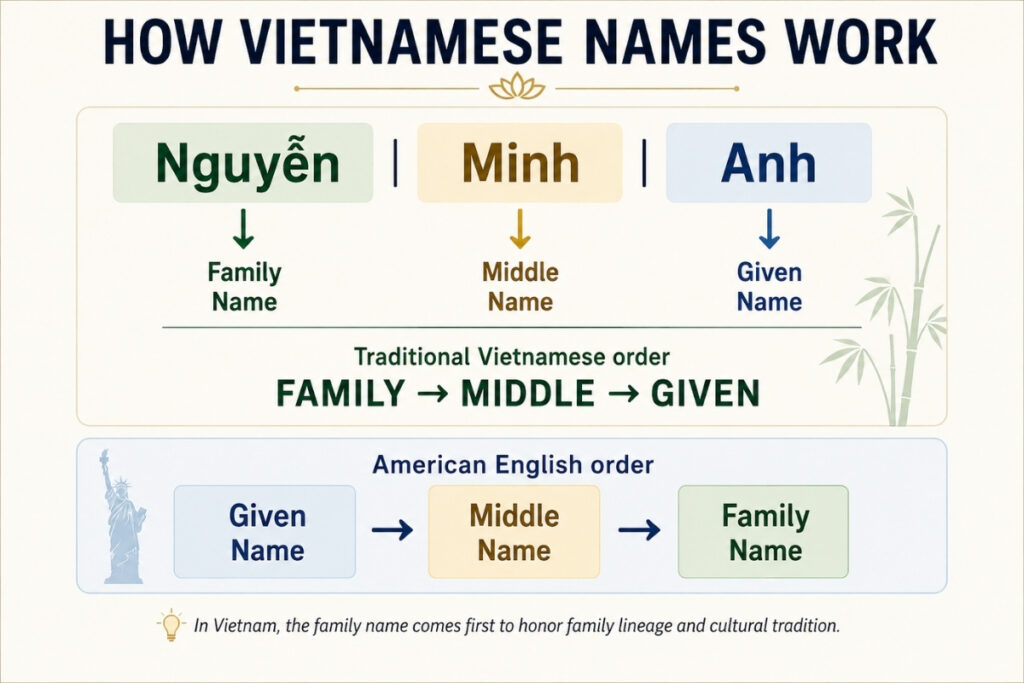
For travelers, the most important thing to remember is simple: the last part of a Vietnamese name is usually the given name, but the way a person is addressed can also depend on age, relationship, and context.
Why Does the Family Name Come First?
Vietnamese names traditionally place the family name before the given name, which is different from the order most Americans are used to seeing.
For example:
Nguyễn Minh Anh
Nguyễn → family name
Minh → middle name
Anh → given name
This order is more than a formatting convention. Traditionally, placing the family name first reflects the importance of family identity and lineage in Vietnamese society. A person’s name identifies them not only as an individual but also as part of a wider family.
Family Identity Comes First
In traditional Vietnamese culture, family relationships have long played an important role in social life. The family name connects a person to their family line, while the given name identifies the individual within that family.
This helps explain why the family name traditionally appears first.
It is also why two people sharing a family name should not automatically be assumed to be close relatives. Nguyễn, Trần, Lê, Phạm, and other common Vietnamese surnames are shared by large numbers of unrelated families.

Why This Can Feel Backward to American Travelers
For someone accustomed to American naming conventions, Nguyễn Minh Anh may initially look as if Nguyễn is the person’s first name.
It is not.
In the traditional Vietnamese order:
Family name → Middle name → Given name
In the common American order:
Given name → Middle name → Family name
So the same person might appear in an English-language context as:
Anh Minh Nguyen
However, people do not necessarily change the cultural structure of their name simply because they are speaking English. Some Vietnamese people continue using the traditional order, while others use a Western-style order in international settings.
What Should Travelers Remember?
The easiest rule is not to memorize every possible variation. Pay attention to how the person introduces themselves and how other people address them.
If someone named Nguyễn Minh Anh tells you, “I’m Anh,” then Anh is the name you should use in conversation.
When filling out an airline, hotel, visa, or other international form, however, follow the fields provided—such as surname/family name and given names—rather than assuming that every system follows the traditional Vietnamese order.
Understanding the basic pattern is useful, but the most respectful approach is always to follow the person’s own preference for how their name is written and used.
Why Is Nguyen So Common in Vietnam?
If you spend even a short time in Vietnam, you will probably notice the surname Nguyễn.
It is by far the most familiar Vietnamese surname to many international visitors, and seeing several unrelated people with the same family name is completely normal.
So why is Nguyễn so common?
The answer is tied to Vietnam’s long political and social history, but there is no single event that explains the surname’s modern prevalence.
The Nguyễn Dynasty Is Part of the Story
The Nguyễn dynasty, which ruled Vietnam from 1802 to 1945, is one important part of the story.
During periods of political change, people could adopt or change surnames for a variety of social and historical reasons. Some historical accounts connect the spread of Nguyễn to people taking the dynasty’s surname, although the reasons behind surname changes were not always the same.
This is why it is too simplistic to say:
“Most Vietnamese people are descendants of the Nguyễn dynasty.”
They are not.
Having the surname Nguyễn does not establish descent from the imperial Nguyễn family.
Nguyễn Is a Family Name, Not a Sign of Royal Ancestry
For travelers, this distinction matters.
If you meet several people named Nguyễn, you should not assume they belong to one extended family or share imperial ancestry.
Vietnam has many common surnames, including:
- Nguyễn
- Trần
- Lê
- Phạm
- Hoàng
- Phan
- Vũ
- Võ
- Đặng
- Bùi
The distribution of these surnames has been shaped by centuries of Vietnamese history, migration, political change, and family traditions.
Why You May Meet So Many Nguyễns
The simplest explanation for a traveler is also the most useful:
Nguyễn is an extremely common Vietnamese family name.
You may encounter a Nguyễn at your hotel, on a restaurant reservation, in a tour group, or among people you meet on the street.
Two people sharing the surname does not mean they are related.
For an American reader, Smith is a useful rough comparison: it is a familiar surname that can belong to many unrelated families.
The comparison is not exact, but it helps explain why seeing Nguyễn repeatedly is not unusual.
Don’t Try to Identify Someone by Nguyễn Alone
Because Nguyễn is so widespread, using only the family name can create confusion.
If someone introduces herself as:
Nguyễn Minh Anh
and tells you:
“You can call me Anh.”
then Anh is the name to use.
The fact that her surname is Nguyễn does not tell you enough to distinguish her from the many other people who share that surname.
This is one reason understanding the full Vietnamese name structure is more useful than simply memorizing that Nguyễn is common.
A Note on the History
The history of Vietnamese surnames is more complicated than a single explanation about the Nguyễn dynasty.
Surname adoption and change occurred in different historical circumstances, and explanations for the prevalence of Nguyễn vary across sources.
For that reason, this guide avoids the popular claim that the surname became common simply because people wanted to honor or identify with the Nguyễn emperors.
The safer conclusion is:
Nguyễn became exceptionally widespread through a combination of historical and social processes, including periods of political change.
That is enough for a traveler to understand why the name appears so frequently without turning a travel guide into a simplified version of Vietnamese dynastic history.
What Do Vietnamese Names Mean?
Vietnamese parents often choose names for their meaning as well as their sound.
A child’s given name may express a quality, hope, or aspiration that parents want to associate with their child.
Names can relate to ideas such as:
- intelligence
- kindness
- beauty
- strength
- happiness
- peace
- virtue
- success
- prosperity
Some names are inspired by nature, including flowers, plants, seasons, landscapes, or other natural images.
Others express personal qualities or values that a family considers important.
For example, Vietnamese given names may carry associations with beauty, wisdom, virtue, brightness, peace, or strength.
The exact meaning, however, can depend on the Vietnamese word, the characters traditionally associated with it, and the context in which the name is used.
So travelers should be careful about treating a Vietnamese name as if it always has one simple English translation.
A Name Can Carry a Family’s Hope
This is one of the more interesting cultural differences for visitors from the United States.
In American naming culture, parents may choose a name because they like its sound, family connection, religious significance, or personal meaning.
Vietnamese parents can consider many of the same things, but the meaning of a Vietnamese given name can be especially important.
A name may express what parents hope their child will become or the qualities they hope the child will have.
That makes asking:
“What does your name mean?”
a much better conversation starter than trying to guess the meaning yourself.
If someone explains the meaning of their name, it can also tell you something about their family, generation, or the values their parents wanted to express.
Don’t Assume Every Vietnamese Name Has a Direct English Translation
This is worth remembering.
A Vietnamese given name is not necessarily equivalent to an English word such as “Beautiful,” “Strong,” or “Happy.”
Some names have recognizable meanings, while others are chosen because of their sound, cultural associations, family traditions, or a combination of factors.
Modern Vietnamese parents also have considerably more freedom than previous generations in choosing names.
So if a Vietnamese friend tells you that her name has a particular meaning, it is best to understand her explanation of her own name rather than relying on a generic translation you found online.
That small distinction makes conversations about Vietnamese names much more respectful — and usually more interesting.
Vietnamese Middle Names: Thị, Văn and Beyond
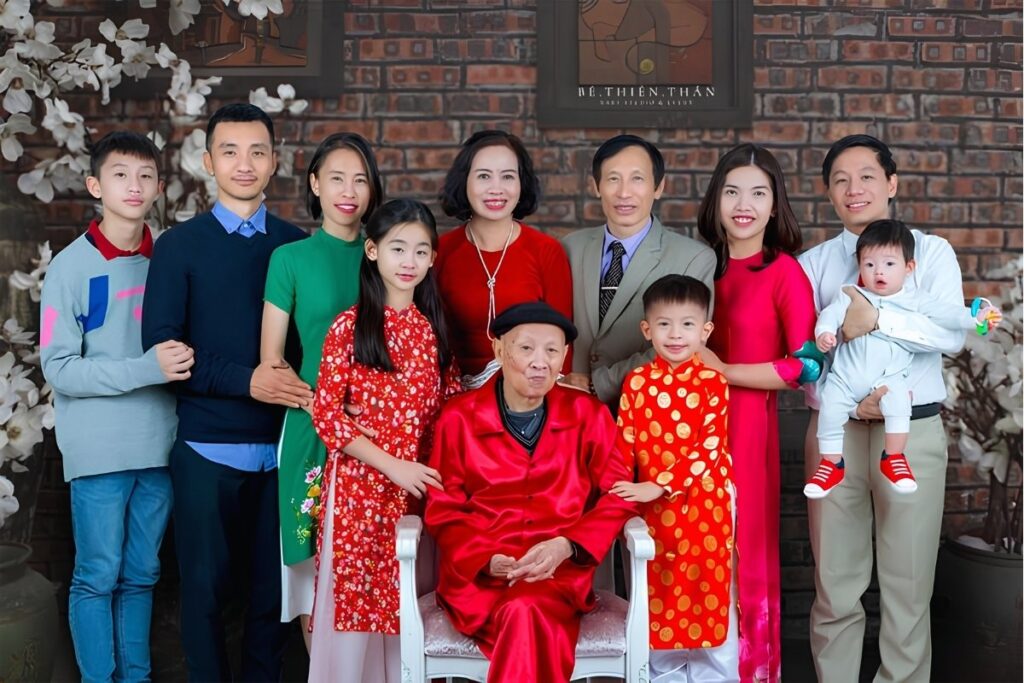
Not every Vietnamese person has a middle name, but many traditional Vietnamese names do.
The middle name sits between the family name and the given name. Depending on the family, generation, and naming tradition, it can serve different purposes.
Two middle names you may encounter frequently are Thị and Văn.
Traditionally, Thị was widely used in women’s names, while Văn was commonly associated with men’s names.
For example:
Nguyễn Thị Lan
and
Trần Văn Minh
are names you may encounter, particularly among older generations.
But don’t turn this into a rule.
Modern Vietnamese parents are not required to use Thị for daughters or Văn for sons. Younger generations have a much wider range of middle names, and some people have no middle name at all.
A middle name may also have its own meaning or simply be part of a family’s preferred naming style.
Why Middle Names Can Be Confusing for Travelers
The middle name can cause confusion when a Vietnamese name is entered into an English-language form.
Consider:
Nguyễn Minh Anh
A traveler unfamiliar with Vietnamese naming order might see:
- Nguyễn — first name
- Minh — middle name
- Anh — last name
That interpretation would be incorrect in the traditional Vietnamese structure.
Instead:
- Nguyễn — family name
- Minh — middle name
- Anh — given name
When dealing with passports, airline tickets, visas, or hotel reservations, however, always follow the specific instructions of the system you’re using.
The cultural structure of a Vietnamese name and the way an international database labels its fields are not always the same thing.
Why Vietnamese People Often Use Their Given Names
In a traditional Vietnamese full name, the family name comes first and the given name comes last.
But in everyday conversation, people are often addressed by their given name.
For example:
Nguyễn Minh Tuấn
may simply be called:
Tuấn
Likewise:
Trần Hoàng Nam
may be addressed as:
Nam
This can feel unusual to American travelers because the family name appears first, while the name used in conversation appears at the end.
The important distinction is:
Nguyễn is the family name. Tuấn is the given name.
So don’t assume that the first word of a Vietnamese name is the name you should use when speaking to someone.
If the person introduces themselves using their given name, follow their lead.
How Vietnamese People Address Each Other
Knowing the structure of a Vietnamese name is only half the story. In everyday conversation, age and relationship can matter as much as the person’s name.
A Vietnamese speaker may use a kinship term instead of someone’s personal name, even when the two people are not related.
You may hear:
- anh — commonly used for an older male or a male around the speaker’s age
- chị — commonly used for an older female or a female around the speaker’s age
- em — commonly used for someone younger
- cô — commonly used for a woman in an older, aunt-like age relationship
- chú — commonly used for a man in an older, uncle-like age relationship
- bác — commonly used for someone older in a senior aunt- or uncle-like relationship
- ông — an older man or grandfather
- bà — an older woman or grandmother
These terms do not map neatly onto Mr., Ms., sir, or ma’am in English.
They express a social relationship.
For example, a Vietnamese speaker may call an unrelated woman chị because she is older than the speaker and occupies a social position similar to an older sister.
That does not mean they are actually sisters.
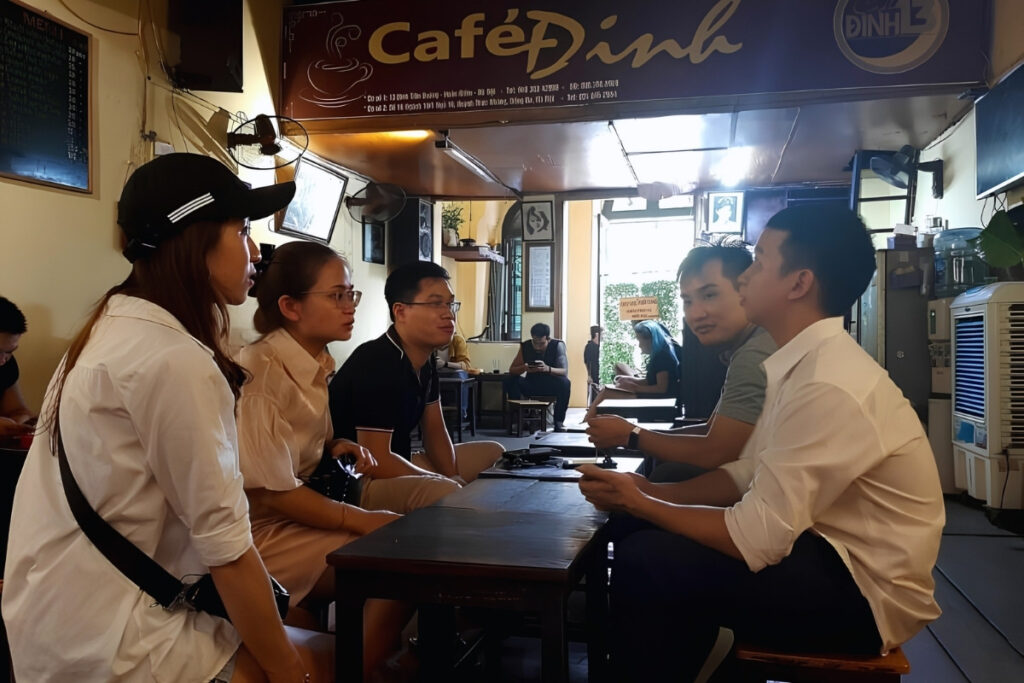
Why Age Matters
Vietnamese forms of address are often based on relative age, rather than simply on someone’s chronological age.
This means the same person may be addressed differently depending on who is speaking to them.
A younger person may use anh or chị for someone slightly older, while an older person may use em for that same speaker.
The choice can also depend on familiarity, context, and regional usage.
For a traveler, there is no need to memorize every possible relationship.
Instead, listen to how Vietnamese people around you address one another.
What Should You Call Someone You Just Met?
If someone introduces themselves by their given name, use that name.
For example, if:
Nguyễn Minh Tuấn
introduces himself as Tuấn, call him Tuấn.
If someone says:
“You can call me Mai.”
then Mai is the name to use.
You do not need to work out the person’s entire family-name structure before having a conversation.
If you’re unsure about a formal situation, asking:
“What should I call you?”
is perfectly reasonable.
Following the person’s preference is usually more natural than trying to translate Vietnamese forms of address directly into English.
A Shared Surname Does Not Mean You’re Family
The same principle of context applies to Vietnamese family names.
If you meet two people named Nguyễn, don’t assume they are closely related simply because they share a surname.
Nguyễn is extremely common in Vietnam, and the same is true of several other Vietnamese family names.
A shared surname can be an interesting conversation starter, but it is not enough to establish a family connection.
What About Mr. and Ms.?
English-speaking travelers often instinctively reach for Mr. or Ms. when they want to be polite.
Vietnamese social address works differently.
In many situations, a kinship term or the person’s given name is more natural than translating the interaction directly into an English title.
If you are speaking English, however, you do not need to force yourself to use Vietnamese terms incorrectly.
A person’s name, or the form of address they have indicated they prefer, is usually the safest choice.
The Best Traveler Rule
You don’t need to master the Vietnamese system of address before your trip.
Remember three things:
- Use the name a person gives you.
- Pay attention to how other people address them.
- Ask politely if you’re unsure.
That is enough for most everyday encounters.
The goal isn’t to speak perfect Vietnamese.
It’s to show that you are paying attention.
How Do You Pronounce Vietnamese Names?
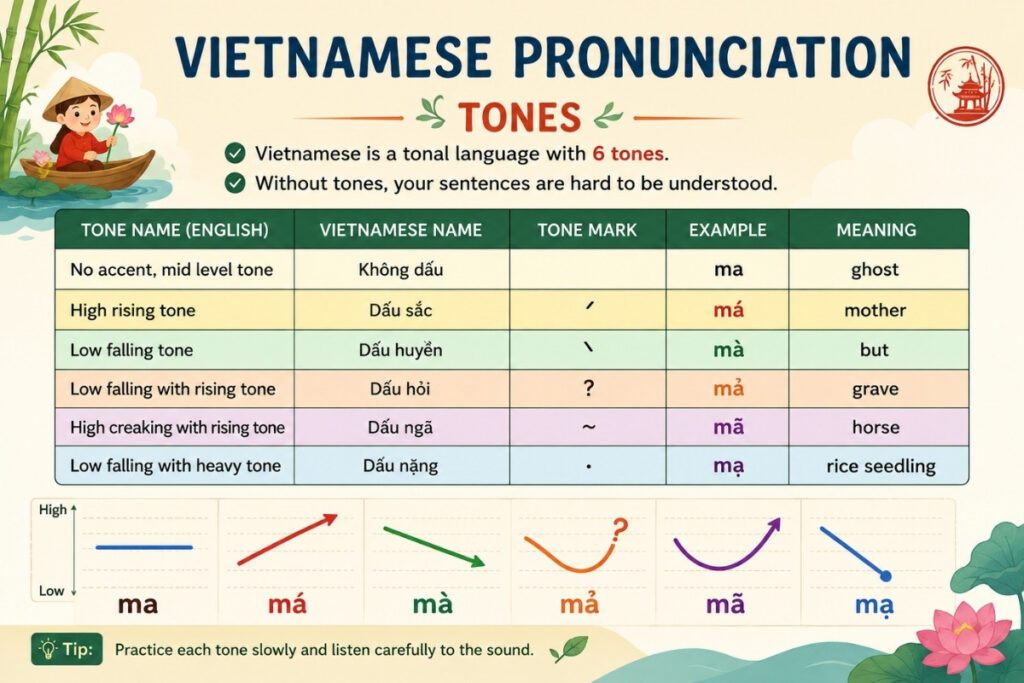
Vietnamese names can be challenging for English speakers at first.
Vietnamese is a tonal language, and its written alphabet includes diacritics that change how letters and words are pronounced. So a Vietnamese name may not sound the way an English speaker would expect from looking at the spelling alone.
For travelers, you do not need to learn Vietnamese pronunciation before your trip.
A few simple habits are enough.
Listen to the Person Say Their Name
The most reliable pronunciation guide is the person introducing themselves.
If someone says their name and you are not sure you heard it correctly, simply ask:
“Could you say your name again?”
You can also ask:
“Did I pronounce that correctly?”
Most people will understand that you are making an effort.
Vietnamese Diacritics Matter
Vietnamese uses marks above and below letters to represent different sounds and tones.
For example:
- Nguyễn
- Hương
- Thảo
- Đặng
- Phạm
These marks are part of the written form of the language. They are not decorative.
In English-language systems, you may sometimes see the same names written without diacritics:
Nguyễn → Nguyen
Đặng → Dang
This does not necessarily mean the person’s name has changed. It may simply reflect the limitations or conventions of the system being used.
Why Nguyễn Can Be Difficult
Nguyễn is one of the names English-speaking travelers are most likely to encounter.
It can be difficult to pronounce from the spelling alone because the Vietnamese pronunciation does not follow the way an English speaker might naturally read the letters.
Rather than trying to force the name into an English pronunciation, listen to how the person says it.
If you are still unsure, ask.
That is usually better than confidently using a pronunciation that the person does not recognize.
You Don’t Need Perfect Pronunciation
Getting someone’s name exactly right on the first attempt is not the goal.
Listen carefully, make a genuine attempt, and correct yourself if necessary.
If you are introduced to someone named Nguyễn Minh Anh, for example, you can simply say:
“Nice to meet you, Anh.”
If you are unsure how to pronounce Anh, ask.
A small effort to say someone’s name correctly is usually more meaningful than trying to sound perfectly Vietnamese.
Regional Accents Can Affect How a Name Sounds
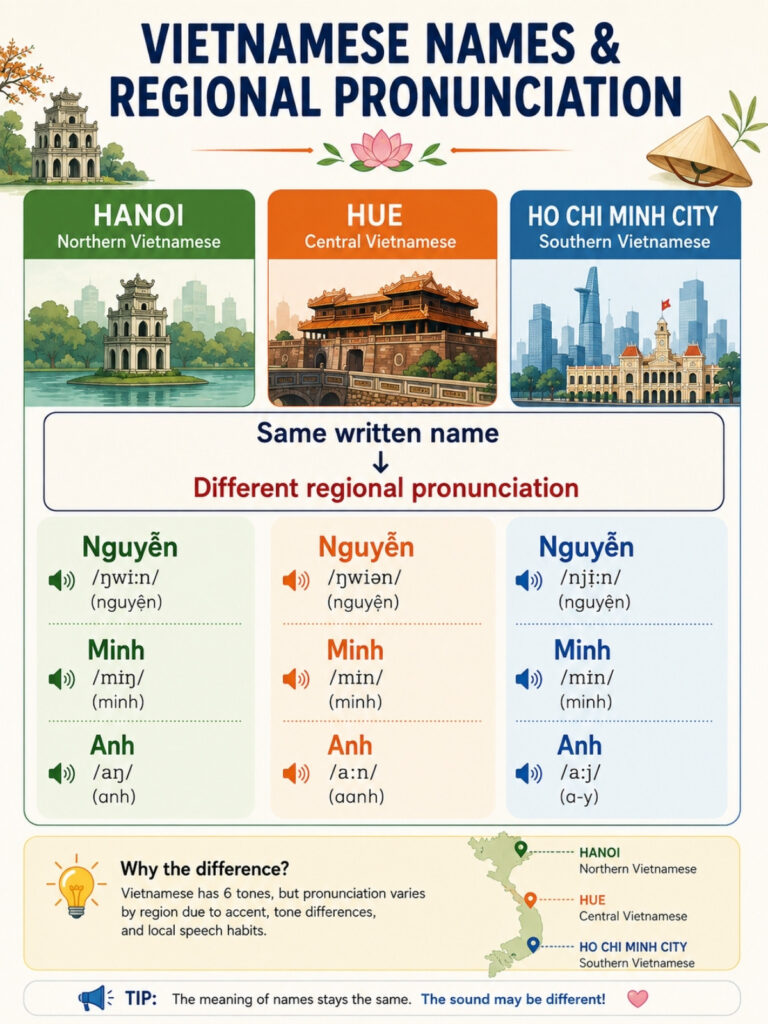
You may hear the same Vietnamese name pronounced somewhat differently in Hanoi, Hue, and Ho Chi Minh City.
This does not necessarily mean that you heard a different name.
Vietnamese pronunciation varies across regions, so the same written name can sound different depending on the speaker.
For travelers, the practical rule is simple:
If a Vietnamese person pronounces their name differently from the way you have heard it before, follow their pronunciation.
A Few Vietnamese Naming Mistakes Travelers Should Avoid
Vietnamese names may work differently from the naming conventions you’re used to, but most mistakes are easy to avoid.
Don’t Assume a Name Needs to Be Changed
Some Vietnamese people use their Vietnamese names in every setting. Others may use an English name at work, school, or when communicating internationally.
Neither approach is more correct.
If someone introduces themselves as Linh, use Linh.
If they tell you they prefer an English name, use that instead.
The person gets to decide what they are called.
Don’t Turn an Unfamiliar Name Into a Joke
Vietnamese names can be difficult for English speakers to pronounce, particularly when you’re hearing the tones for the first time.
If you get someone’s name wrong, simply ask them to repeat it.
A genuine attempt is far more respectful than avoiding the name or replacing it with a nickname without permission.
Vietnamese Names on Passports, Flights, Hotels and International Forms
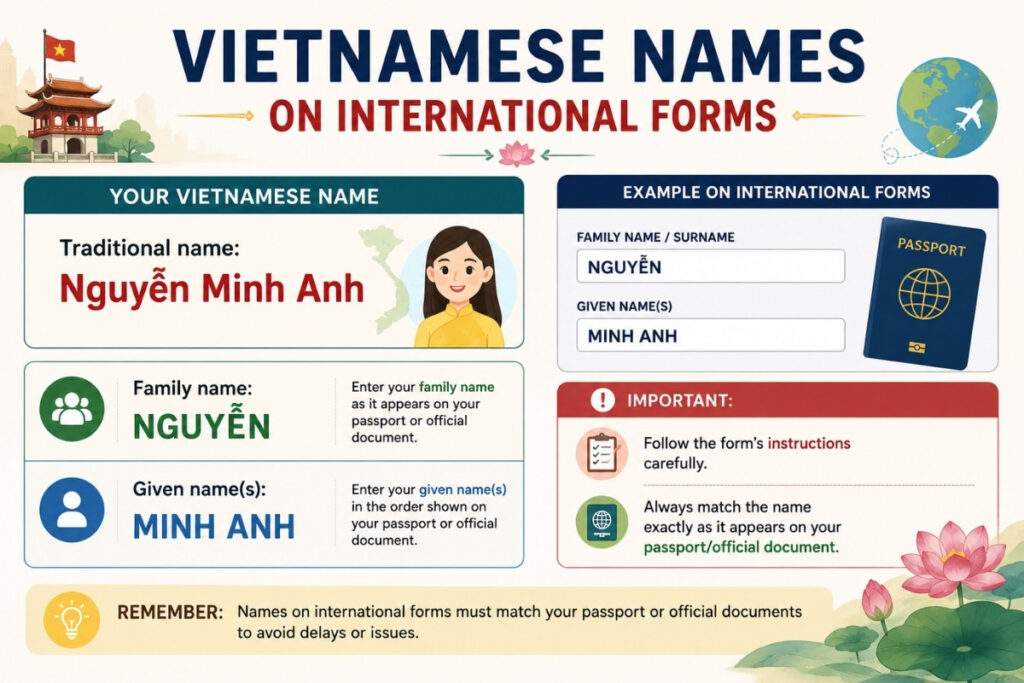
Vietnamese name order is relatively straightforward until you have to type a Vietnamese name into an international booking form.
This is where things can get confusing.
A Vietnamese person may write their name in the traditional order:
Nguyễn Văn Minh
But an airline, hotel, visa application, or online booking system may ask for:
- First name
- Middle name
- Last name
Those labels are based on the system’s naming conventions, not necessarily on Vietnamese name order.
A Simple Example
Take the Vietnamese name:
Nguyễn Văn Minh
Traditionally:
- Nguyễn — family name
- Văn — middle name
- Minh — given name
If an international form separately asks for first, middle, and last names, the fields may correspond to:
- First / Given name: Minh
- Middle name: Văn
- Last / Family name: Nguyễn
However, do not rely on this as a universal rule for every booking system.
Some websites combine given and middle names. Others may label fields differently or provide instructions specifically for passport names.
For flights, visas, immigration documents, and other official travel documents, the safest approach is always to follow the instructions of the specific form and use the name exactly as required by the relevant official document.
Why This Matters When Booking Flights
Airline reservations are one of the places where getting a name wrong can become more than a minor inconvenience.
If you are booking a ticket for a Vietnamese traveler, don’t simply rearrange the name because it looks more natural in English.
Check:
- the airline’s instructions for first/given and family/last names;
- how the passenger’s name appears on their passport;
- whether the airline asks for a middle name;
- whether the booking system combines given and middle names.
A Vietnamese name may look different when displayed on a boarding pass or reservation confirmation.
That does not necessarily mean the airline has changed the person’s name.
It may simply be displaying the name according to its own database format.
Hotel Reservations and Tour Bookings
Hotels and tour companies are generally less complicated, but the same principle applies.
If a booking form asks for:
First name + Last name
don’t assume that the first word of a Vietnamese full name belongs in the “First name” field simply because it appears first.
Check the form’s instructions.
If you are making a reservation on behalf of someone else, asking them how their name should be entered is often the easiest solution.
A few seconds of clarification is better than having to correct a reservation later.
Vietnamese Names on Visas and Immigration Documents
For visas and immigration paperwork, accuracy matters even more.
Use the name exactly as requested by the relevant government or immigration system.
Do not:
- remove parts of the name simply because they look like a middle name;
- change the order without checking the instructions;
- assume an English-style format applies;
- shorten the name to the form you normally use in conversation.
A person may be called Minh by friends and colleagues, while their official travel document contains their complete legal name.
Those are two different contexts.
Legal Name vs. Everyday Name
This distinction is useful beyond travel.
A Vietnamese person may introduce themselves simply as:
Minh
while their full legal name is:
Nguyễn Văn Minh
There is nothing unusual about this.
In everyday conversation, using the given name is common. On official documents, the complete legal name matters.
This is similar to how an American named Robert James Smith might commonly introduce himself as Robert or Bob, while official documents use the full legal name.
The cultural naming order is different in Vietnam, but the basic distinction between an everyday name and a legal name is familiar to travelers from the United States.
What If a Vietnamese Person Uses an English Name?

Some Vietnamese people who live, study, or work internationally use an English name in certain settings.
For example, someone named Linh may introduce herself as Linh everywhere, while another person may use an English name at work or school.
Neither practice is universal.
If someone introduces themselves using an English name, use that name.
If they use their Vietnamese name, use their Vietnamese name.
The person’s own preference matters more than any general rule about Vietnamese naming.
Legal Names vs. Everyday Names
A Vietnamese person may introduce themselves simply by their given name.
For example:
Nguyễn Văn Minh
may be known in everyday conversation as:
Minh
That is not a contradiction.
The full name remains the person’s legal name, while Minh is the name used in ordinary conversation.
For travelers, the distinction is simple:
Use the name a person gives you in conversation. Use the full legal name when an official form requires it.
What If a Vietnamese Person Uses an English Name?
Some Vietnamese people use an English name in certain international settings, while others continue using their Vietnamese name.
There is no single rule.
If someone introduces themselves using an English name, use that name.
If they introduce themselves using their Vietnamese name, use their Vietnamese name.
The person’s preference matters more than any general naming convention.
Vietnamese Names in International Systems
When a Vietnamese name is entered into an English-language database, school system, airline reservation, or other international platform, it may appear in a different format.
For example:
Nguyễn Minh Anh
may appear as:
Nguyen Minh Anh
if the system does not preserve Vietnamese diacritics.
In some English-language settings, you may also see the name presented as:
Minh Anh Nguyen
The format may reflect the requirements or conventions of the institution rather than a change to the person’s Vietnamese name.
If you are completing a form for someone else, ask them how they want their name entered.
For flights, visas, immigration documents, and other official paperwork, follow the instructions of the specific institution and the person’s official documents rather than guessing.
Vietnamese Given Names You May Encounter

Once you understand that the given name usually comes last, Vietnamese names become much easier to read.
You may encounter given names such as:
Anh, Minh, Linh, Mai, Lan, Hương, Hoa, Thảo, Trang, Ngọc, Nam, Hùng, Dũng, Đức, Tuấn, Long, Quang, Hải, and Thành.
These are examples rather than a ranking of Vietnam’s most common names. Naming preferences vary by generation, family, region, and personal taste.
Some Given Names Can Be Used Across Genders
One detail that can surprise English-speaking travelers is that a Vietnamese given name does not always tell you a person’s gender.
Names such as Anh, Minh, and Thanh, for example, can be used by people of different genders.
Other names may be more strongly associated with one gender or another, but naming conventions are not rigid enough for a traveler to determine someone’s gender from their name alone.
If you’re unsure, don’t guess.
Use the name the person gives you or follow the way other people address them.
A Name’s Meaning Is Not a Personality Description
Vietnamese given names can have meanings associated with qualities, nature, beauty, intelligence, virtue, or family hopes.
But the meaning of a name should not be treated as a description of the person who has it.
Someone named Minh, for example, may have a name associated with ideas such as brightness or clarity, but that does not tell you anything about their personality.
The cultural meaning belongs to the name.
The person is still the person.
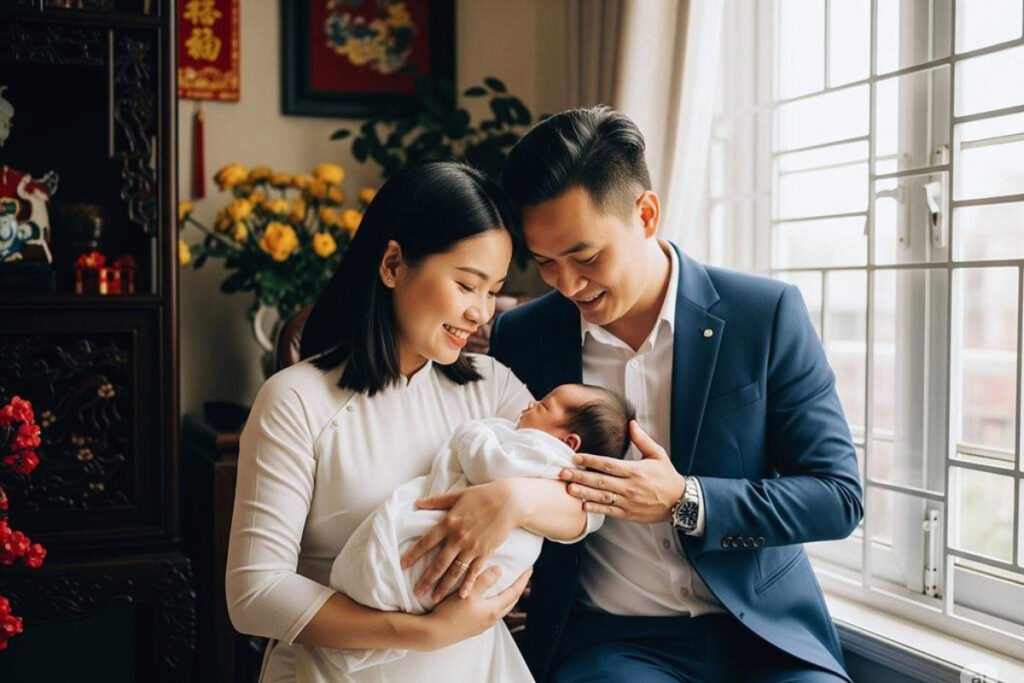
Names Can Feel Different Across Generations
Some Vietnamese given names have remained familiar across generations, while others may feel more characteristic of a particular period.
Parents today may choose names based on meaning, sound, family traditions, or simply what they like.
This is why two Vietnamese people from different generations may have noticeably different naming styles even when they come from the same family.
For travelers, this is one reason not to think of Vietnamese names as a fixed list.
They are part of a living naming tradition that continues to change.
How Vietnamese Naming Traditions Have Changed Across Generations
Vietnamese naming traditions have changed over time.
Older generations are more likely to have names that reflect traditional naming patterns, including middle names such as Thị and Văn.
Younger generations often have more varied naming styles.
Parents may choose names based on:
- meaning
- sound
- family traditions
- personal preferences
- cultural associations
- hopes for the child
This means that two Vietnamese people from different generations may have noticeably different naming styles even when they come from the same family or region.
Family Naming Traditions
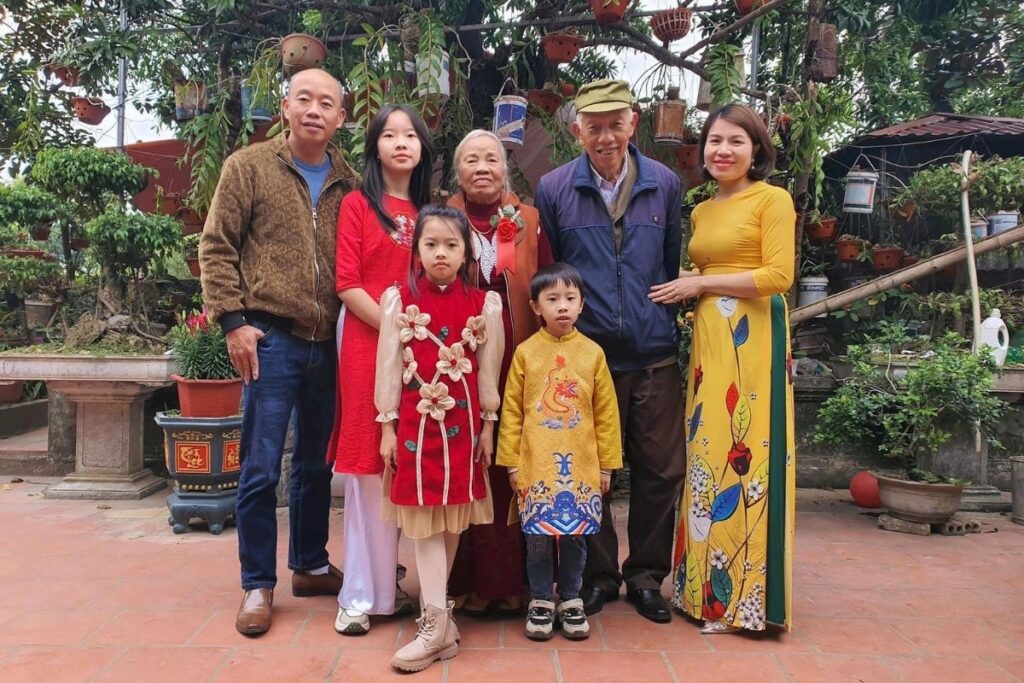
Some families follow naming patterns across generations.
A family may choose names that share a particular middle name, follow a generational naming tradition, or reflect an older family convention.
But this is not universal.
Vietnamese families differ considerably, and modern parents have more freedom to choose names that reflect their own preferences.
So if you notice several members of a Vietnamese family sharing part of their names, it may reflect a family tradition — but it is better to ask rather than assume.
Do Vietnamese Names Change by Region?
The basic structure of a Vietnamese name is broadly consistent across the country:
Family name + middle name + given name
So if you travel from Hanoi to Hue or Ho Chi Minh City, you should not expect an entirely different naming system.
What can change is the way a name is pronounced, heard, or used in everyday conversation.
Northern, Central, and Southern Differences
Vietnam has distinct regional varieties of spoken Vietnamese.
For travelers, these differences are most noticeable in pronunciation rather than in the basic structure of people’s names.
A name written the same way may sound somewhat different when spoken by someone from Hanoi, Hue, or Ho Chi Minh City.
This can be especially noticeable with tones and certain consonant sounds.
The important point is that a different pronunciation does not necessarily mean you heard a different name.
Regional Identity Can Shape How Names Sound
Vietnamese people often recognize regional differences in speech very quickly.
A local may be able to tell that someone is from another part of the country simply by listening to their accent.
For a foreign visitor, these differences may be much harder to notice.
If a Vietnamese name sounds different from the way you heard it elsewhere, there is usually no need to correct the speaker or assume that one version is wrong.
The written name may be the same; the regional pronunciation may simply be different.
Should Travelers Expect Different Naming Rules in Different Regions?
Not usually.
The basic conventions discussed throughout this guide — family name first, given name last, and the use of given names in many everyday interactions — apply broadly across Vietnam.
Local speech habits and forms of address can vary, but travelers do not need to learn a separate naming system for northern, central, and southern Vietnam.
If you are unsure, listen to how people around you address one another and follow the local context.
Frequently Asked Questions About Vietnamese Names
Should I call a Vietnamese person by their given name?
Often, yes, especially if that is the name they use when introducing themselves.
For example, someone named Nguyễn Minh Anh may simply introduce herself as Anh.
However, Vietnamese forms of address can also depend on age and relationship. If you are unsure, follow the way local people address the person or ask what they prefer.
Is Nguyễn always a Vietnamese surname?
No naming system is completely absolute, but Nguyễn is overwhelmingly used as a Vietnamese family name and is the surname most travelers will encounter most often.
Seeing several unrelated people named Nguyễn is therefore normal.
Having the surname Nguyễn does not, by itself, indicate a relationship to the Nguyễn imperial family.
Do all Vietnamese people have a middle name?
No.
Many traditional Vietnamese names include a middle name, but it is not required. Some people have a middle name such as Thị or Văn, while others have a different middle name or no middle name at all.
Naming practices also vary between generations.
Can Vietnamese names be gender-neutral?
Yes.
Some Vietnamese given names are more strongly associated with men or women, while others can be used by people of different genders.
For travelers, it is better not to assume someone’s gender from their name alone.
Why does a Vietnamese name sometimes appear without accents?
Vietnamese diacritics may be removed when a name is entered into a database, booking system, airline reservation, or other platform that does not preserve Vietnamese characters.
For example:
Nguyễn → Nguyen
The spelling difference does not necessarily mean that the person’s name or identity has changed.
Can Vietnamese people use English names?
Yes.
Some Vietnamese people use an English name in particular international, professional, academic, or social settings, while others use their Vietnamese name everywhere.
There is no universal rule.
If someone tells you what they prefer to be called, use that name.
What is the safest way to address someone in Vietnam?
The simplest approach is to follow the person’s lead.
Use the name they introduce themselves with, pay attention to how other people address them, and ask if you are unsure.
In Vietnamese, forms of address such as anh, chị, em, cô, chú, and bác can also reflect relative age and relationships.
How should I enter a Vietnamese name on a flight or visa form?
Do not rely on the traditional Vietnamese name order alone.
Use the instructions provided by the airline, immigration authority, hotel, visa application, or other institution, and match the person’s official travel document where required.
If you are unsure which part belongs in a particular field, check the institution’s instructions rather than guessing.
Final Thoughts
The first time you encounter a Vietnamese name, the order may feel unfamiliar.
After a while, it starts to make sense.
What matters most when traveling in Vietnam is not memorizing every naming convention. It is understanding that a person’s name carries family history, personal identity, and cultural context — and that the way people address one another can depend on age, relationship, and setting.
You may see the same name written differently on a passport, hear it pronounced differently in another region, or meet someone who uses an English name in an international setting.
None of these situations necessarily changes who that person is.
For travelers, the simplest approach is also the most useful:
Listen to how people introduce themselves. Use the name they prefer. Ask when you’re unsure.
Once you stop trying to fit Vietnamese names into familiar Western naming rules, they become much easier to understand.
And that small shift in perspective can make everyday interactions in Vietnam feel more natural — from checking into a hotel to meeting a local family, joining a conversation over coffee, or simply saying hello.
Continue Exploring Vietnamese Culture
Understanding Vietnamese names is one small part of understanding how people connect with family, community, age, and tradition.
If you want to explore the cultural context behind the customs discussed in this guide, these related guides from Tam Voc Viet are a good place to continue:
- Vietnamese Culture – Explore the values, traditions, beliefs, and everyday customs that shape life across Vietnam.
- Vietnamese Family Culture – Learn why family relationships, respect for elders, and ideas of family identity remain central to Vietnamese life.
- Ao Dai: Vietnam’s National Dress -Discover the history and cultural significance of Vietnam’s iconic traditional costume.
- Tet Holiday in Vietnam – Learn how Vietnam’s most important holiday brings families together and connects generations through traditions and ancestral customs.
- Vietnamese Etiquette – Understand everyday customs, forms of respect, greetings, and social behavior that can help you travel more comfortably in Vietnam.
- Ancestor Worship in Vietnam – Discover why family ancestry and remembrance remain important parts of Vietnamese cultural life.
- Vietnamese Traditional Clothing – Explore the cultural meaning and diversity of traditional clothing across Vietnam.
- Vietnamese Festivals – Explore the celebrations and family traditions that bring communities together throughout the year.
- Vietnamese Religion & Beliefs – Understand the Buddhist, Confucian, Taoist, folk, and other cultural influences that have shaped Vietnamese society.
Together, these guides offer a broader look at the cultural values behind many of the everyday interactions travelers encounter in Vietnam.
A Note for Travelers
One of the easiest ways to understand Vietnamese culture is to pay attention to how people interact with one another.
You may notice that a conversation involves more than simply saying someone’s name.
A younger person may address an older person using a kinship term. Family members may introduce one another by explaining their relationship. A shopkeeper may use anh, chị, or em when speaking to a customer. Friends may switch between a person’s given name and a form of address depending on the situation.
These details can seem unfamiliar at first.
But they reveal something important about Vietnamese social life: names and forms of address are closely connected to relationships.
As you travel through Vietnam, listen to how people introduce themselves and how others address them.
You don’t need to memorize every rule.
Often, simply paying attention — and politely asking when you’re unsure — will teach you more than trying to translate every form of address literally.
Sources & Further Reading
This guide draws on Vietnamese linguistic and cultural research, official resources, and established scholarship on personal names and forms of address.
- Phạm Tất Thắng, “Tình hình nghiên cứu tên riêng chỉ người trong Việt ngữ học” – An overview of research on Vietnamese personal names within Vietnamese linguistics, including earlier ethnographic and sociological approaches.
- Vietnam Airlines, “Understanding Common Vietnamese Names: Origins, Pronunciation, and Significance”
- Merav Shohet & Jack Sidnell, “The Problem of Peers in Vietnamese Interaction” – Research on Vietnamese forms of address, kinship terms, age, social relationships, and the use of personal names in interaction.
- Language Variation and Change, Cambridge University Press, “Shifting Rules Across Generations: Variable Subject Expression in the Canberra Vietnamese Heritage Language” – Recent research examining how Vietnamese personal names and kinship terms function across generations and social contexts.
About the Author
Tam Voc Viet Editorial Team
The Tam Voc Viet Editorial Team creates practical travel and cultural guides for international readers who want to understand Vietnam beyond its most famous destinations.
Our guides explore Vietnam through its history, culture, traditions, food, people, and everyday life, with an emphasis on information that helps travelers better understand what they encounter during a trip.
We use official sources, established cultural references, and research to support factual information, while keeping the writing practical and accessible for international travelers.
Article Information
Category: Vietnamese Culture
Topic: Vietnamese Names
Published: August 2026
Last Updated: August 2026
Author: Tam Voc Viet Editorial Team
